Smartly Planning Countertop and Storage Space for an Ice Cream Maker in a Small Kitchen
Learn how to fit, store, and use an ice cream maker efficiently without overcrowding your small kitchen or losing valuable workspace.
Planning Countertop and Storage Space for an Ice Cream Maker in a Small Kitchen
Adding an ice cream maker to a compact kitchen can feel like a luxury that pushes your space to its limits. With thoughtful planning, however, you can enjoy homemade frozen treats without sacrificing precious countertop or cabinet space. This guide walks you step by step through evaluating your kitchen, choosing the right location, and creating smart storage that keeps your ice cream maker accessible but not in the way.
Table of Contents
- Understanding Your Ice Cream Maker and Its Space Needs
- Assessing Your Small Kitchen Layout and Constraints
- Deciding: Countertop Appliance or Stored Between Uses?
- Planning Countertop Space for an Ice Cream Maker
- Smart Cabinet and Closet Storage for Ice Cream Makers
- Using Vertical and Hidden Spaces Efficiently
- Aligning Storage with Workflow and Usage Patterns
- Safety, Ventilation, and Maintenance Considerations
- Example Layouts and Space Planning Scenarios
- Frequently Asked Questions (FAQs)
- Conclusion
Understanding Your Ice Cream Maker and Its Space Needs
Not all ice cream makers are the same. Some are compact and lightweight, while others are heavy, compressor-based machines that demand permanent space and good ventilation. Understanding your machine type is the first step to planning where it will live in a small kitchen.
Common Types of Ice Cream Makers and Size Implications
Most home kitchens use one of the following types of ice cream makers, each with its own storage profile:
- Freezer-bowl electric machines – A motorized base with a removable insulated bowl that must be frozen before use. The base is usually modest in size, but the bowl requires freezer space.
- Compressor (self-freezing) machines – Heavier, bulkier units with built-in refrigeration. Some countertop models can weigh over 40–50 kg and have dimensions close to a small microwave, requiring strong, stable countertop support and adequate airflow.
- Manual or hand-crank models – Often used less frequently, these can be stored like seasonal appliances in deeper cabinets or auxiliary storage.
- Attachment-based makers – For example, an ice cream bowl attachment for a stand mixer. These share storage with the primary appliance but add freezer and cabinet demands.
Key Measurements to Note
Before deciding where the machine goes, measure:
- Width, depth, and height of the unit, including any lids or handles.
- Required clearance above the lid for loading, removing the bowl, or opening the top.
- Cord length, to ensure it can reach an outlet without stretching across sinks or cooktops.
- Weight, especially if you plan to store it in lower cabinets and lift it to the counter.
Heavy appliances, such as stand mixers or large ice cream makers, are often best kept in lower cabinets or on shelves where they can be slid rather than lifted, reducing strain on your back.
Assessing Your Small Kitchen Layout and Constraints
In a small kitchen, every surface and cabinet has a job. To fit an ice cream maker comfortably, you must first understand how your current space is being used and what can be reconfigured.
Map Your Existing Countertop Zones
Identify your main work and storage zones:
- Primary prep zone – The clear area where you usually chop, mix, and assemble meals.
- Cooking zone – Space around the stove or cooktop.
- Cleaning zone – The area around the sink and dish rack.
- Beverage or coffee station – Often holding the coffee maker, kettle, or toaster.
Counter space is at a premium in small kitchens, so adding another permanent appliance to the countertop may require moving or storing something else.
Evaluate Cabinet and Pantry Capacity
To determine whether your ice cream maker can be stored off the counter between uses, inspect your cabinets and pantry:
- Note upper vs. lower cabinets: upper shelves are easier for light items, while heavy or large appliances are usually better in lower cabinets or drawers.
- Check depth: shallow, wide shelves often work better for appliance storage than deep, narrow cabinets where items get buried in the back.
- Look for adjustable shelves that could be repositioned to gain vertical clearance for the machine.
- Identify any overflow storage (hallway closet, utility room, garage) for very rarely used appliances.
Appliance Inventory and Usage Frequency
List your small appliances and group them by how often you use them. Many organizing experts suggest categories similar to:
- Daily-use items (coffee maker, microwave, toaster) – typically countertop or very accessible open shelving.
- Regular-use items (blender, food processor, rice cooker) – stored in easy-to-reach cabinets or drawers close to your prep area.
- Occasional-use items (waffle iron, large slow cooker, seasonal baking tools, some ice cream makers) – kept in deeper cabinets, tall pantry shelves, or overflow storage outside the kitchen.
Decide honestly which category your ice cream maker belongs to. If you make ice cream weekly, it deserves high accessibility; if you only use it a few times a year, it might be stored with other seldom-used appliances.
Deciding: Countertop Appliance or Stored Between Uses?
The next step is choosing whether your ice cream maker will live on the countertop or be stored in a cabinet, pantry, or other space between uses. This decision has a big impact on how often you actually use it.
Pros and Cons of Permanent Countertop Placement
| Aspect | Advantages | Disadvantages |
|---|---|---|
| Accessibility | Always ready to use; encourages frequent ice cream and dessert making. | Occupies valuable prep space that could be used for daily cooking tasks. |
| Weight handling | No lifting or moving required for heavy compressor units. | Difficult to clean behind and around; may dominate a small counter visually. |
| Visual impact | Can be integrated into a dessert or beverage station and look intentional. | Can make a small kitchen feel cluttered or cramped if many appliances are visible. |
Pros and Cons of Storing Between Uses
| Aspect | Advantages | Disadvantages |
|---|---|---|
| Counter space | Keeps surfaces open for food prep and daily tasks. | Requires setup time each time you make ice cream. |
| Kitchen appearance | Reduces visual clutter; ideal for minimalist or rental kitchens. | If storage is inconvenient, you may use the appliance less often. |
| Ergonomics | Can be placed in a low, shallow cabinet for easy sliding access. | Heavy machines can be hard to lift from floor-level or deep cabinets. |
Guiding Questions to Decide Placement
- How often will you realistically use the ice cream maker?
- Is your unit compact and light or large and heavy?
- Can you remove or relocate another countertop appliance to free space?
- Do you have a cabinet, drawer, or pantry shelf that allows easy access without moving many items?
As a rule of thumb, treat compressor-based ice cream makers more like a small countertop oven or espresso machine, and lighter, freezer-bowl models more like a blender or food processor that can be stored between uses.
Planning Countertop Space for an Ice Cream Maker
If you decide your ice cream maker will sometimes or always sit on the counter, it needs a dedicated, well-planned spot that fits your workflow and safety requirements.
Choosing the Best Countertop Zone
When placing the machine on the counter, consider:
- Proximity to power outlets to avoid trailing cords across walkways or the sink.
- Distance from heat sources like the oven or cooktop, which can affect performance and longevity.
- Access to freezer and fridge for ingredients, bowls, and mix-ins.
- Clear working space in front for scooping, mixing toppings, and serving.
Many small kitchens benefit from combining the ice cream maker with an existing coffee or dessert station, where syrups, toppings, and bowls are already nearby.
Protecting Countertops and Managing Mess
- Use a tray or appliance mat under the machine to catch drips, condensation, or stray mix-ins.
- Ensure the surface is level and sturdy, especially for heavier compressor machines.
- Leave enough space around ventilation grilles or fan openings for airflow.
Making the Ice Cream Station Multi-Purpose
In a small kitchen, it is helpful if each area can serve multiple roles. Design your ice cream zone so it can double as:
- A baking station when the machine is stored away, using the same measuring tools and bowls.
- A beverage bar, where toppings and syrups can also be used in coffee drinks or smoothies.
- A flexible prep zone with quick access to cutting boards and utensils.
Smart Cabinet and Closet Storage for Ice Cream Makers
If the ice cream maker will be stored between uses, you need a cabinet strategy that keeps it accessible while avoiding clutter and heavy lifting.
Choosing the Right Cabinet Type
Some cabinet configurations work better than others for small kitchen appliances:
- Wide, shallow lower cabinets allow heavy appliances to be stored at waist height without stacking.
- Deep drawers are ideal for medium-sized appliances like blenders or small ice cream makers, making it easy to see and reach them.
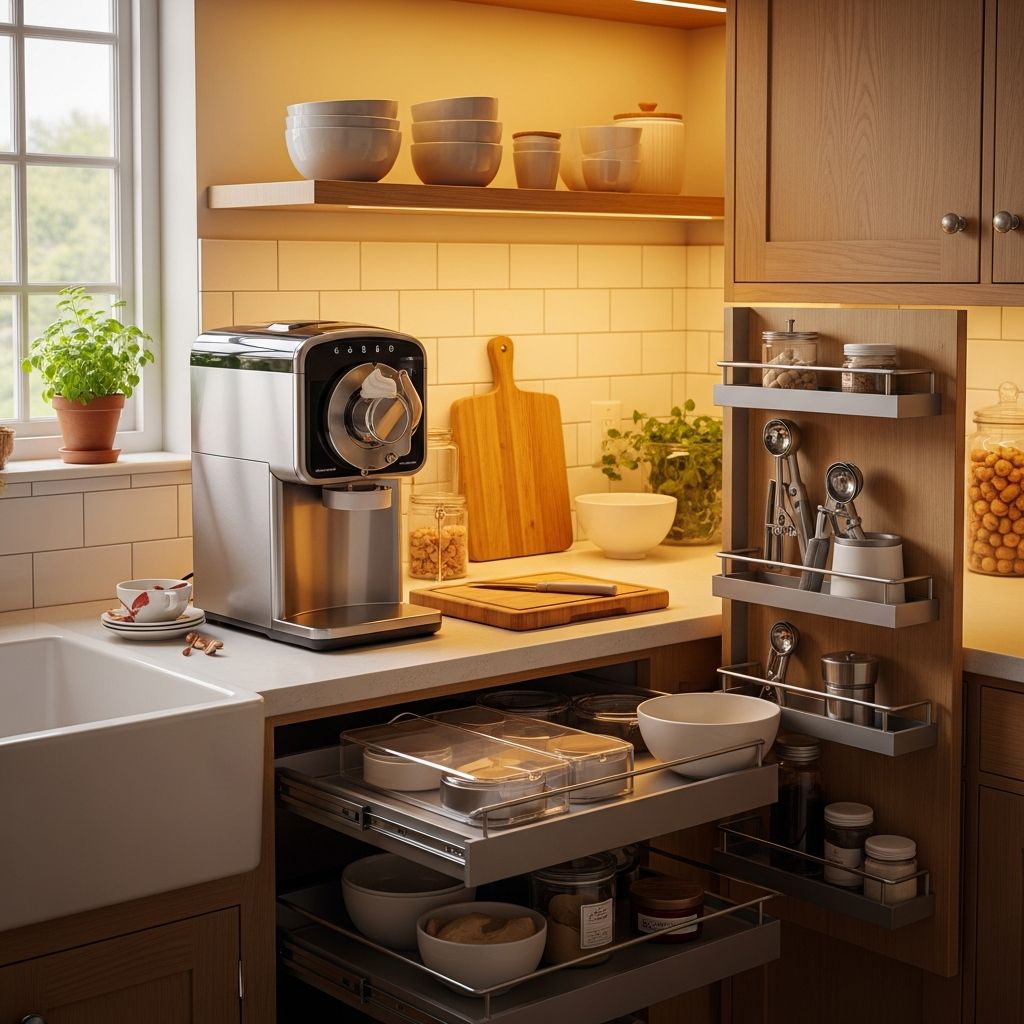
- Pull-out shelves or roll-out trays in base cabinets let you slide the machine toward you instead of lifting it from the back.
- Upper cabinets may be fine for very light units, but repeated lifting overhead can be tiring and unsafe.
Adjusting Shelf Heights
Adjustable shelving is one of the simplest ways to create dedicated appliance storage:
- Measure the appliance height with the lid on and position shelves to give a little clearance above.
- Store taller items (such as the main body) on one level and shorter accessories (lids, paddles) on another to maximize space.
- If shelf pins are limited, consider removing one shelf entirely to create a tall bay for multiple appliances side by side.
Grouping Accessories and Components
Ice cream makers often have several parts: bowls, paddles, lids, and storage containers. To keep everything together:
- Use clear bins or baskets inside the cabinet to hold small components.
- Store the instruction manual and favorite recipes in a slim folder or envelope in the same cabinet.
- Consider labeling the shelf or bin so anyone in the household can find and return parts easily.
Overflow and Seasonal Storage
If your ice cream maker is used primarily in certain seasons, or you own multiple dessert appliances, consider moving the least-used items to:
- A hallway or bedroom closet on a designated appliance shelf.
- A utility area or garage with closed shelving to protect from dust.
- High pantry shelves, with a step stool stored nearby for safe access.
Using Vertical and Hidden Spaces Efficiently
When cabinet and counter space are limited, vertical and hidden areas become valuable real estate.
Under-Cabinet and Wall Solutions
- Install sturdy wall shelves near your prep area to hold lighter accessories or serving dishes related to your ice cream station.
- Use hooks or rails for scoops, measuring cups, and towels, keeping counters clear.
- Consider a narrow rolling cart that can slide between cabinets or beside the fridge, holding the ice cream maker on top and supplies below.
Inside-Cabinet Door Storage
While the main unit usually cannot hang on a door, inside-cabinet door storage is perfect for:
- Recipe cards or a printed quick-start guide.
- Small containers of mix-ins like sprinkles or cones if they fit securely.
- Cleaning brushes and specialized tools.
Using Freezer Space Strategically
Freezer-bowl models and homemade ice cream storage containers require freezer planning:
- Designate a specific shelf or basket for the ice cream bowl so it stays upright and accessible.
- Use stackable, uniform containers for finished ice cream to maximize available freezer space.
- Label containers with dates and flavors to avoid confusion and waste.
Aligning Storage with Workflow and Usage Patterns
An ice cream maker is much more enjoyable when it fits naturally into your cooking and entertaining routine. Your storage decisions should reflect how you use it.
Weekly or Frequent Use
If you make frozen desserts every week:
- Store the machine in a prime cabinet near your main prep area or keep it on a portion of the counter.
- Keep ingredients and tools nearby: sugar, vanilla, chocolate, measuring cups, and mixing bowls.
- Reserve a consistent freezer zone for pre-chilled bowls and finished ice cream.
Occasional or Seasonal Use
If your machine is used monthly or seasonally:
- Store it with other specialty appliances like waffle makers or party platters.
- Use a deeper cabinet or secondary storage that you can still reach without moving too many items.
- Consider placing the manual and a simple recipe in a visible spot to encourage you to pull it out more often.
Entertaining and Family Use
For households that use the machine mainly for gatherings or kids’ parties:
- Create a temporary “ice cream bar” zone on the dining table or a movable cart during events.
- Store extra toppings, cones, and disposable cups in a labeled bin that comes out with the machine.
- Keep serving spoons and napkins near the dining area instead of the cooking zone.
Safety, Ventilation, and Maintenance Considerations
Proper placement is not only about convenience; it is also about safety and appliance care.
Ventilation and Heat Management
Compressor-style machines generate heat and need airflow:
- Leave clearance around vents and avoid enclosing the machine in tight shelves while it is operating.
- Do not run the machine directly under low-hanging curtains or against combustible materials.
- Avoid placing it right next to the oven or in direct sunlight to maintain performance.
Electrical Safety
- Plug the machine directly into a wall outlet, avoiding overloaded power strips or extension cords.
- Route cords away from sink areas and walking paths to prevent tripping or water contact.
- Unplug and cool the machine completely before wiping or moving it back to storage.
Cleaning and Drying Before Storage
Storing a damp appliance can lead to odors or mold:
- Thoroughly wash and dry all removable parts, including paddles and bowls.
- Leave lids slightly ajar while the machine air-dries before closing and storing.
- Wipe down the exterior and base to remove drips that may attract pests.
Example Layouts and Space Planning Scenarios
To visualize how a small kitchen can accommodate an ice cream maker, consider these sample scenarios.
Scenario 1: Galley Kitchen with Limited Counter Space
- Daily items (coffee maker, toaster) remain on one short section of counter.
- The ice cream maker is stored in a pull-out drawer under the main prep zone and placed on the counter only when needed.
- A freezer-bowl attachment lives on the top freezer shelf with a labeled bin for toppings.
Scenario 2: Small Kitchen with Island or Peninsula
- The island hosts a dessert and beverage station with the ice cream maker, blender, and coffee gear.
- Wide, shallow island cabinets store heavy appliances, making them easy to slide in and out.
- Upper cabinets above the main counter are reserved for dishes, while lower cabinets handle appliances.
Scenario 3: Studio Apartment Kitchenette
- Counter space is mostly kept clear for prep, with only the most essential daily appliance left out.
- The ice cream maker lives on a narrow rolling cart that can be moved into the living area when in use.
- After use, the machine is cleaned, cooled, and slid back into a closet or beside the fridge.
Frequently Asked Questions (FAQs)
Where should I store a heavy ice cream maker in a small kitchen?
Store heavy units in a lower cabinet, wide drawer, or on a shallow shelf around waist height so you can slide rather than lift them. Avoid high shelves or deep, hard-to-reach corners that require awkward lifting.
Can I keep my ice cream maker on the counter all the time?
Yes, if you use it frequently and can spare the space. Make sure it is away from direct heat, has access to an outlet, and does not block your main prep area. Consider pairing it with a dessert or coffee station so the setup looks intentional.
How do I fit the freezer bowl in a tiny freezer?
Dedicate one area of your freezer, such as a side or top shelf, and reorganize other items into stackable containers. Keep the bowl upright and avoid stacking heavy items on top. You can also store the bowl elsewhere and chill it only before planned ice cream sessions if freezer space is very limited.
What if I do not have any spare cabinets?
Look for alternative solutions like a slim rolling cart, under-bed storage bins (for very occasional use), or a hallway closet shelf. You can also declutter infrequently used appliances and tools to free a single dedicated shelf for the ice cream maker.
How can I keep all the accessories organized?
Place paddles, lids, manuals, and specialty containers in a labeled bin or basket stored next to the main unit. Using clear containers and simple labels ensures that all parts are easy to find and return after cleaning.
Conclusion
Planning countertop and storage space for an ice cream maker in a small kitchen is about balancing enjoyment with practicality. By carefully measuring your appliance, honestly assessing how often you will use it, and analyzing your existing countertop and cabinet layout, you can decide whether it belongs on display or tucked away between batches.
Thoughtful choices about cabinet type, shelf height, and vertical storage let you integrate the ice cream maker with your other small appliances instead of competing with them. Combining it with a dessert or beverage station, organizing accessories in bins, and reserving a consistent freezer zone help streamline the entire process from mixing to serving.
With a clear plan, your ice cream maker becomes a seamless part of your kitchen workflow rather than a space-hogging gadget. The result is a compact kitchen that still feels open and functional, while giving you the flexibility to make homemade frozen desserts whenever inspiration strikes.
Similar Articles






Read full bio of medha deb