Types of Home Ice Cream Makers Explained: Compressor, Freezer-Bowl, Hand-Crank, and Rock-Salt
Understand compressor, freezer-bowl, hand-crank, and rock-salt ice cream makers so you can choose the ideal design for your home kitchen.
Overview: Understanding Types of Home Ice Cream Makers
Homemade ice cream has become more accessible thanks to a wide range of home ice cream makers. Modern machines range from fully automatic models with built-in refrigeration to simple hand-crank buckets that rely on ice and salt. Each design involves the same core process—chilling and churning a sweet dairy (or non-dairy) base—but they differ greatly in cost, convenience, texture control, and batch capacity.
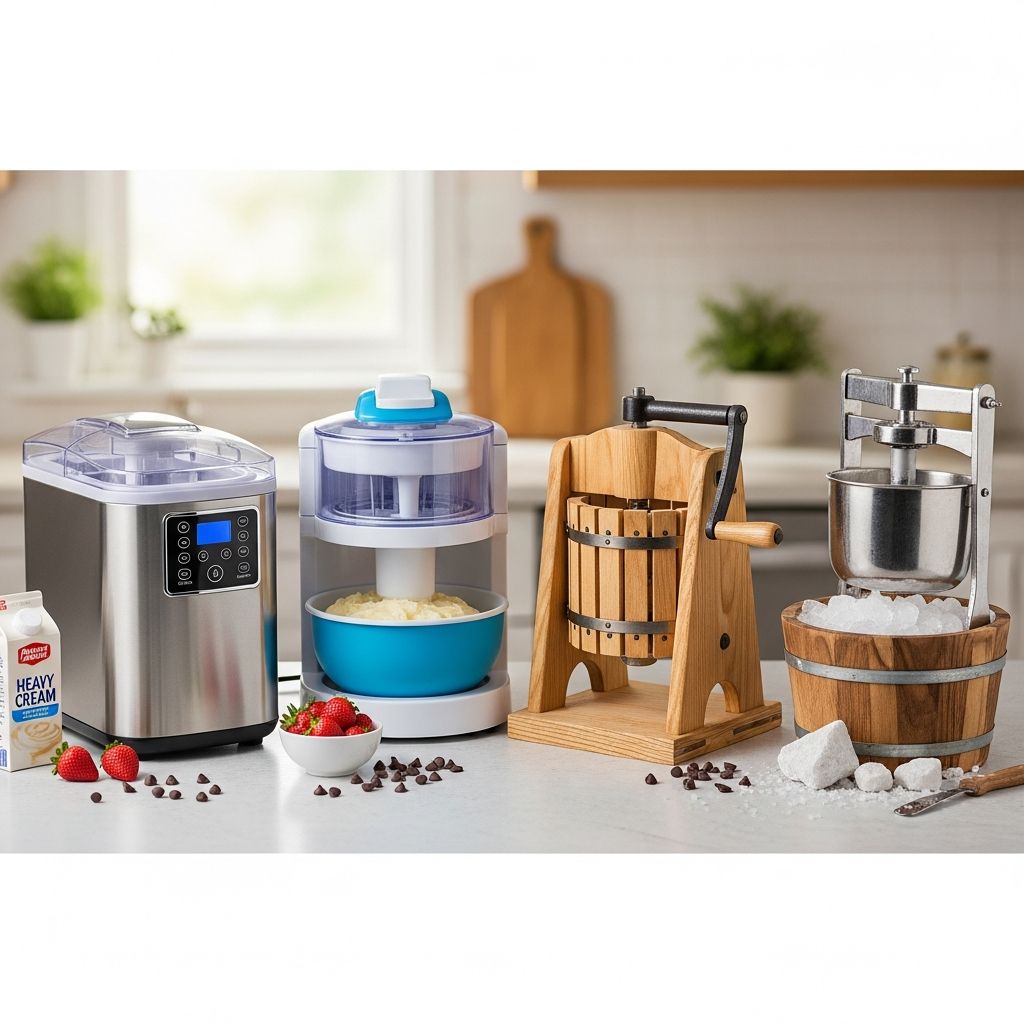
Broadly, home ice cream makers can be grouped into four major types:
- Compressor (self-refrigerating) ice cream makers
- Freezer-bowl (canister) ice cream makers
- Hand-crank ice cream makers
- Rock-salt (ice-and-salt) ice cream makers, usually manual or semi-electric
Choosing the right style means balancing budget, countertop space, batch frequency, and how hands-on you want the process to be. Home-focused reviews often divide machines into compressor and non-compressor categories, with compressor models favored for convenience and repeated batches, and canister machines recommended for quality and value at lower prices.
Table of Contents
- How Home Ice Cream Makers Work
- Compressor Ice Cream Makers
- Freezer-Bowl Ice Cream Makers
- Hand-Crank Ice Cream Makers
- Rock-Salt Ice Cream Makers
- Side-by-Side Comparison Table
- How to Choose the Right Ice Cream Maker Type
- Care, Maintenance, and Longevity
- Frequently Asked Questions (FAQs)
- Conclusion
How Home Ice Cream Makers Work
All types of home ice cream makers share two essential functions:
- Rapid cooling of the ice cream base to partially freeze it
- Continuous churning to incorporate air and prevent large ice crystals
When a cold surface or chilled mixture freezes the base while a paddle (dasher) scrapes and stirs, the result is a smooth, scoopable texture rather than a solid block of ice. Reviews of popular machines highlight that faster freezing and stronger churning usually produce smoother, denser ice cream.
The four main types differ primarily in how they supply the cold:
- Compressor machines use a built-in refrigeration unit.
- Freezer-bowl machines rely on a pre-frozen insulated canister from your freezer.
- Hand-crank and rock-salt designs use an ice-and-salt slurry around an inner canister.
Compressor Ice Cream Makers
Compressor ice cream makers, also called self-refrigerating machines, have a built-in refrigeration compressor like a mini freezer. They chill the bowl on demand, so you do not need to pre-freeze any parts. Expert guides often divide the market into two categories: machines with in-built refrigeration and those without, emphasizing that compressor models provide greater convenience for multiple batches and different flavors in a single day.
How Compressor Ice Cream Makers Work
Inside the unit, a refrigeration system circulates refrigerant, cooling a metal or removable bowl. The motor turns a dasher that scrapes the mixture from the bowl walls as it freezes. High-end models emphasize powerful compressors and motors that can freeze the mixture quickly and continue churning even as the ice cream becomes firm, which directly improves texture.
Typical Features of Compressor Machines
- Integrated cooling system with on-demand chilling
- One-button or program-based operation
- Multiple modes for ice cream, gelato, sorbet, or frozen yogurt
- Keep-cool or pre-cool functions in some advanced models
- Capacities typically around 1.0 to 2.1 quarts for home units
Advantages of Compressor Ice Cream Makers
- No pre-freezing required—you can decide to make ice cream at short notice.
- Multiple batches per day, making it convenient for entertaining or recipe testing.
- Consistent freezing thanks to controlled compressor cooling, often resulting in smooth and creamy textures.
- Stable performance that is less dependent on freezer strength or available freezer space.
Drawbacks of Compressor Ice Cream Makers
- Higher price compared with canister or manual designs; some premium models cost several times more than entry-level machines.
- Larger size and weight, which can limit portability and require dedicated countertop or storage space.
- More complex internals, meaning more components that could require repair over time.
Who Should Choose a Compressor Machine?
Compressor ice cream makers are well suited to:
- Home cooks who make ice cream regularly throughout the year.
- People wanting professional-style texture with minimal planning.
- Small households that enjoy experimenting with different flavors and styles (e.g., gelato, sorbet).
- Users who value convenience more than initial purchase price.
Freezer-Bowl Ice Cream Makers
Freezer-bowl, or canister, ice cream makers are among the most common and affordable options for home use. They use an insulated bowl filled with a special liquid that freezes solid in your household freezer. Once frozen, the bowl goes into a motorized base that turns a dasher to churn the ice cream mixture. Reviewers often highlight canister machines as providing excellent value and even producing ice cream that can be smoother than many compressor models, aside from very high-end units.
How Freezer-Bowl Machines Work
The canister contains a coolant that freezes to a low temperature in your freezer, usually requiring 12 to 24 hours. When the bowl is removed and placed on the machine, the frozen walls draw heat from the ice cream base. The dasher keeps the mixture moving and scrapes frozen layers off the sides, forming a semi-frozen, aerated mixture.
Advantages of Freezer-Bowl Machines
- Lower cost than compressor models, making them a popular starting point for home ice cream.
- Good texture quality when the bowl is fully frozen and recipes are properly chilled.
- Simpler design with fewer mechanical parts and less risk of complex failures.
- Smaller footprint and lighter weight than many compressor machines.
Drawbacks of Freezer-Bowl Machines
- Bowl must be pre-frozen, typically overnight, limiting spontaneity.
- Only one batch per frozen bowl; for multiple batches, you need extra bowls or must refreeze the same one.
- Requires freezer space large enough to store the canister perfectly level.
- Performance can vary depending on how cold and efficient your freezer is.
Who Should Choose a Freezer-Bowl Machine?
Freezer-bowl ice cream makers are ideal for:
- Users on a modest budget who still want high-quality homemade ice cream.
- People who plan ahead and do not mind freezing the bowl in advance.
- Small families who make one batch at a time.
- Cooks exploring ice cream occasionally but not multiple times per week.
Hand-Crank Ice Cream Makers
Hand-crank ice cream makers are traditional bucket-style devices where you turn a crank to rotate the dasher inside a chilled canister. The canister sits in a larger bucket filled with ice and rock salt. This style dates back generations and continues to be popular for gatherings, outdoor events, and those who enjoy a hands-on experience.
How Hand-Crank Machines Work
The inner metal canister holds the ice cream base, while the outer bucket is packed with alternating layers of ice and rock salt. The salt lowers the freezing point of the ice, forming a very cold brine that freezes the base. Turning the crank rotates the dasher, scraping frozen layers from the canister walls and incorporating air.
Advantages of Hand-Crank Machines
- Traditional, interactive experience that can be fun for families and events.
- No electricity required for manual models, making them suitable for outdoor use.
- Larger batch sizes than many compact automatic machines, depending on the model.
- Simple mechanical design that can be durable with proper care.
Drawbacks of Hand-Crank Machines
- Physical effort required to churn; extended cranking can be tiring.
- Requires ice and rock salt, which you must buy and store.
- Less precise control of freezing rate and texture than electronic machines.
- Messier setup and cleanup compared to self-contained electric models.
Who Should Choose a Hand-Crank Machine?
Hand-crank ice cream makers suit:
- Families wanting a nostalgic, activity-based way to make dessert.
- Users who prioritize simplicity and occasional use over convenience.
- Situations where electricity access is limited or unreliable.
Rock-Salt Ice Cream Makers
Rock-salt ice cream makers are closely related to hand-crank designs but may use either manual cranking or an electric motor to turn the dasher. The defining feature is the use of ice and rock salt around an inner canister. Whether manual or electric, they rely on the same principle of lowering the freezing point of ice to create a very cold environment for the ice cream base.
How Rock-Salt Designs Work
The inner canister, filled with ice cream mixture, is surrounded by layers of ice and rock salt in a bucket. As the salt melts the ice, it creates an ice brine that can be significantly colder than plain ice. The dasher inside the canister is rotated, either by hand or by an electric motor. As the mixture freezes, the dasher scrapes and churns to keep the texture smooth.
Advantages of Rock-Salt Machines
- Flexible power source, since many models offer both hand-crank and electric motor options.
- Large capacity, suited for parties, gatherings, or potlucks.
- Very low initial cost in some manual models, making them accessible.
- Works independently of freezer capacity, since chilling comes from ice and salt.
Drawbacks of Rock-Salt Machines
- Ongoing need for ice and salt, adding recurring cost and preparation time.
- Potentially messy brine and melted ice water to drain after churning.
- Less compact storage than small electric countertop machines.
Who Should Choose a Rock-Salt Machine?
Rock-salt designs are a good fit for:
- Users who make ice cream mainly for large groups or special occasions.
- People who enjoy a rustic or outdoor setup, such as picnics or camping (when ice is available).
- Anyone wanting a budget-friendly way to create big batches without relying on freezer space.
Side-by-Side Comparison Table
| Type | Cooling Source | Typical Capacity | Convenience | Approximate Cost Level | Best For |
|---|---|---|---|---|---|
| Compressor | Built-in refrigeration | 1.0–2.1 quarts (home models) | Very high (no pre-freezing) | High | Frequent makers, serious enthusiasts |
| Freezer-bowl | Pre-frozen canister | 1.0–2.0 quarts | Moderate (needs planning) | Low to medium | Budget-conscious home users |
| Hand-crank | Ice and rock salt | Often 2–4 quarts | Low (manual effort) | Low to medium | Traditional, outdoor use, family activity |
| Rock-salt (electric/manual) | Ice and rock salt | 2–6 quarts | Moderate (prep and cleanup) | Low to medium | Large batches, parties, occasional use |
How to Choose the Right Ice Cream Maker Type
When deciding which type of home ice cream maker to buy, it helps to use a simple decision framework that balances cost, frequency of use, desired texture, and kitchen logistics.
1. Frequency of Use
- If you make ice cream weekly or more, a compressor machine offers on-demand convenience and multiple batches without freezing bowls.
- If you make ice cream monthly or occasionally, a freezer-bowl or rock-salt machine is usually sufficient and more economical.
2. Budget Range
- Entry-level budget: Consider freezer-bowl or manual hand-crank models.
- Mid-range budget: Look at higher-capacity freezer-bowl machines or basic compressor units that balance performance and cost.
- Premium budget: High-end compressor machines deliver top texture and build quality, sometimes outperforming lower-end models significantly.
3. Kitchen Space and Storage
- Compressor machines are bulky and heavy, so you should ensure permanent counter space or sturdy storage.
- Freezer-bowl machines are compact but require freezer space for the canister.
- Hand-crank and rock-salt buckets may be large but usually store in a pantry or garage between uses.
4. Texture Expectations
- For restaurant-style smoothness, powerful compressor machines and well-designed canister models are strong options.
- For casual, nostalgic ice cream, hand-crank or rock-salt machines provide traditional textures and a fun process.
5. Convenience vs. Experience
- If you prioritize speed and ease, compressor or freezer-bowl models with automatic timers are a better match.
- If you enjoy hands-on, social experiences, hand-crank and rock-salt designs can turn dessert into an activity.
Care, Maintenance, and Longevity
Proper care helps any ice cream maker perform better and last longer, regardless of type.
General Care Tips
- Clean immediately after each use to prevent residue buildup on the dasher and bowl.
- Avoid abrasive tools on non-stick or polished metal surfaces.
- Allow parts to dry fully before storage to prevent odors and corrosion.
Type-Specific Care Considerations
- Compressor machines: Keep vents clear, avoid tipping the machine, and follow manufacturer guidelines for resting the compressor between batches.
- Freezer-bowl machines: Do not expose the frozen bowl to very hot water; allow it to come closer to room temperature before washing.
- Hand-crank and rock-salt machines: Rinse the bucket and immediately discard brine to reduce rust or wooden swelling. Lightly oil metal gears if recommended by the manufacturer.
Frequently Asked Questions (FAQs)
Q: Which ice cream maker type produces the best texture?
A: Powerful compressor machines and well-designed freezer-bowl models can both produce very smooth, creamy ice cream when used with properly chilled mixtures. High-end compressor machines may offer the most consistent results, but some canister machines are reported to outperform many mid-range compressor units in texture quality.
Q: Do I need a compressor machine to make gelato or sorbet?
A: No. Gelato and sorbet can be made in freezer-bowl, hand-crank, or rock-salt machines as long as churning and cooling are properly balanced. However, compressor machines often include dedicated programs and precise control that make it easier to standardize texture across different recipes.
Q: How long does it take to churn a batch of ice cream?
A: Most home machines, regardless of type, take about 20 to 40 minutes to churn a batch once the cooling system (bowl or ice) is ready. The exact time depends on recipe composition, starting temperature of the base, and the machine’s cooling power.
Q: Can I make multiple batches in a row?
A: Compressor machines are best for back-to-back batches because they cool on demand. Freezer-bowl machines generally can only make one batch per frozen canister unless you have multiple bowls. Rock-salt and hand-crank designs can make several batches as long as you supply enough ice and salt.
Q: Are hand-crank or rock-salt machines suitable for children?
A: Many families involve children in turning the crank or helping pack ice and salt, but adult supervision is important. The brine can be very cold, and some mechanical parts may pinch if misused. Electric rock-salt models reduce physical effort but still require careful handling.
Conclusion
Home ice cream makers fall into four main categories—compressor, freezer-bowl, hand-crank, and rock-salt—each offering a distinct balance of cost, convenience, and experience. Compressor machines emphasize effortless, on-demand churning with strong performance, while freezer-bowl models provide excellent value and quality for planners who do not mind pre-freezing the bowl. Hand-crank and rock-salt designs preserve a classic, hands-on approach that shines in social and outdoor settings.
A thoughtful choice starts with honest reflection on how often you will make ice cream, how much space and budget you have, and whether you value automation or the ritual of churning. Matching these preferences to the strengths and limitations of each design makes it easier to select a machine that fits naturally into your kitchen and your routines.
Whichever type you select, combining sound equipment with well-chilled bases and attention to freezing time will help you consistently produce satisfying homemade ice cream, sorbet, and gelato tailored to your taste.
Similar Articles




Read full bio of Sneha Tete