
Air Conditioner Refrigerants Explained for Homeowners: Types, Efficiency, and Future Rules
Understand AC refrigerant types, efficiency ratings, and upcoming regulations so you can make smarter, future-ready home cooling decisions.
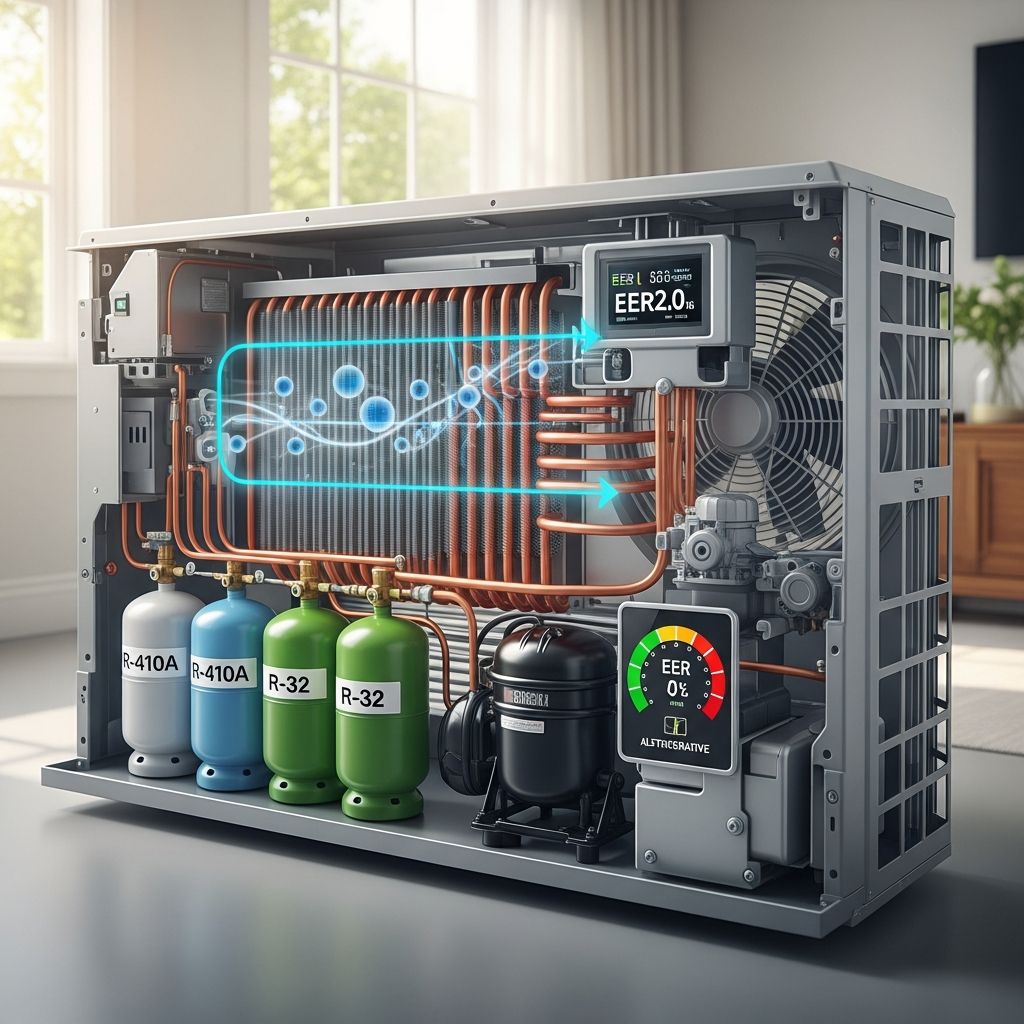
Air Conditioner Refrigerants Explained: What Homeowners Should Know
Modern air conditioners rely on refrigerants to move heat out of your home. Understanding which refrigerant your system uses and how new regulations are changing those options can help you make smarter decisions about repair, replacement, and long-term efficiency.
This guide explains the main refrigerant types found in residential systems, how they affect performance and energy bills, and what upcoming rules mean for homeowners planning their next HVAC upgrade.
Table of Contents
- What Is an AC Refrigerant and Why It Matters
- Major Refrigerant Families and Classes
- Common Home Air Conditioner Refrigerants
- Refrigerants, Efficiency, and Performance
- Environmental Impact and Safety Considerations
- Future Regulations and Phase-Out Timelines
- Choosing and Upgrading: What Homeowners Should Do
- Frequently Asked Questions
- Conclusion
What Is an AC Refrigerant and Why It Matters
A refrigerant is a specially formulated fluid that circulates inside your air conditioner, absorbing heat from indoors and releasing it outdoors as it changes between liquid and vapor states. Its properties determine how efficiently your system can move heat, what pressures the equipment must handle, and how safe and environmentally friendly the system is.
For homeowners, the refrigerant type matters for several reasons:
- Energy efficiency and electricity costs
- Compatibility with existing equipment
- Repair costs and refrigerant availability
- Environmental footprint (ozone depletion and global warming potential)
- How long your current system will remain supported under new regulations
Major Refrigerant Families and Classes
Refrigerants are often grouped by their chemical family and regulatory history.
Legacy refrigerant families
- CFCs (Chlorofluorocarbons): Early refrigerants like R-12, very effective but with high ozone depletion potential (ODP); now phased out in most countries.
- HCFCs (Hydrochlorofluorocarbons): Transitional refrigerants such as R-22 (Freon), with lower but still significant ODP; being phased out due to environmental impact.
Current and emerging families
- HFCs (Hydrofluorocarbons): Such as R-410A and R-32, do not deplete ozone but can have high global warming potential (GWP).
- HFOs (Hydrofluoroolefins): Newer refrigerants like R-1234yf with very low GWP and no ozone depletion; often blended with HFCs.
- Blends and A2L class refrigerants: New low-GWP blends such as R-454B combine HFC and HFO components and are classified as mildly flammable (A2L) under safety standards.
Common Home Air Conditioner Refrigerants
Most homeowners will encounter four main refrigerants in residential systems: R-22, R-410A, R-32, and R-454B.
| Refrigerant | Family | Typical Use Period | Ozone Depletion | Relative GWP | Status |
|---|---|---|---|---|---|
| R-22 (Freon) | HCFC | Older systems, especially pre-2010 | Yes | High | Phased out for new equipment; limited service only |
| R-410A | HFC blend | Standard in systems from about 2010 to mid-2020s | No | High (GWP around 2088) | Being phased down; still used in existing units |
| R-32 | HFC | Next-generation systems; widely used in Asia, growing in US | No | Moderate (about 675, roughly 32 percent of R-410A) | Key low-GWP option; mildly flammable (A2L) |
| R-454B | HFC/HFO blend | New systems as R-410A replacement (mid-2020s onward) | No | Lower (around 466) | Planned primary replacement for R-410A in many brands |
R-22 (Freon)
R-22 is a long-used HCFC refrigerant found in older residential systems. Due to its ozone-depleting properties, it has been phased out for new equipment, and production and import have been heavily restricted, making it expensive and harder to source.
For homeowners, this means R-22 systems can still be serviced if refrigerant is available, but major leaks or compressor failures often make replacement with a new system more economical than repair.
R-410A
R-410A, sometimes branded as Puron, became the main R-22 replacement for residential air conditioners and heat pumps manufactured around 2010 and later. It is an HFC blend that operates at higher pressures and provides good efficiency and stable, non-flammable performance.
However, R-410A has a relatively high GWP, so global and national policies are now pushing a transition toward lower-GWP refrigerants.
R-32
R-32 is a single-component HFC refrigerant and one of the key next-generation options. It offers high energy efficiency and a significantly lower GWP than R-410A, about 675 or around 32 percent of R-410A’s GWP. Many newer residential systems worldwide are being designed specifically for R-32.
R-32 is classified as mildly flammable (A2L), which requires specific safety standards and system designs but is considered manageable in properly engineered equipment.
R-454B
R-454B is a blend of R-32 (HFC) and R-1234yf (HFO) created to replace R-410A with a significantly lower GWP while maintaining strong performance. Leading manufacturers state that R-454B will gradually replace R-410A in new residential cooling equipment, with R-410A production for new units ending around January 2025 in some markets.
Like many new low-GWP refrigerants, R-454B is mildly flammable (A2L) and is not backward compatible with R-410A systems, meaning an existing R-410A unit cannot simply be refilled with R-454B.
Refrigerants, Efficiency, and Performance
Refrigerant choice has a direct impact on how efficiently your air conditioner can transfer heat, which affects system size, operating pressure, and overall energy use.
How refrigerant affects AC efficiency
- Heat transfer properties: Some refrigerants absorb and release heat more effectively, allowing manufacturers to design higher-efficiency systems.
- Operating pressures: Refrigerants with favorable pressure-temperature relationships can improve compressor performance and reliability.
- Refrigerant charge amount: Some newer refrigerants allow systems to use less refrigerant for the same capacity, which can further improve efficiency.
Comparing common home refrigerants on efficiency
- R-22 systems offered reasonable efficiency for their time but are now surpassed by modern equipment.
- R-410A enabled higher efficiency designs and became the standard for many years.
- R-32 is often more efficient than R-410A and can deliver higher cooling capacity and lower power use in properly designed systems.
- R-454B blends aim to match or exceed R-410A efficiency, while substantially lowering climate impact.
For homeowners, the key takeaway is that replacing an older R-22 or early R-410A system with a modern low-GWP system can reduce both energy bills and environmental impact, even when the nominal tonnage remains the same.
Environmental Impact and Safety Considerations
Two main environmental measures are used for refrigerants: ozone depletion potential (ODP) and global warming potential (GWP).
Ozone depletion potential (ODP)
- CFCs like R-12 and HCFCs like R-22 have significant ODP and are being phased out.
- HFCs, HFOs, and modern blends (R-410A, R-32, R-454B) have zero ODP.
Global warming potential (GWP)
- R-410A has a relatively high GWP (around 2088).
- R-32 reduces GWP to roughly 675, about 32 percent of R-410A’s value.
- R-454B further reduces GWP to roughly the 400–500 range, offering a substantial climate benefit.
Safety and flammability
Refrigerants are classified for safety based on toxicity and flammability. Many new low-GWP refrigerants, including R-32 and R-454B, are labeled A2L, meaning low toxicity and mild flammability.
For homeowners, this does not mean a higher day-to-day risk when systems are installed and serviced by licensed professionals. Instead, it means equipment designs, standards, and building codes are updated to manage these properties safely, including limits on charge sizes and specific installation practices.
Future Regulations and Phase-Out Timelines
Environmental agreements and national policies are driving a transition away from high-ODP and high-GWP refrigerants. This affects which refrigerants can be used in new HVAC equipment and influences long-term service options for existing systems.
From R-22 to R-410A
- R-22 production for new equipment has already been phased out in many regions due to its ozone impact.
- Existing R-22 systems can continue to operate, but refrigerant supplies are limited and costly, increasing repair costs.
From R-410A to lower-GWP options
- R-410A, while ozone-safe, has a high GWP, and regulations are now curbing its use in new systems.
- Major manufacturers and industry groups have identified R-454B and R-32 as leading replacements for R-410A.
- New equipment manufacturing using R-410A is set to be phased out around January 2025 for many residential applications, though existing R-410A systems can still be serviced.
What regulations mean for homeowners
- Your existing R-22 or R-410A system can keep running, but repairs involving significant refrigerant may become more expensive over time.
- Any new or replacement equipment you buy in the coming years is increasingly likely to use a low-GWP refrigerant such as R-32 or R-454B.
- Licensed HVAC professionals will handle the regulatory details, but you may see updated terminology in quotes and product literature as new refrigerants become standard.
Choosing and Upgrading: What Homeowners Should Do
Homeowners do not choose the refrigerant separately from the system; instead, each system is engineered for a specific refrigerant and pressure range. However, knowing the basics helps you evaluate repair versus replacement options and understand the long-term implications of each choice.
Can you switch refrigerants in an existing system
- R-410A systems cannot simply be recharged with R-454B or R-32 because the components, lubricants, and design pressures differ.
- Some legacy R-22 systems can be converted to certain alternative blends, but performance and reliability may be affected, and conversions are best evaluated case by case by an HVAC professional.
Repair versus replace decision framework
When facing a major AC repair, consider the following factors:
- System age: Older R-22 systems are often past their prime, and investing in large repairs may not be cost-effective compared with replacement.
- Refrigerant type: If your system uses R-22, the high cost and limited availability of refrigerant push the economics toward replacement. For R-410A, service is still widely available, but future restrictions favor planning for eventual upgrade.
- Energy efficiency: New low-GWP systems designed around R-32 or R-454B can provide efficiency gains that offset some of the upfront cost through lower energy bills over time.
- Repair scope: A minor leak repair in a relatively new R-410A system may make sense; a failed compressor in an old R-22 unit may favor full replacement.
Questions to ask your HVAC contractor
- Which refrigerant does my current system use?
- How old is my system, and what is its expected remaining life?
- What refrigerant will the proposed new system use (R-32, R-454B, or another) and why?
- How do the energy efficiency ratings compare to my current system?
- Are there any code or regulatory issues I should be aware of for this refrigerant in my area?
Frequently Asked Questions
Is R-22 refrigerant still available for my older AC?
R-22 is no longer used in new equipment and its production and import are strictly limited due to its ozone impact, but it may still be obtainable from recycled or pre-existing stocks. Availability is shrinking and prices are high, so large R-22 leaks or major component failures often point toward system replacement.
Can I put R-454B or R-32 into my existing R-410A system?
No. R-454B and R-32 are not compatible drop-in replacements for R-410A systems. They have different pressure, lubrication, and safety characteristics, and equipment must be specifically designed for them.
Is R-410A being banned?
R-410A is being phased down for use in new equipment due to its high GWP, with manufacturing of new residential systems using R-410A scheduled to end around early 2025 in many markets. However, existing R-410A systems can still be serviced and will not suddenly become unusable.
Are the new mildly flammable refrigerants safe in homes?
Low-GWP refrigerants such as R-32 and R-454B are classified as mildly flammable (A2L), but HVAC equipment, codes, and safety standards are designed to manage this risk. When systems are properly installed and maintained by licensed professionals, these refrigerants can be used safely in residential applications.
Which refrigerant should I choose for a new system?
Homeowners typically choose the system, not the refrigerant directly. Leading manufacturers are moving toward R-454B and R-32 in new high-efficiency equipment, both of which offer significantly reduced climate impact compared with R-410A while maintaining strong performance. Discuss specific product options, efficiency ratings, and refrigerant types with your HVAC contractor.
Conclusion
Air conditioner refrigerants have evolved from ozone-depleting CFCs and HCFCs like R-12 and R-22 to high-GWP HFCs such as R-410A and now toward low-GWP options like R-32 and R-454B. Each step reflects a balance of performance, safety, and environmental responsibility shaped by regulation and technology.
For homeowners, understanding which refrigerant is in your system helps clarify repair costs, expected system lifetime, and the benefits of upgrading. Older R-22 units face high service costs and limited refrigerant availability, while R-410A systems remain serviceable but are being replaced in new equipment by more climate-friendly choices.
A thoughtful, informed decision considers system age, refrigerant type, efficiency ratings, and the direction of future regulations. Working with a qualified HVAC professional, you can use this knowledge to select or plan a system that cools effectively, manages long-term running costs, and aligns with emerging refrigerant standards.
Similar Articles






Read full bio of Sneha Tete