
Air Fryers vs Traditional Ovens: Key Differences in Cooking Style and Everyday Use
Understand how air fryers and traditional ovens differ in heat, texture, speed, capacity and daily cooking practicality.
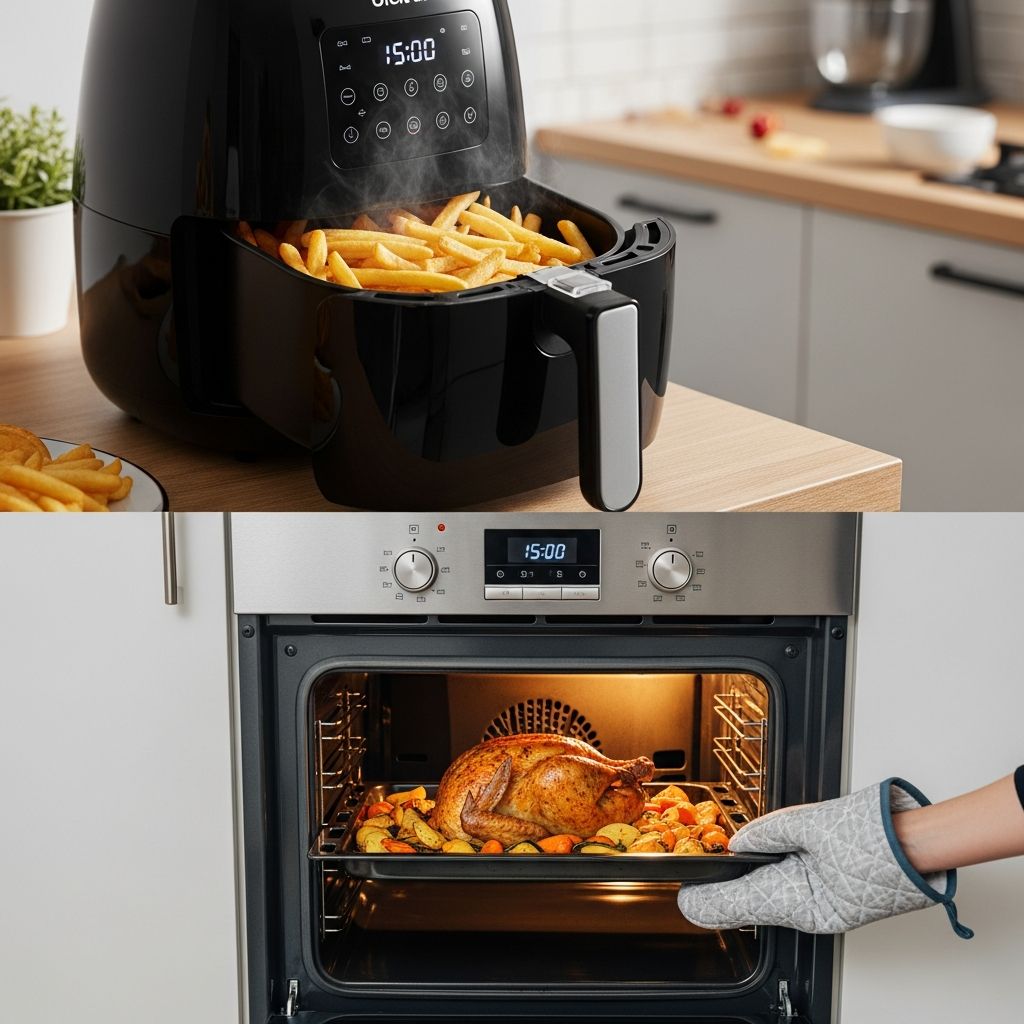
Air Fryers vs Traditional Ovens: Differences in Cooking Style and Everyday Use
Air fryers have moved from trendy gadgets to serious kitchen tools, raising a common question: how do they really compare to traditional ovens in cooking style and everyday use? Understanding the differences in heat, texture, speed, capacity and practicality helps you decide what works best for your kitchen and the way you cook.
Table of Contents
- Overview of Air Fryers and Traditional Ovens
- How Each Appliance Works
- Cooking Style and Food Texture
- Cooking Time, Temperature and Preheating
- Capacity, Layout and Batch Size
- Energy Use, Noise and Kitchen Heat
- Perceived Health and Nutrition Differences
- Everyday Use Cases and Best Fits
- Side-by-Side Comparison Table
- Frequently Asked Questions (FAQs)
- Conclusion
Overview of Air Fryers and Traditional Ovens
Both air fryers and traditional ovens cook food with dry heat, but they differ in size, airflow and intensity of heat. According to appliance and testing guides, air fryers are compact countertop appliances that circulate hot air rapidly around food, while traditional ovens are full-size built-in or range ovens that bake and roast using larger heating elements and, in some models, weaker or no fan assistance.
In practical terms, this means:
- Air fryers focus on speed and crispiness in smaller batches.
- Traditional ovens focus on versatility and capacity for larger meals.
How Each Appliance Works
How an Air Fryer Works
Most air fryers use a powerful heating element and a high-speed fan located at the top of the cooking chamber. The fan drives very hot air down and around the food, often through a perforated basket or tray, creating intense convection.
Key characteristics of air fryer operation include:
- Top-mounted heating element and fan that cook from the top down.
- Small, enclosed cavity that concentrates heat close to the food.
- Fast airflow, often faster than the fan in a convection oven, which accelerates browning and crisping.
- Perforated basket or rack that allows hot air to contact more of the food surface and lets excess fat drip away.
How a Traditional Oven Works
Traditional ovens (also called conventional ovens) use heating elements on the bottom and, often, the top of a large cavity. They may or may not have a fan.
There are two major types:
- Conventional ovens use still air. Heat rises naturally, leading to hotter zones at the top and cooler zones at the bottom.
- Convection ovens add a fan (and sometimes a third heating element) to circulate hot air through the oven. This reduces hot and cold spots and improves browning, but the fan is typically gentler than in an air fryer.
Traditional ovens are much larger than air fryers, so heat is less concentrated and food usually takes longer to crisp.
Cooking Style and Food Texture
Texture and Crispiness
One of the biggest reasons people buy air fryers is their ability to create a crisp, browned surface using little or no added oil. The concentrated heat and fast air circulation help food develop a crunchy exterior similar to deep-fried results.
Comparative tests show that:
- Air fryer chicken, potatoes and vegetables often come out crisper on the outside while staying moist inside.
- Convection oven versions of the same foods usually need more time to approach similar crispiness, and by then the interior can be drier.
- Conventional (non-fan) ovens struggle to achieve a true fried-like crisp unless foods contain enough oil and cook for longer or are finished under the broiler.
Cooking Style and Best-Suited Dishes
Because of their different heat patterns, each appliance excels with different cooking styles:
- Air fryers excel at:
- Frozen snacks (fries, nuggets, mozzarella sticks, spring rolls)
- Small cuts of meat (wings, drumsticks, thighs, pork chops)
- Roasted vegetables in small batches
- Reheating pizza and fried foods to restore crispiness
- Traditional ovens excel at:
- Baking (cakes, cookies, bread, pastries)
- Roasting large meats (whole chicken, turkey, beef roasts)
- Sheet-pan dinners and multiple dishes at once
- Slow cooking, braising and low-temperature roasting
While air fryers can bake and roast, their smaller size and intense heat can make delicate baked goods more prone to overbrowning if not carefully monitored.
Cooking Time, Temperature and Preheating
Preheating
- Air fryers preheat faster because of their small internal volume and concentrated heat source.
- Traditional ovens, especially full-size ones, may take significantly longer to reach the same temperature.
For many everyday tasks, this can make the total time from “idea to plate” shorter with an air fryer, especially for small portions.
Cooking Time and Temperature Adjustments
Both air fryers and convection-style ovens often use temperatures about 20–25°F lower than recipes written for conventional ovens, due to the fan-driven airflow. Guidance from manufacturers and cooking resources suggests that when you adapt oven recipes for air fryers, you can often:
- Reduce the temperature by about 25°F compared to a conventional oven.
- Shorten the cooking time by roughly 15–20 percent, checking for doneness earlier.
For example, a recipe baked at 375°F for 10 minutes in a conventional oven might be cooked at around 350°F for about 8 minutes in an air fryer.
In broad terms:
- Air fryers often achieve similar or better browning in less time than ovens for many crisp-focused foods.
- Traditional ovens may match air fryers for some dishes when using convection, but usually with slightly longer times.
Capacity, Layout and Batch Size
Overall Capacity
Capacity is one of the most important practical differences between air fryers and traditional ovens. Sources consistently highlight that ovens can cook far more food at once than standalone air fryers.
- Air fryers usually handle about two to four servings comfortably, depending on the model and the food shape.
- Traditional ovens can accommodate large roasting pans, multiple racks, whole turkeys, sheet pans of cookies and big batch meals.
Cooking Surfaces and Arrangement
The way food is arranged also differs:
- Air fryers typically use baskets or compact trays. Food needs to be in a relatively single layer for best crisping. Overcrowding reduces airflow and leads to uneven results.
- Ovens offer multiple racks and larger baking sheets. You can cook several dishes at once, but more crowded pans and lower fan speeds mean less intense crisping per piece.
For families or those who batch cook, oven capacity is a major advantage. For one or two people making quick meals, an air fryer can feel more efficient despite its smaller size.
Energy Use, Noise and Kitchen Heat
Energy Consumption
Because air fryers have smaller cavities and faster preheat times, they often use less energy for small to medium portions than firing up a full-size oven for the same job. A small space requires less energy to heat and maintain temperature, and shorter cooking times reduce total energy use.
However:
- For very large quantities cooked at once, a full-size oven may be more efficient than multiple small air fryer batches.
- Energy use depends on the specific models, insulation and your cooking habits.
Kitchen Heat and Noise
- Kitchen heat: Air fryers tend to heat up the surrounding kitchen less than a full oven, especially in warm weather or small apartments. The smaller compartment means less heat radiates outward.
- Noise: Air fryers rely on a high-speed fan, so they produce a noticeable fan noise during operation. Convection ovens also make some fan noise, but traditional still-air ovens are quieter when not using a fan.
Perceived Health and Nutrition Differences
Air fryers are often promoted as a “healthier” alternative to deep frying because they can create a crispy surface with significantly less oil. In many recipes, only a light coating of oil is needed, or none at all, while excess fat from foods can drip into the bottom of the basket.
Compared with traditional ovens, the health difference is more nuanced:
- Both air frying and oven baking can be done with modest amounts of oil.
- Air fryers may make it easier to get a fried-like texture without feeling pressured to add extra oil for crispiness.
- Traditional ovens may need more oil or longer cooking times, especially for crisping, but nutrition ultimately depends on recipes and ingredients rather than the appliance alone.
From a health perspective, both tools can support healthier cooking patterns, especially when used for roasting vegetables, lean proteins and home-prepared meals instead of heavily processed fried foods.
Everyday Use Cases and Best Fits
When an Air Fryer Shines
Based on performance and practical usage, air fryers are especially convenient for:
- Small households or individuals who rarely cook large roasts or multiple dishes at once.
- Quick weeknight dinners when you want food ready fast without long preheat times.
- Crispy frozen foods like fries, nuggets and snacks that benefit from rapid hot air circulation.
- Reheating leftovers such as pizza, roasted potatoes and fried chicken with restored crispiness.
- Minimizing kitchen heat in small or warm spaces where running a full oven is uncomfortable.
When a Traditional Oven Is Better
Traditional ovens remain central in most kitchens for good reasons:
- Cooking for families or groups where large capacity and multiple dishes are needed.
- Baking cakes, breads, pies and large batches of cookies where even, gentle heat is important.
- Holiday and special occasion meals featuring turkeys, roasts and multiple sides.
- Sheet-pan meals where ingredients spread out over a full baking tray for easy batch cooking.
- Slow-roasting and braising, which benefit from steady, moderate heat over longer periods.
Can One Replace the Other?
Guides and testing consistently indicate that an air fryer is not a complete replacement for a traditional oven, mainly because of capacity limitations and differences in baking performance. For small portions and crisp-focused dishes, an air fryer can substitute effectively. For big-batch baking, large roasts, or complex meals, an oven is still necessary.
Some modern full-size ovens now include “air fry” or high-speed convection modes, combining elements of both tools. These can narrow the gap, but tests suggest that dedicated air fryers often still produce crisper results due to their smaller cavities and more intense airflow.
Side-by-Side Comparison Table
| Feature | Air Fryer | Traditional Oven |
|---|---|---|
| Heating style | Top heating element with powerful fan, intense convection | Bottom and top elements; optional fan (convection) or still air |
| Size and capacity | Compact; ideal for 1–4 portions; limited batch size | Full-size cavity; suitable for large roasts and multiple dishes |
| Preheat time | Very short; heats quickly due to small volume | Longer; more air and surfaces to heat |
| Crispiness | Excellent; very efficient at browning and crisping | Good with convection and enough oil; slower to crisp |
| Baking performance | Can bake, but intense heat and small space require careful control | Ideal for cakes, cookies, bread and pastries |
| Energy use (small meals) | Often lower; short cook times and small cavity | Higher for small portions due to large volume and longer preheat |
| Everyday convenience | Excellent for quick, crispy meals and reheating leftovers | Best for large meals, batch cooking and baking |
| Kitchen heat | Less heat output, good for small or warm spaces | More heat released into the kitchen during long bakes and roasts |
Frequently Asked Questions (FAQs)
Is an air fryer just a small convection oven?
Air fryers and convection ovens use similar principles of fan-driven hot air, but they are not identical. Air fryers are smaller, use more concentrated heat and usually have faster, more powerful fans that cook from the top down. This combination often produces crisper results more quickly than a standard convection oven.
Can an air fryer replace my traditional oven completely?
For small households and simple meals, an air fryer can handle a large portion of everyday cooking. However, it cannot fully replace a traditional oven for tasks like baking large batches, roasting big cuts of meat or cooking multiple dishes at once.
Does food taste the same from an air fryer and an oven?
The core flavors are similar because both use dry heat, but the texture can be noticeably different. Air-fried foods often have a crispier exterior and juicier interior, especially for items like chicken, potatoes and vegetables, compared with the same foods cooked in a conventional or even convection oven.
Are air fryers healthier than ovens?
Air fryers can help you achieve a fried-like texture with less oil than deep frying, but when compared directly with oven baking, the health difference depends mostly on your ingredients and recipes. Both tools can be used for healthy cooking with moderate oil and whole foods.
Can I bake cakes and cookies in an air fryer?
Yes, many recipes can be adapted for air fryers, often by slightly lowering the temperature and shortening the baking time. However, a full-size oven still offers more even heat, more space and easier control for delicate baked goods and large batches.
Conclusion
Air fryers and traditional ovens share the same basic method of cooking with dry heat, yet they deliver notably different experiences in texture, speed, capacity and everyday convenience. Air fryers focus on fast, concentrated convection that excels at crisp, small-batch cooking and quick reheating, while traditional ovens provide the space, stability and versatility needed for baking, large roasts and multi-dish meals.
The most useful way to decide between them is to consider how you cook most of the time: small, crispy weeknight meals and snacks, or larger, varied menus that involve baking and roasting for several people. Many kitchens benefit from using both, with the oven handling bigger and more delicate projects and the air fryer taking over quick, crisp-focused tasks that would otherwise require heating a full-size oven.
Understanding the strengths and limits of each appliance makes it easier to choose the right tool for each dish, reduce cooking time and energy use, and match your equipment to your household size and cooking style.
Similar Articles







Read full bio of medha deb