Best Practices for Running Your Air Conditioner at Night for Better Sleep
Learn how to run your air conditioner at night for optimal sleep quality, quieter operation, and energy-efficient temperature settings.
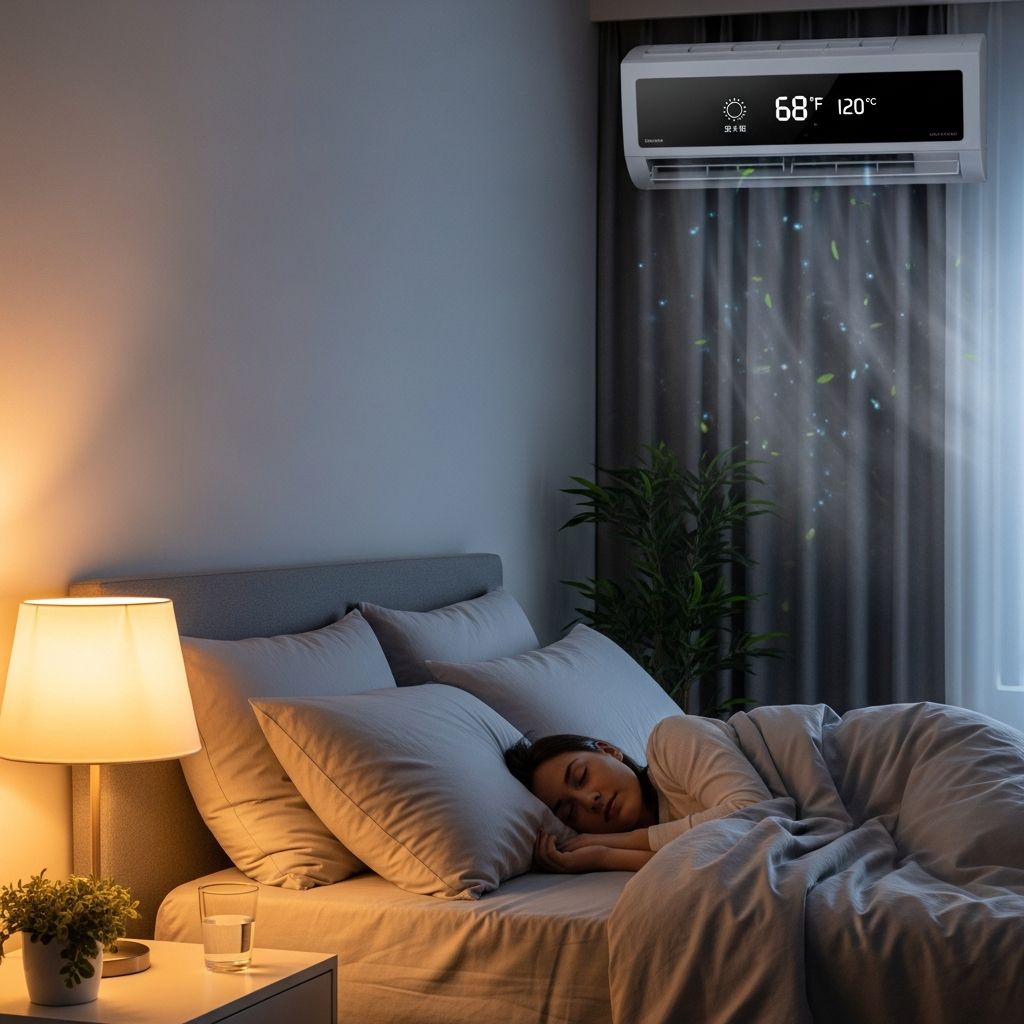
Best Practices for Running Your Air Conditioner at Night: Sleep Quality, Noise, and Temperature Settings
Running your air conditioner at night can dramatically improve comfort during hot seasons, but if it is used incorrectly it can also disturb sleep, dry out the air, and waste energy. This guide explains how to set up and run your AC at night to support healthy, restorative sleep while keeping noise and energy use under control.
Table of Contents
- Why Nighttime Air Conditioning Affects Sleep
- Ideal Bedroom Temperature for Sleep
- How to Set Your Air Conditioner at Night
- Managing AC Noise for Better Sleep
- Airflow, Vent Placement, and Draft Control
- Humidity, Filtration, and Air Quality at Night
- Energy-Efficient Cooling While You Sleep
- Health and Safety Considerations
- Practical Night Routines and Example Settings
- Frequently Asked Questions (FAQs)
- Conclusion
Why Nighttime Air Conditioning Affects Sleep
Human body temperature naturally drops as you move from wakefulness into deeper stages of sleep. A cooler bedroom supports this process and is consistently linked with better sleep quality, fewer awakenings, and more restorative deep sleep. An AC that is too cold, too loud, or cycling on and off aggressively works against this natural rhythm.
Key ways AC use at night affects sleep include:
- Room temperature: Too warm leads to sweating and restlessness; too cold can cause shivering, muscle tension, and early awakenings.
- Noise: Fan hum, compressor kicks, and vibration may fragment sleep, especially for light sleepers.
- Air movement: Cold drafts directly on your body may cause stiffness or dry eyes and nose.
- Humidity and air quality: Over-dry air, dirty filters, or poor circulation can irritate airways and worsen allergies.
Ideal Bedroom Temperature for Sleep
Studies and sleep organizations suggest that slightly cooler environments are best for sleep. Several expert sources recommend nighttime bedroom temperatures in the following ranges:
- Common recommendation: about 60 to 67 degrees Fahrenheit (roughly 15.5 to 19.5 degrees Celsius) for most adults.
- Some HVAC and manufacturer guidance suggests 26 to 28 degrees Celsius (about 78 to 82 degrees Fahrenheit) as a general comfort range, particularly in very hot climates, emphasizing stability over extreme cooling.
Practical advice is to start within the 60–67°F (16–19°C) zone and adjust based on personal comfort and bedding thickness. Many people sleep better when the bedroom is cooled more than the rest of the home, often by using zoning or a separate bedroom unit.
| Temperature Range | Typical Effect on Sleep | Best For |
|---|---|---|
| Below 60°F (below ~15°C) | May feel too cold, risk of waking from chill or muscle tension | Very warm sleepers with heavy bedding |
| 60–67°F (15.5–19.5°C) | Often optimal balance of comfort and thermoregulation | Most adults in typical climates |
| 68–72°F (20–22°C) | Comfortable for some, may feel slightly warm to hot sleepers | People sensitive to cold, lighter climates |
| Above 72°F (above ~22°C) | Higher risk of sweating and fragmented sleep, especially in humid air | Those without AC, or where energy costs must be minimized |
Another practical guideline is to avoid setting your AC more than about 6–7 degrees Celsius cooler than the outdoor temperature to reduce thermal shock and energy waste.
How to Set Your Air Conditioner at Night
Nighttime AC settings should prioritize steady, gentle cooling and minimal disturbances.
1. Use Sleep Mode When Available
Many modern air conditioners have a dedicated sleep mode or night mode. When activated, it typically:
- Starts at your chosen temperature (for example, 24°C or 75°F) and then gradually raises it by a few degrees over several hours to avoid overcooling.
- Reduces fan speed, which lowers noise and prevents strong drafts.
- Runs for 6–8 hours before turning off or reverting to standard settings, matching a normal sleep duration.
- Improves overall energy efficiency and can extend system life by lowering nighttime workload.
To use sleep mode effectively, set a comfortable initial temperature, typically between 24°C and 26°C (75–78°F) if your AC will automatically adjust slightly warmer as the night progresses.
2. Prefer Continuous, Stable Cooling Over Aggressive Timers
Some people turn the AC off after an hour or two to save energy, only to wake up sweating later. Researchers and manufacturers point out that running the AC all night on a stable, moderate setting is often better for sleep than using only a short timer, because body temperature continues to fluctuate through the night.
If your AC does not have sleep mode, consider:
- Setting a slightly higher temperature than you use in the evening, but keeping the unit on all night.
- Using a programmable thermostat so the temperature drops around bedtime and slowly rises again near morning.
3. Avoid Extreme Pre-Cooling
Cooling the bedroom heavily right before bed and then turning the unit off can lead to a cycle of getting too cold, then waking up too hot hours later. It is generally better to:
- Cool the room to your target sleep temperature shortly before bedtime.
- Maintain that temperature steadily through most of the night.
4. Use Timers Wisely
Timers can be helpful when nighttime temperatures outdoors drop significantly, or when you want the AC off after sunrise. Consider setting:
- Delayed shutdown a short time before your usual wake time, not in the middle of your core sleep period.
- Startup before bedtime to pre-cool the room if evenings are very hot.
Managing AC Noise for Better Sleep
Noise from your AC can be as disruptive as poor temperature control. Common noise sources include compressor cycling, rattling ducts, high fan speeds, and vibration through walls or window frames.
Best practices to minimize nighttime AC noise:
- Use sleep or quiet mode to reduce fan speed and compressor activity where possible.
- Run the fan on a consistent low or medium speed instead of auto, which may reduce sudden bursts of noise when the compressor cycles.
- Position portable or window units as securely as possible to avoid rattling; add padding around contact points if needed.
- Combine AC with a steady fan to create gentle white noise that masks compressor sounds and outside noise.
- Keep the unit maintained; worn bearings, loose panels, or clogged filters can increase noise.
Airflow, Vent Placement, and Draft Control
How cool air moves through your bedroom matters almost as much as the thermostat number. Direct cold air blowing on your face, neck, or back can contribute to stiffness or dryness.
To optimize airflow:
- Aim vents or louvers upward or away from the bed, rather than directly at you.
- Use adjustable deflectors on ceiling or wall vents if you cannot change their direction easily.
- Place portable units so the main airflow path crosses the room, not your pillow.
- Complement AC with a ceiling or pedestal fan to create more even air distribution at lower speeds.
Humidity, Filtration, and Air Quality at Night
Comfortable sleep is influenced by more than temperature. Humidity that is too high feels muggy and can encourage mold and dust mites, while humidity that is too low may dry out eyes, throat, and skin. Air conditioners naturally dehumidify to some extent, but may not fully control humidity in very damp or very dry climates.
Better nighttime air quality practices include:
- Maintaining relative humidity in roughly the 40–60 percent range where possible, using a dehumidifier or humidifier as needed.
- Cleaning or replacing air filters regularly so the AC does not circulate dust or microorganisms.
- Ensuring vents are open and unobstructed to provide steady airflow and prevent stale pockets of hot or cold air.
- Considering blackout curtains to reduce daytime heat gain, which helps the AC work less at night and keeps the room more stable.
Energy-Efficient Cooling While You Sleep
Smart nighttime AC use can both improve sleep and reduce energy costs. Key strategies include:
- Using programmable thermostats to automatically lower temperature at bedtime and slightly raise it near morning.
- Setting nighttime temperature only as cool as needed; every degree warmer can reduce energy consumption.
- Cooling bedrooms more than the rest of the house, using zoning, separate bedroom units, or closing vents and doors to unused areas.
- Leveraging sleep mode to gradually ease off cooling later in the night while still maintaining comfort.
- Improving insulation, sealing gaps, and using curtains or blinds to reduce heat gain so the AC does not need to work as hard at night.
Some manufacturers also note that using sleep mode or moderate constant settings at night can extend the lifespan of the unit by reducing mechanical wear.
Health and Safety Considerations
Used properly, running AC at night can support health by improving sleep quality and reducing heat stress. Research cited by health and HVAC sources indicates that maintaining a cool, stable bedroom temperature supports the body’s natural overnight cooling process, which is vital for deep, restorative sleep.
To avoid negative effects:
- Do not sleep directly in a strong cold airflow; aim vents away from the bed and use lower fan speeds.
- Keep filters clean to limit allergens, dust, and microorganisms from circulating in the room.
- Avoid setting the temperature extremely low to the point of shivering or numbness; this can strain circulation and muscles.
- Monitor children, older adults, and people with chronic respiratory or cardiovascular conditions, as they may be more sensitive to cold or dry air.
Practical Night Routines and Example Settings
Putting these recommendations together, below are sample routines for different situations. These are general examples; always adjust to your own comfort, climate, and equipment.
Example 1: Central AC with Programmable Thermostat
- Early evening: Keep home at a comfortable day setting (for example, around 76–78°F / 24–26°C).
- One hour before bed: Program thermostat to lower bedroom or whole-home temperature into the 60–67°F (16–19°C) range.
- During the night: Maintain a stable temperature, avoiding large swings.
- One hour before wake time: Allow the temperature to rise a few degrees to reduce morning energy demand.
Example 2: Split or Window AC with Sleep Mode
- 30 minutes before bed: Turn on AC, set temperature to about 24–26°C (75–78°F), and enable sleep mode.
- Night: Let the AC gradually adjust temperature up by a few degrees while reducing fan speed and noise.
- Morning: The unit either turns off or returns to normal cooling as programmed.
Example 3: Very Hot Climate with High Outdoor Temperatures
- Daytime: Use curtains and shading to limit solar gain. Keep doors and windows closed in the hottest hours.
- Evening: Begin cooling bedrooms earlier so the AC does not have to work aggressively right before bed.
- Night: Set bedroom temperature at a level that is cooler than outdoors but not more than about 6–7°C lower to limit shock and energy use.
Frequently Asked Questions (FAQs)
What is the best temperature to set my AC at night for sleep?
Many sleep and HVAC experts recommend a bedroom temperature between 60 and 67°F (about 16 to 19°C) for most adults, with minor adjustments for personal comfort and bedding thickness.
Is it better to leave my AC on all night or use a timer?
For many people, steady, moderate cooling all night produces better sleep than using a short timer that turns the AC off while you are still in deep sleep phases. Some research from manufacturers suggests running the AC all night, especially during very hot nights, can support more continuous, restful sleep compared with stopping it partway through the night.
What is AC sleep mode, and should I use it?
Sleep mode is a feature that automatically adjusts temperature and fan speed at night. It usually starts at your chosen setting, then gradually increases temperature by a few degrees and lowers fan speed to save energy and reduce noise, while still keeping the room comfortable. It is generally a good option for nighttime use.
Can sleeping with AC harm my health?
When used correctly, nighttime AC can support health by improving sleep and preventing overheating. Problems typically arise from air that is too cold, directly blowing on the body, or circulating through dirty filters. Keeping temperatures in a moderate range, cleaning filters, and avoiding strong drafts minimizes risks.
How can I make my AC quieter at night?
Use sleep or quiet mode to slow the fan and soften compressor noise, secure loose panels or window frames, keep the system well maintained, and consider adding a fan for gentle white noise that masks sudden sounds.
Conclusion
Running your air conditioner at night works best when it supports your body’s natural tendency to cool down during sleep, instead of fighting it. A slightly cool, stable bedroom, typically in the 60–67°F (16–19°C) range for many adults, helps you fall asleep faster and stay asleep more deeply, provided the AC does not blast cold air directly on you or cycle loudly through the night.
Thoughtful use of features such as sleep mode and programmable thermostats, combined with attention to airflow direction, noise control, filtration, and humidity, allows you to balance comfort, health, and energy efficiency. Small adjustments, like cleaning filters, softening drafts, or raising the thermostat by a degree or two, can significantly improve how rested you feel in the morning.
Ultimately, the best nighttime AC setup is the one that keeps your bedroom quietly cool, your breathing easy, and your sleep uninterrupted, while using only as much energy as necessary to maintain that comfort.
Similar Articles







Read full bio of medha deb