
Compressor vs Thermoelectric Wine Refrigeration Technologies for Homes
Understand compressor and thermoelectric wine cooling so you can choose the best technology to protect your bottles at home.
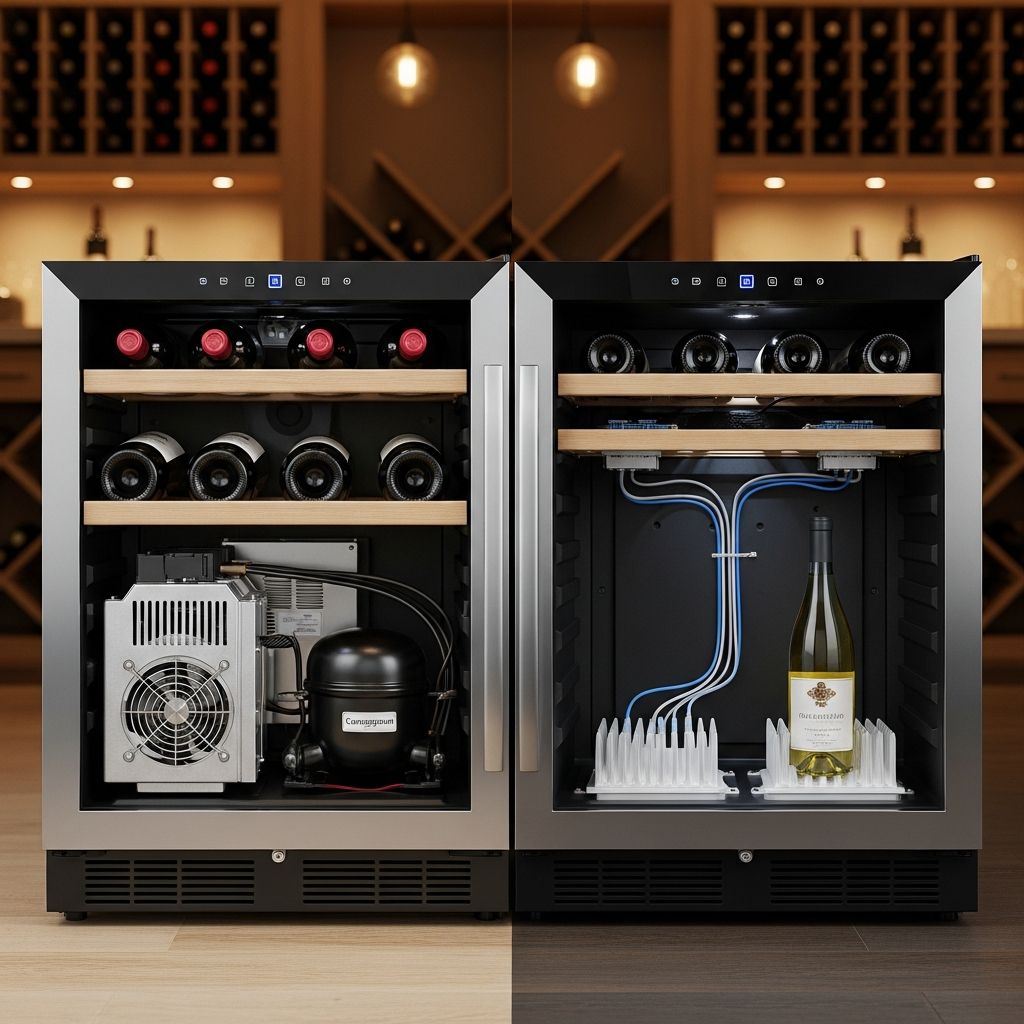
Compressor and Thermoelectric Wine Refrigeration Technologies Explained for Homeowners
Modern wine fridges use two main cooling technologies: compressor-based systems and thermoelectric systems. Understanding how each works, where they perform best, and their trade-offs in noise, efficiency, and capacity helps homeowners choose the right wine refrigeration for their space and collection.
Table of Contents
- Why Wine Needs Special Refrigeration
- Overview of Wine Cooling Technologies
- How Compressor Wine Coolers Work
- How Thermoelectric Wine Coolers Work
- Compressor vs Thermoelectric: Key Differences
- Choosing the Right Technology for Your Home
- Installation and Placement Tips
- Energy, Noise and Environmental Factors
- Care and Maintenance Basics
- Frequently Asked Questions (FAQs)
- Conclusion
Why Wine Needs Special Refrigeration
Wine is more sensitive than most foods or drinks. For best flavor, aroma, and longevity, it prefers stable, moderate conditions rather than the very cold, fluctuating environment of a normal kitchen fridge.
Key storage and serving needs include:
- Stable temperature, typically between 45°F and 65°F (7°C to 18°C), depending on wine style and whether you are storing or serving.
- Minimal vibration, because constant shaking can disturb sediments and potentially affect aging.
- Gentle airflow and balanced humidity, which help protect corks from drying out while preventing mold.
- Consistent conditions even when the room around the fridge gets warmer or cooler.
Wine coolers are built around these requirements, and the choice between compressor and thermoelectric cooling directly affects how well these needs are met in different home environments.
Overview of Wine Cooling Technologies
Home wine refrigerators today typically use one of two core technologies:
- Compressor wine coolers – Work like conventional kitchen refrigerators using a vapor-compression cycle with refrigerant gas, a compressor, condenser, evaporator, and fans.
- Thermoelectric wine coolers – Use the Peltier effect, where an electric current passing through two different materials transfers heat from one side of a module to the other, with fans to move air.
Both are capable of creating a temperature-controlled environment for wine, but their performance, size, and operating conditions differ significantly. Compressor units are more common in larger-capacity cabinets and serious long-term storage, while thermoelectric units appear more often in compact, countertop, or small undercounter models.
How Compressor Wine Coolers Work
Compressor wine coolers use the same fundamental refrigeration cycle found in standard household fridges. A refrigerant circulates through a closed system, absorbing heat from inside the cabinet and releasing it to the surrounding room.
Basic refrigeration cycle
In a typical compressor wine cooler, the cooling process follows a repeating loop:
- The compressor squeezes the refrigerant gas, raising its pressure and temperature and sending it to the condenser coils.
- In the condenser coils on the back or base, the hot gas releases heat into the room air, cools, and condenses into a liquid.
- The liquid refrigerant then passes through an expansion device or capillary tube, where its pressure drops and it becomes colder.
- Inside the cabinet, the refrigerant moves through evaporator coils and absorbs heat from the interior air, cooling the wine compartment.
- The warmed refrigerant returns to the compressor, and the cycle repeats.
Internal fans often circulate air to maintain even temperatures across shelves, while external fans may move heat away from the compressor and condensers for better efficiency.
Advantages of compressor wine coolers
- Powerful cooling and wide temperature range – Compressor systems can reach lower temperatures and handle both chilling and long-term storage in various climates.
- Stable and precise temperature control – They cope well with room-temperature swings, keeping wine at a consistent set point even in warmer or fluctuating environments.
- Larger capacity – Many medium to large wine cabinets and dual-zone units rely on compressors to support bigger bottle counts efficiently.
- Better efficiency for strong cooling – Vapor-compression systems typically achieve a far higher efficiency than Peltier-based systems at similar cooling loads.
- Serviceability – Components can generally be diagnosed and repaired by standard refrigeration technicians, and parts are often modular.
Disadvantages of compressor wine coolers
- Noise and vibration – The compressor and fans introduce some sound and mechanical vibration, though quality units use rubber mounts and design features to reduce this impact.
- Higher purchase cost – Compressors, refrigerant circuits, and related manufacturing steps are more complex, which tends to make these units more expensive than small thermoelectric models.
- Use of refrigerant gases – These systems depend on refrigerants, though many modern wine fridges use more eco-conscious gases such as R600a, with better efficiency and no ozone depletion.
How Thermoelectric Wine Coolers Work
Thermoelectric wine coolers rely on a solid-state technology called the Peltier effect. Instead of compressing and expanding a refrigerant gas, they move heat directly through a small module using electricity.
The Peltier effect in simple terms
In a thermoelectric module, two different conductive materials are joined together. When a direct current (DC) passes through this junction, heat is transferred from one side to the other, creating a temperature difference.
- One side of the module becomes cold as it absorbs heat from inside the cooler.
- The other side becomes hot and must release that heat into the surrounding room.
Heatsinks and fans are attached to both sides. Inside the cabinet, a fan moves air over the cold side to distribute cool air evenly. Outside, a heatsink and fan help disperse the heat away from the hot side.
How a thermoelectric wine cooler is arranged
- A thermoelectric module (Peltier device) is mounted on a wall of the cooler.
- A cold-side heatsink and internal fan pull heat from the interior air and circulate cooled air around the bottles.
- A hot-side heatsink and external fan release the collected heat into the room.
- A control board regulates current to the module to maintain the target temperature, within limits set by room temperature.
In practical terms, many thermoelectric wine coolers can maintain the interior around 10–12°F (about 6–7°C) cooler than the ambient room temperature, with performance dropping off in very warm rooms.
Advantages of thermoelectric wine coolers
- Quiet operation – With no compressor and only small fans, thermoelectric units are noticeably quieter than most compressor coolers, making them attractive for bedrooms, offices, and open living spaces.
- Low vibration – The absence of a compressor means minimal mechanical vibration, which is favorable for wine sediment and for enthusiasts concerned about gentle storage.
- No refrigerant gases – These systems do not rely on chemical refrigerants; cooling is achieved purely with electricity and solid-state components.
- Simpler construction and lower cost – Thermoelectric coolers are less complex to manufacture and are commonly used in small, affordable wine fridges.
Disadvantages of thermoelectric wine coolers
- Limited cooling strength – Thermoelectric systems have weaker pull-down capability and struggle to reach low temperatures in hot rooms. They generally work best when the ambient temperature stays moderate.
- Sensitivity to room temperature – Because they can only cool a certain amount below ambient, high summer temperatures may push the cabinet above ideal wine-serving or storage ranges.
- Lower efficiency at larger loads – In efficiency terms, thermoelectric systems are often only a fraction as efficient as compression systems when doing the same amount of cooling, so running costs can be higher for the same capacity.
- Typically smaller capacity – Most thermoelectric wine fridges are compact, designed for small to medium collections and shorter-term storage.
Compressor vs Thermoelectric: Key Differences
The choice between compressor and thermoelectric cooling usually comes down to performance versus quiet simplicity. The comparison below summarizes major distinctions that matter to homeowners.
| Feature | Compressor Wine Cooler | Thermoelectric Wine Cooler |
|---|---|---|
| Cooling strength | Strong; reaches lower temperatures and maintains them reliably even in warm rooms | Moderate; typically cools 10–12°F below ambient, struggles in hot environments |
| Temperature stability | Excellent stability, good for long-term storage and larger collections | More affected by room temperature swings; better for serving than serious cellaring |
| Noise level | Audible compressor and fan noise, though often well controlled | Very quiet, only low fan noise |
| Vibration | Some vibration, minimized with good design and shock mounts | Very low vibration because there is no compressor |
| Capacity | Supports medium to large collections and multi-zone designs | Commonly used for small to moderate-capacity coolers |
| Energy efficiency at strong cooling | Generally more efficient for deeper and sustained cooling loads | Less efficient at strong cooling; best for mild cooling needs |
| Ambient climate tolerance | Performs well in a wide range of room temperatures, including hot climates | Works best in moderate indoor climates; performance drops in heat |
| Environmental aspects | Uses refrigerant gas, often modern low-impact types like R600a | No refrigerant; solid-state system using electricity only |
| Upfront cost | Generally higher, especially for larger or advanced models | Usually lower for small, entry-level units |
Choosing the Right Technology for Your Home
Rather than asking which technology is universally better, it is more useful to match each approach to your specific household conditions and goals.
When a compressor wine cooler is usually best
- You live in a region with hot summers or large temperature swings, and the wine fridge may sit in a kitchen, garage, or room that gets warm.
- You need to store a medium to large collection, possibly with dual or multi-temperature zones.
- Long-term aging and precise, stable temperatures are a priority.
- You want a versatile appliance that can keep wine at serving temperature and also handle deep chilling if needed.
- You are comfortable with some level of noise similar to a household refrigerator.
When a thermoelectric wine cooler is usually best
- You want a very quiet, low-vibration cooler for a bedroom, office, or living area.
- Your collection is small, and you primarily care about keeping bottles at reasonably cool serving temperatures.
- Your home maintains a stable, moderate indoor climate year-round, without large temperature swings.
- You prefer a design without refrigerant gas and value straightforward, solid-state technology.
- You are looking for an affordable, compact unit to get started with wine storage.
Questions to ask yourself before deciding
- How many bottles do I plan to store now and in the next few years?
- Is my main goal short-term serving convenience or long-term cellaring?
- How warm can the room become in summer, and how often does it fluctuate?
- How sensitive am I to noise in the room where the fridge will be placed?
- What is my budget for purchase and for long-term energy use?
Installation and Placement Tips
Regardless of cooling technology, correct placement and installation make a noticeable difference in performance and longevity.
General placement guidelines
- Allow enough clearance for ventilation around the sides, back, and top, following the manufacturer’s recommendations.
- Keep the fridge away from direct sunlight, ovens, radiators, or other heat sources that can raise the surrounding temperature.
- Place the unit on a level, stable surface so doors seal properly and internal components are not stressed.
- Avoid locations that experience extreme cold or heat, such as unconditioned garages, unless the model is specifically designed for such environments.
Special considerations for compressor fridges
- Ensure there is enough space for condenser airflow so the compressor is not forced to work harder than necessary.
- If the model is built-in or undercounter, verify that it has a front-venting design and that cabinetry does not block air intake or exhaust.}
Special considerations for thermoelectric fridges
- Choose a location where the room temperature stays within the manufacturer’s recommended range, since performance declines sharply outside that band.
- Keep the hot-side vents unobstructed so the module can shed heat efficiently.
- Remember that a thermoelectric unit cannot cool far below ambient; placement in already cool parts of the home is ideal.
Energy, Noise and Environmental Factors
For many homeowners, ongoing operating costs, sound levels, and environmental impact are as important as raw cooling performance.
Energy use
- Compressor systems generally provide higher efficiency when deep or sustained cooling is required, especially with modern refrigerants and good insulation.
- Thermoelectric systems can be less efficient overall when trying to maintain large temperature differences, though in small, lightly used units the total energy draw may still be modest.
- Sizing the cooler appropriately to your needs helps avoid paying for unused capacity and excess energy consumption.
Noise and vibration
- Compressor units produce cycling noise as the compressor turns on and off, plus constant fan sound. High-quality models use better insulation, rubber mounts, and quieter fans to minimize disturbance.
- Thermoelectric units are among the quietest options, generating only a soft fan noise, with very little vibration.
Environmental considerations
- Many compressor wine fridges now use refrigerants such as R600a, which offer improved energy efficiency and zero ozone-depleting potential compared with older gases.
- Thermoelectric units avoid refrigerants altogether and rely on solid-state modules; their environmental impact is primarily tied to electricity use.
- Maintaining good ventilation, cleaning dust from vents, and operating within recommended conditions improves efficiency and reduces wasted energy for both types.
Care and Maintenance Basics
Proper care helps any wine cooler, whether compressor-based or thermoelectric, perform better and last longer.
Shared maintenance tips
- Periodically vacuum or wipe dust from air vents and grills to keep airflow unobstructed.
- Clean shelves and interior surfaces with mild, non-abrasive cleaners and avoid harsh chemicals.
- Check and clean the door gasket so it seals well; replace it if cracked or excessively worn.
- Avoid overloading the cabinet so air can circulate around bottles.
Compressor-specific maintenance
- Keep the area around the condenser and compressor free of dust buildup.
- Listen for unusual noises that may indicate loose components, failing fans, or compressor issues.
- If cooling performance drops significantly, a refrigeration technician can check refrigerant charge and system health.
Thermoelectric-specific maintenance
- Ensure fans are working properly; fan failure is a common cause of poor cooling in thermoelectric units.
- Avoid operating the cooler in rooms above the recommended temperature range, as this forces the module to work at its limits and may shorten its life.
Frequently Asked Questions (FAQs)
Q1: Which is better for long-term wine storage, compressor or thermoelectric?
For most homeowners, compressor wine fridges are better suited to long-term storage because they can maintain stable temperatures even when room temperatures vary and can support larger collections.
Q2: Are thermoelectric wine coolers really silent?
They are not completely silent but are very quiet. Thermoelectric units have no compressor, so the only noise typically comes from small internal fans, making them suitable for noise-sensitive rooms.
Q3: Can a thermoelectric wine fridge work in a hot kitchen?
Thermoelectric coolers work best in moderate environments and usually can only keep the interior about 10–12°F cooler than the ambient air. In a hot kitchen or during heatwaves, they may not maintain ideal wine temperatures.
Q4: Do compressor wine coolers vibrate too much for fine wines?
Compressor systems create some vibration, but good designs isolate the compressor on rubber mounts and use thoughtful construction to reduce transmission to the shelves. For most home collections, the vibration level is considered acceptable.
Q5: Are thermoelectric wine coolers more environmentally friendly?
Thermoelectric units do not use refrigerant gases, which some users prefer. However, compressor systems with modern refrigerants like R600a can be more energy-efficient for strong cooling tasks. Overall impact depends on your usage patterns and local energy mix.
Conclusion
Compressor and thermoelectric wine refrigeration technologies offer two clear but different paths to keeping wine at the right temperature at home. Compressor-based wine coolers provide strong, stable cooling and are ideal where ambient conditions fluctuate, collections are larger, or long-term cellaring is important. Thermoelectric coolers excel in quiet, low-vibration operation and are well suited to smaller collections in consistently moderate environments.
A thoughtful choice begins with an honest look at your home’s climate, the space where you will place the fridge, how many bottles you plan to store, and how sensitive you are to noise and energy use. Matching these factors to the strengths of each technology leads to a solution that protects your wine reliably and fits comfortably into your daily living space.
By understanding how each cooling system works and where it performs best, homeowners can select a wine refrigerator that not only meets technical needs but also aligns with their lifestyle, ensuring wines are stored and served under conditions that respect their quality.
Similar Articles








Read full bio of medha deb