
Condensing Boilers Explained: Efficiency, Benefits, Limitations and Best Uses
Understand how condensing boilers work, when they achieve top efficiency, and the real-world benefits and limitations for your heating system.
Condensing Boilers Explained: Efficiency, Benefits, and Limitations
Condensing boilers have become the standard choice in many modern heating systems because they offer significantly higher efficiency than older, non-condensing boilers. They do this by capturing heat that would otherwise be wasted in the flue gases and using it to preheat the system water, extracting additional energy from the fuel being burned. Understanding how these boilers work, where their advantages are greatest, and what limitations they have is essential for making informed decisions about residential, commercial, or industrial heating.
Table of Contents
- What Is a Condensing Boiler?
- How Condensing Boilers Work
- Efficiency of Condensing Boilers
- Key Benefits of Condensing Boilers
- Limitations and Challenges
- System Design and Operating Conditions
- Condensing vs Non-Condensing Boilers
- Suitability and Typical Applications
- Maintenance, Materials, and Longevity
- Frequently Asked Questions (FAQs)
- Conclusion
What Is a Condensing Boiler?
A condensing boiler is a high-efficiency gas or oil-fired boiler that recovers additional heat from the hot flue gases by condensing the water vapor present in those gases and using the released latent heat to warm the system water. In contrast, a traditional non-condensing boiler simply sends this water vapor and its associated heat out of the flue, wasting that energy.
In many countries, building regulations now require replacement gas or oil boilers to be of the condensing type because of their improved energy performance and lower carbon emissions.
Core Characteristics
- Uses gas or oil as primary fuel.
- Employs at least one high-efficiency heat exchanger, often two (primary and secondary).
- Captures heat from flue gases by condensing water vapor to liquid water.
- Requires a condensate drain to remove acidic condensate from the boiler.
- Typically includes modulating burners for better control and efficiency.
How Condensing Boilers Work
To understand the advantages of condensing boilers, it helps to compare their internal operation with that of standard boilers.
Operation of a Conventional Non-Condensing Boiler
In a conventional boiler:
- Fuel is burned in a combustion chamber, producing hot gases including water vapor.
- These hot gases pass through a single heat exchanger, transferring heat to the circulating water.
- Once the gases have given up some heat, they are exhausted through the flue to the atmosphere at relatively high temperature.
- The latent heat contained in the water vapor is not recovered and is lost with the flue gases.
Operation of a Condensing Boiler
A condensing boiler builds on this process with additional heat recovery:
- The burner heats the primary heat exchanger, raising the temperature of the circulating water.
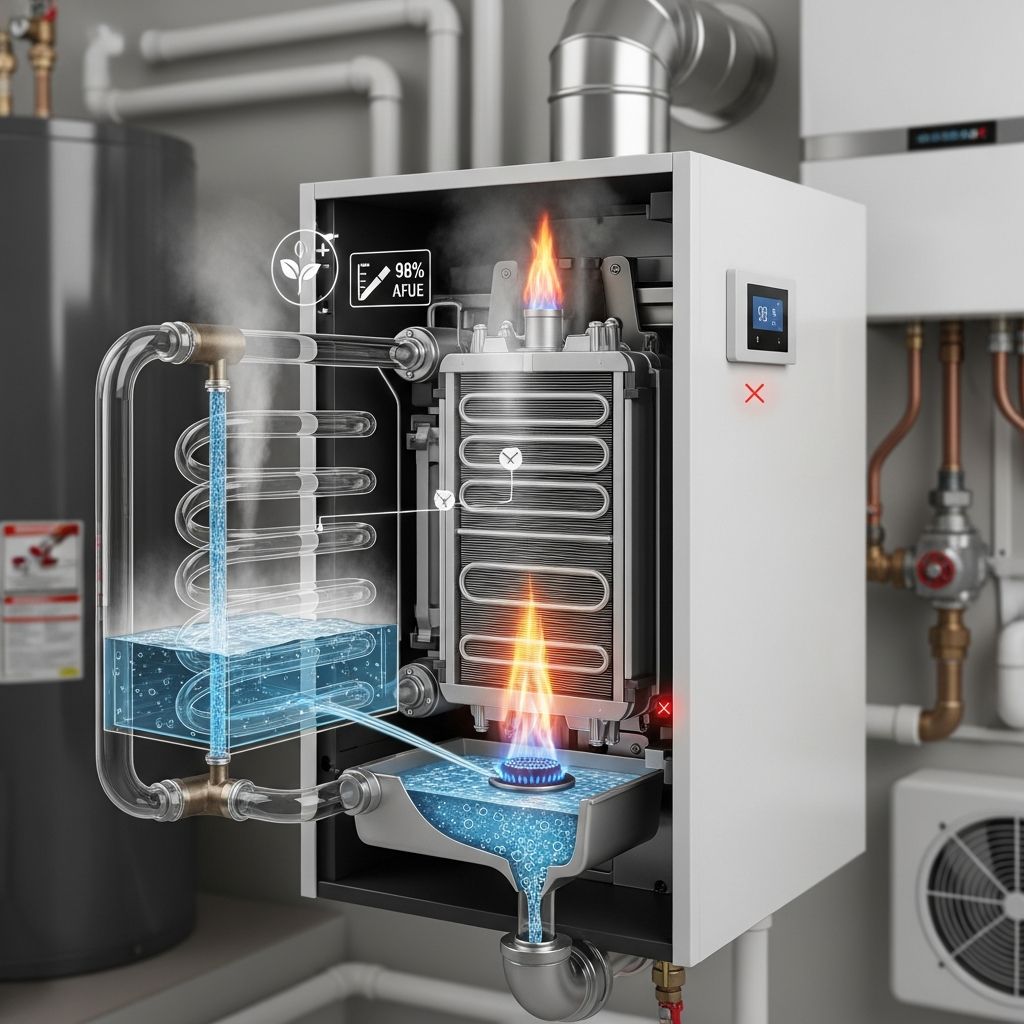
- Hot flue gases leaving the primary heat exchanger then pass through a secondary heat exchanger (the condensing section).
- Relatively cool return water from the heating system first flows through this secondary exchanger, preheating before it reaches the primary exchanger.
- As the flue gases are cooled below their dew point (around 54 °C / 130 °F), water vapor in the gas condenses to liquid.
- The phase change releases latent heat, roughly 970 Btu per pound of water condensed, which is transferred to the water in the secondary exchanger.
- The resulting condensate collects at the bottom of the exchanger and is drained away via a condensate line.
Because flue gases leave the boiler at much lower temperature than in a conventional boiler, less energy is wasted, and overall efficiency is higher.
Counter-Flow Heat Exchange
In many condensing boiler designs, flue gas and water move in opposite directions through the heat exchangers (counter-flow arrangement). Flue gas first enters the primary exchanger, while system water first enters the secondary condensing section. This pattern maximizes temperature differences locally and improves heat transfer, supporting higher efficiencies.
Key Components Involved in Condensing Operation
- Primary heat exchanger – handles the main load of heating the system water directly from burner combustion.
- Secondary (condensing) heat exchanger – recovers additional heat from cooling and condensing the flue gases.
- Modulating burner – adjusts output to match heating demand and maintain efficient combustion.
- Condensate drain and neutralizer – removes and treats acidic condensate, often with limestone or similar media.
- Non-corrosive materials – stainless steel or aluminum alloys are commonly used in heat exchangers exposed to condensate.
Efficiency of Condensing Boilers
The high efficiency of condensing boilers comes from recovering latent heat during condensation of water vapor in the flue gases.
Efficiency Gains
- By condensing the water vapor, a condensing boiler can improve efficiency by approximately 10–12 percentage points compared with a similar non-condensing model.
- Overall seasonal efficiencies can exceed 90% when measured on a higher heating value (HHV) basis and even higher on a lower heating value (LHV) basis, depending on standards and operating conditions.
- Even when operating at traditional higher water temperatures, a condensing boiler may still be 4–5% more efficient than a non-condensing boiler due to improved heat exchanger design and burner controls.
Effect of Return Water Temperature
The boiler’s ability to condense depends strongly on the return water temperature:
- Condensation occurs when the flue gas temperature falls below its dew point, roughly 54 °C (130 °F).
- Lower return water temperatures allow more condensation and therefore higher efficiency.
- The closer return water temperature gets to about 15–16 °C (around 60 °F), the higher the proportion of latent heat recovered and the greater the efficiency gain.
| Return Water Temperature | Condensation Level | Typical Boiler Efficiency |
|---|---|---|
| Above 60 °C (140 °F) | Minimal or no condensation | Only a few percent better than non-condensing |
| Around 54 °C (130 °F) | Condensation begins | Noticeable efficiency improvement |
| 40–45 °C (104–113 °F) | Moderate condensation | High efficiency, significant latent heat recovery |
| Near 15–20 °C (59–68 °F) | Strong condensation | Maximum practical efficiency gains |
Key Benefits of Condensing Boilers
Condensing boilers offer several important advantages when properly applied and operated within suitable conditions.
1. Higher Energy Efficiency
- Recovering latent heat from flue gases increases energy utilization and reduces fuel consumption.
- Improved burner modulation and advanced controls further enhance seasonal efficiency.
2. Lower Fuel Bills
- Higher efficiency translates directly into lower gas or oil usage for the same heat output.
- Over the life of the boiler, this can offset the higher initial cost of condensing technology in many applications.
3. Reduced Carbon Emissions
- Lower fuel consumption means less CO2 released for the same heating demand.
- Many regions encourage or mandate condensing boilers as part of decarbonization strategies.
4. Better System Flexibility
- Condensing boilers can operate efficiently across a wider range of water temperature differentials (Delta-T), such as 30–50 °F (17–28 °C).
- Higher Delta-T allows reduced flow rates, enabling smaller pumps, less pumping energy, and potentially smaller piping.
5. Compatibility with Low-Temperature Systems
- They are particularly well-suited to underfloor heating, low-temperature radiators, and other systems designed for cooler return water.
- Such systems can keep the boiler in condensing mode for much of the operating season, maximizing savings.
Limitations and Challenges
Despite their advantages, condensing boilers are not free of limitations, especially if installed or operated incorrectly.
1. Dependence on Return Water Temperature
- Efficiency gains are strongly dependent on keeping return water temperatures below the flue gas dew point.
- Systems originally designed for high-temperature radiators may not allow the boiler to condense much of the time if controls and emitters are not updated.
2. Condensate Management
- Condensing boilers produce acidic condensate that must be drained safely via a dedicated condensate pipe.
- Condensate is often routed through a neutralizer, typically containing limestone, to mitigate acidity before entering the drain system.
- Freezing risk in poorly insulated external condensate pipes can cause faults in cold climates if not properly designed.
3. Material and Corrosion Considerations
- Because internal surfaces are exposed to moisture and acidic condensate, heat exchangers must be made of non-corrosive materials such as stainless steel or specialized alloys.
- Poor water quality, lack of maintenance, or incorrect venting materials can reduce equipment life.
4. Higher Initial Cost
- Condensing boilers typically cost more upfront than comparable non-condensing models due to more complex heat exchangers and control systems.
- Economic payback depends on how often the boiler operates in condensing mode and local fuel prices.
5. Installation and Design Complexity
- Proper sizing, piping, venting, and control strategies are essential to realize the expected efficiency gains.
- In existing buildings, achieving low enough return water temperatures may require upgrades to distribution systems or controls.
System Design and Operating Conditions
Designing the heating system to support condensing operation is critical to getting the most from a condensing boiler.
Low Return Water Temperature Strategy
- System designers aim to keep return water below about 54 °C (130 °F) whenever possible.
- Using larger radiators, low-temperature emitters, or underfloor heating can allow lower supply and return temperatures.
- Weather-compensated controls that reduce boiler water temperature at milder outdoor temperatures help maintain condensing operation across the season.
Delta-T and Flow Management
- Increasing the temperature difference between supply and return (Delta-T) reduces the flow rate required to deliver a given heat output.
- Lower flow rates can reduce pump size, pump energy use, and system noise.
- Modern condensing systems may use control strategies such as minimum-flow bypass valves to protect boilers while taking advantage of variable flow to coils and zones.
Venting and Flue Materials
- Because flue gases are cooler and contain condensate, venting can often be done with corrosion-resistant plastic materials instead of metal.
- Flue routing must still comply with local codes, especially for termination locations and condensate management.
Condensing vs Non-Condensing Boilers
The table below summarizes key differences between condensing and traditional non-condensing boilers.
| Feature | Condensing Boiler | Non-Condensing Boiler |
|---|---|---|
| Heat Exchangers | Often two (primary and secondary) for added heat recovery | Usually one main heat exchanger |
| Use of Flue Gas Heat | Recovers both sensible and latent heat by condensing water vapor | Recovers mostly sensible heat; water vapor and latent heat are lost |
| Typical Efficiency Gain | About 10–12% higher than non-condensing under suitable conditions | Lower, often 70–85% depending on age and design |
| Condensate Production | Produces acidic condensate; requires drain and neutralization | Minimal condensate within boiler; no dedicated condensate drain |
| Flue Gas Temperature | Relatively low due to heat recovery | Higher; more heat lost through flue |
| Material Requirements | Corrosion-resistant materials for heat exchanger and flue | Less exposure to condensate; different material tolerances |
| Best Applications | Low-temperature systems with cool return water (e.g., underfloor heating) | High-temperature systems where efficiency upgrades are difficult |
Suitability and Typical Applications
Condensing boilers are widely used in both residential and commercial settings, but their true value depends on matching the boiler to the system and usage profile.
Ideal Situations for Condensing Boilers
- Homes and buildings with low-temperature radiant floor heating or oversized radiators designed for lower supply temperatures.
- Systems with long operating hours where small efficiency gains add up to significant annual savings.
- New construction projects where the heating system can be designed from scratch around condensing operation (low return temperature, proper emitters, controls, and flow strategies).
Situations Requiring Extra Care
- Retrofits of older systems sized for high-temperature operation (for example, 80/60 °C supply/return) where emitters may limit the ability to run at lower temperatures.
- Properties where routing a condensate drain to a suitable discharge point is difficult.
- Very intermittent use with fast warm-up expectations at high water temperatures, which may keep the boiler out of condensing mode much of the time.
Maintenance, Materials, and Longevity
Because condensing boilers operate with cooler flue gases, frequent condensation, and acidic condensate, proper materials and maintenance practices are important for long service life.
Materials and Construction
- Critical components in contact with flue gases and condensate are typically made of stainless steel or specially treated aluminum alloys to resist corrosion.
- Heat exchanger design is optimized for high turbulence and surface area, promoting effective heat transfer but requiring clean surfaces for best performance.
Maintenance Considerations
- Regular inspection and cleaning of heat exchangers help maintain efficiency and prevent corrosion or blockages.
- Condensate drains and neutralizers should be checked to ensure free flow and maintained neutralizing media.
- Burner and control systems should be tuned periodically for correct combustion, especially in modulating boilers.
Expected Service Life
- With appropriate materials, proper installation, and regular maintenance, condensing boilers can provide long service life comparable to modern high-quality non-condensing boilers.
- Failing to manage condensate correctly or neglecting maintenance can lead to early corrosion and reduced lifespan.
Frequently Asked Questions (FAQs)
Do condensing boilers always run at higher efficiency than non-condensing boilers?
Condensing boilers are at least as efficient than non-condensing boilers and can be significantly more efficient, particularly when return water temperatures are low enough to promote consistent condensation. In systems that always operate at very high temperatures, the efficiency advantage is smaller but still present due to better heat exchangers and controls.
What is the role of the secondary heat exchanger in a condensing boiler?
The secondary (condensing) heat exchanger captures additional heat from the flue gases after they leave the primary heat exchanger. As the gases cool below their dew point, water vapor condenses and releases latent heat, which is transferred to the return water flowing through the secondary exchanger, boosting overall efficiency.
Why is a condensate drain necessary?
When flue gases are cooled and water vapor condenses inside the boiler, liquid condensate is produced. This condensate is slightly acidic and must be drained safely, often through a small plastic pipe and sometimes through a neutralizer that reduces acidity before the water enters the building’s drainage system.
Can I retrofit an old heating system with a condensing boiler?
Yes, but the efficiency gains depend on how the system operates post-retrofit. If radiators and controls still require high supply and return temperatures, the boiler may not condense often, reducing the potential savings. Adjusting system design, using weather compensation, and possibly upgrading emitters can help achieve lower return temperatures and maximize benefits.
Are condensing boilers only for gas heating?
Most condensing boilers today are gas-fired, but condensing technology is also used with oil-fired boilers and in some large-scale hot water systems. The underlying principle of recovering latent heat from flue gases applies to any fuel that produces water vapor during combustion.
Conclusion
Condensing boilers represent an important evolution in boiler technology, capturing energy that older systems simply wasted up the flue. By condensing water vapor in the exhaust and reclaiming its latent heat, these boilers can achieve efficiencies roughly 10–12% higher than comparable non-condensing models under favorable operating conditions. Even when operated at more traditional temperatures, modern condensing designs and advanced controls usually offer modest efficiency gains over older equipment.
The true effectiveness of a condensing boiler depends on system design and operation. Low return water temperatures, appropriate emitters, thoughtful control strategies, and proper condensate handling are all critical to ensuring the boiler spends as much time as possible in condensing mode. When these conditions are met, the result is lower fuel use, reduced emissions, and often significant long-term cost savings.
At the same time, recognizing the technology’s limitations helps set realistic expectations. Condensing boilers are not a universal cure for every heating system, particularly where high operating temperatures cannot be avoided or where condensate management is impractical. Evaluating building needs, system characteristics, and design options provides the most reliable basis for deciding whether a condensing boiler is the right choice for a given application.
Similar Articles





Read full bio of medha deb