
Estimating Wine Refrigerator Energy Use and Its Impact on Household Electricity Bills
Learn how to calculate wine fridge energy consumption, interpret labels, and understand its real impact on your monthly electricity bill.
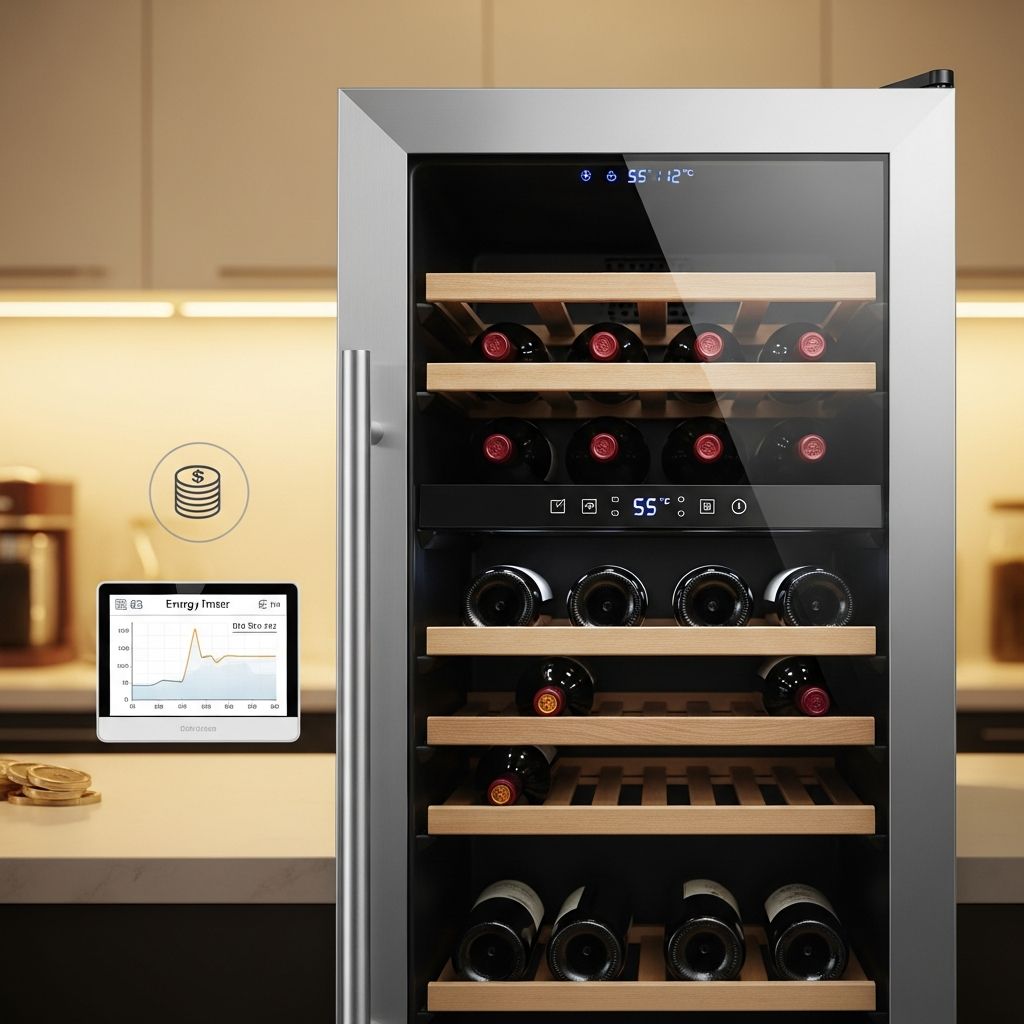
Wine refrigerators, or wine coolers, keep bottles at stable serving and aging temperatures, but they also add to household electricity use. To make an informed decision about owning or upgrading a wine fridge, it is important to understand how much energy it consumes, how to estimate operating costs, and what factors influence its impact on your monthly bill.
Table of Contents
- Overview: How Wine Refrigerators Use Energy
- Key Energy Metrics and Labels Explained
- How to Estimate Wine Refrigerator Energy Use
- Translating Energy Use into Household Electricity Costs
- Factors That Influence Wine Fridge Energy Consumption
- Worked Examples of Wine Refrigerator Costs
- Comparing Wine Refrigerators to Other Household Appliances
- Practical Ways to Reduce Wine Fridge Energy Use
- Environmental and Long-Term Cost Considerations
- Frequently Asked Questions (FAQs)
- Conclusion
Overview: How Wine Refrigerators Use Energy
Wine refrigerators are small, insulated cabinets equipped with a cooling system designed to keep wine at a stable temperature, typically between 45°F and 65°F (7°C to 18°C). Most household wine fridges use a compressor-based system similar to standard refrigerators, while some use thermoelectric modules, especially in compact or low-capacity units.
Like any refrigerator, a wine cooler cycles on and off: the compressor or thermoelectric unit turns on when the internal temperature rises above the set point, then shuts off after cooling the interior. This cycling means the appliance does not draw full rated wattage continuously, so estimating energy use requires understanding duty cycle and average running power, not just nameplate wattage.
Utility and energy calculators classify wine coolers as relatively low-to-moderate energy users compared with large kitchen fridges. For example, one residential energy estimator lists a typical wine cooler with an annual operating cost of around $25 at common electricity rates, significantly less than a full-size refrigerator.
Key Energy Metrics and Labels Explained
To estimate wine refrigerator energy use, it helps to know the main metrics found on labels and in manuals:
- Wattage (W): The rate at which the appliance uses power when the cooling system is running. Household fridges commonly use 100–400 watts; wine fridges, being smaller, often sit on the lower end of this range.
- Voltage (V) and Amperage (A): Multiply volts by amps and divide by 1000 to estimate kilowatts: (Amps × Volts) / 1000 = kW.
- Annual energy consumption (kWh/year): Many modern appliances carry a label stating annual kilowatt-hour use, such as 150 kWh/year. This already accounts for cycling and typical operating conditions, and is the most straightforward figure to use in cost calculations.
- Energy efficiency ratings: Depending on the region, labels may include efficiency classes or ENERGY STAR logos for certain refrigeration products, indicating lower-than-average consumption compared with similar models.
These values, combined with the number of hours the unit operates and your local electricity rate, allow you to estimate total energy use and cost using standard formulas.
How to Estimate Wine Refrigerator Energy Use
The U.S. Department of Energy provides a simple method to estimate appliance energy use and cost that applies directly to wine refrigerators.
1. Using Nameplate Wattage and Estimated Run Time
If you know the approximate wattage and typical hours per day the compressor runs, you can calculate daily and annual energy use.
According to general refrigeration guidance, residential refrigeration units may effectively run around 8 hours per day when cycling on and off under typical conditions. Wine coolers, being smaller and sometimes better insulated, may have a similar or slightly lower duty cycle, but 6–10 hours per day is a reasonable range for estimation.
The Department of Energy formula is:
- Daily kWh = (Wattage × Hours Used Per Day) ÷ 1000
- Annual kWh = Daily kWh × 365
- Annual Cost = Annual kWh × Electricity Rate (per kWh)
2. Using the Appliance’s Annual kWh Rating
Many modern refrigeration products provide a kWh/year figure directly on their label or product sheet. This is often the most accurate input, because it comes from standardized test procedures and already includes compressor cycling and typical operating conditions.
- Annual Cost = Labeled kWh/year × Electricity Rate
If you only have a yearly kWh rating and want to estimate average running wattage, you can work backwards similarly to refrigerator examples: annual kWh ÷ 365 ≈ daily kWh, and daily kWh × 1000 ÷ 24 ≈ average watts.
3. Using Real-World Measurement
For maximum accuracy, some homeowners plug the wine refrigerator into an energy monitoring device that logs kWh over days or weeks. This approach captures effects of room temperature, door openings, and temperature set points. The resulting daily kWh value can then be scaled to monthly or annual use using the same formulas provided by energy agencies.
Translating Energy Use into Household Electricity Costs
Once you have an estimate of the wine refrigerator’s kWh use, converting it into cost is straightforward.
The Department of Energy recommends multiplying annual kWh by your utility’s per-kWh rate. Many calculators default to $0.10 per kWh, but actual household rates often range higher or lower depending on location and tariff. To get an accurate figure, use the average price per kWh from your own bill.
For example, a residential energy estimator lists a representative wine cooler with an annual operating cost around $24.96, or roughly $2.08 per month, at a given electricity price. If your local rate is higher than the default used in such calculators, your actual cost will scale proportionally.
Because wine refrigerators are relatively small compared with full-size kitchen fridges, they generally represent a modest share of total household consumption. However, in homes with multiple separate refrigeration units—kitchen fridge, garage fridge, freezer, and wine cooler—the combined contribution can become meaningful, especially in regions with high electricity prices.
Factors That Influence Wine Fridge Energy Consumption
Earlier guidance for refrigerators and calculators identifies several factors that also apply to wine coolers and impact their power consumption and cost.
- Size and capacity – Larger cabinets with more internal volume generally require more energy to cool, just as larger refrigerators do.
- Location and ambient temperature – Placing a cooler in a hot kitchen, near ovens, or in an unconditioned garage can increase compressor run time. Some guidance suggests that refrigeration units in very warm spaces can run almost twice as long daily.
- Age and efficiency – Newer refrigeration products often use more efficient compressors, better insulation, and improved controls. For standard refrigerators, advances over recent decades have substantially reduced typical energy use; similar efficiency trends benefit wine fridges as they adopt newer components.
- Temperature set point – Colder settings require more work from the cooling system. Setting a dual-zone wine fridge unnecessarily low in one or both zones can increase consumption.
- Door openings and usage patterns – Frequent door openings let in warm air; the cooling system then must remove that heat, increasing run time. This effect is widely acknowledged in refrigeration and cooling calculators.
- Insulation and door seals – Poor insulation or worn gaskets allow warm air infiltration and cold air loss, leading to more frequent cycling and higher energy use.
- Lighting and internal equipment – Internal lights, fans, or electronic displays add small but real heat loads. While minor individually, they contribute to overall consumption, especially if lights remain on for long periods.
Worked Examples of Wine Refrigerator Costs
The following examples illustrate the methods and approximate magnitudes of energy use and cost, using standard formulas from the Department of Energy and refrigerator calculators.
Example 1: Small Thermoelectric Wine Cooler
- Approximate running wattage: 70 W (compressor-equivalent average; actual thermoelectric models may vary)
- Estimated run time: 8 hours per day (cycling on and off)
- Electricity rate: $0.15 per kWh
Daily kWh = (70 W × 8 hours) ÷ 1000 = 0.56 kWh/day.
Annual kWh = 0.56 × 365 ≈ 204.4 kWh/year.
Annual cost = 204.4 × $0.15 ≈ $30.66/year, or about $2.55/month.
This is broadly consistent with residential tools that estimate wine cooler operation at a few dollars per month under typical conditions.
Example 2: Medium Dual-Zone Compressor Wine Refrigerator with Label
- Labeled annual energy use: 180 kWh/year
- Electricity rate: $0.20 per kWh
Annual cost = 180 × $0.20 = $36/year, or $3/month.
Average daily use = 180 ÷ 365 ≈ 0.49 kWh/day. The equivalent average wattage over 24 hours would be about 20 W, which reflects cycling rather than constant full power.
Example 3: Warmer Location Scenario
Using the same cooler as in Example 2, but placed in a warm garage where it effectively runs almost twice as many hours per day—a pattern described for some refrigeration units in hot environments.
- Assume effective energy use doubles: 180 kWh/year × 2 = 360 kWh/year
- Electricity rate: $0.20 per kWh
Annual cost = 360 × $0.20 = $72/year, or $6/month.
The energy use remains modest in absolute terms, but the cost relative to a more efficient placement is significantly higher, underlining how location and ambient temperature affect operating costs.
Comparing Wine Refrigerators to Other Household Appliances
To understand the impact of a wine fridge in context, it helps to compare approximate costs to other appliances using energy calculators and typical estimates.
| Appliance | Typical Annual kWh | Approx. Annual Cost at $0.15/kWh | Relative Impact |
|---|---|---|---|
| Wine refrigerator (small to medium) | 150–250 kWh (estimated range) | $22.50–$37.50 | Low to moderate |
| Full-size kitchen refrigerator | 400–700 kWh (modern models; older can be higher) | $60–$105 | Moderate to significant |
| Second fridge / freezer in garage | Can be substantially higher in hot climates | Often exceeds primary fridge cost | Significant |
| Electric water heater | High (often thousands of kWh/year, depending on size and use) | One of the largest loads | Very significant |
| Television or electronics | Varies widely with size and usage | Often comparable or lower than wine fridge if used moderately | Low to moderate |
These comparisons show that while a wine fridge is not usually the largest consumer in a home, it is a continuous load that runs every day, unlike many intermittent appliances. For energy-conscious households, understanding and managing even modest continuous loads can be important, especially when combined with other refrigeration devices.
Practical Ways to Reduce Wine Fridge Energy Use
General energy-saving strategies for refrigerators translate directly to wine coolers and are echoed in guidance from energy agencies and efficiency programs.
- Choose an efficient model – When buying or replacing a wine fridge, compare labeled kWh/year and efficiency ratings. Products with lower annual kWh will cost less to operate over their lifetime.
- Right-size the unit – Avoid significantly oversizing. Larger units tend to use more energy simply because they cool a greater volume.
- Place it in a cooler location – Avoid garages, direct sunlight, or next to ovens and dishwashers. Cooler ambient temperatures reduce run time and energy use, a factor highlighted in refrigerator cost analyses.
- Set an appropriate temperature – Use temperature ranges suitable for wine rather than extremely low settings. For many wines, 50°F–60°F is adequate, reducing the cooling load compared with colder settings.
- Limit door openings – Group bottle retrieval and storage tasks to minimize how often the door is opened, reducing warm air infiltration.
- Maintain seals and insulation – Periodically inspect door gaskets for cracks or gaps and replace if worn, just as recommended for standard refrigerators to prevent energy waste.
- Allow air circulation – Follow manufacturer guidelines for clearance around the unit so heat from the condenser can dissipate efficiently.
- Monitor and verify consumption – If electricity use is a concern, periodically measure the unit’s kWh over time with an energy monitor and compare it with calculated expectations.
Environmental and Long-Term Cost Considerations
Beyond immediate utility bills, energy calculators emphasize that annual kWh is also a proxy for environmental impact, because it can be translated into greenhouse gas emissions based on the electricity generation mix.
Some commercial refrigeration tools explicitly tie lifetime kWh savings to emission reductions and financial benefits. While these tools typically target larger systems, the same principles apply at a residential scale: lower kWh use in your wine refrigerator reduces both long-term operating costs and associated emissions from electricity generation.
When deciding whether to add a wine fridge or upgrade an existing model, it is helpful to consider:
- Upfront purchase price versus long-term energy cost.
- Expected service life of the appliance.
- Opportunities to offset added consumption through efficiency improvements elsewhere in the home.
- Local electricity carbon intensity, which determines the environmental weight of each kWh used.
Frequently Asked Questions (FAQs)
Q1: How much does it typically cost per month to run a wine refrigerator?
Many calculators and sample estimates suggest that a typical household wine refrigerator often costs only a few dollars per month to operate, with one representative figure around $2 per month under moderate electricity rates and conditions. Actual cost depends on your model’s kWh/year and local electricity price.
Q2: Is a wine fridge a major contributor to my electricity bill?
Compared to large loads such as water heaters, electric heating and cooling, and full-size kitchen refrigerators, a wine fridge is generally a small to moderate contributor. However, in homes with several always-on refrigeration units, the combined impact can be noticeable.
Q3: How can I find my wine refrigerator’s energy use if there is no label?
You can estimate energy use by finding the wattage (from the manual or nameplate), estimating average run time per day, and then using the Department of Energy formula to compute daily and annual kWh. For higher accuracy, you can measure consumption with a plug-in energy monitor over several days.
Q4: Are thermoelectric wine coolers more efficient than compressor models?
Thermoelectric units are often quieter and vibration-free, which is beneficial for wine storage, but their efficiency strongly depends on ambient temperature and design. Compressor-based coolers generally achieve better energy performance for larger capacities and warmer environments, similar to general refrigeration trends, although specific kWh/year labels provide the best comparison.
Q5: Does filling or emptying the wine fridge affect energy use?
As with standard refrigerators, having a reasonably stocked interior can help stabilize temperatures, because bottles provide thermal mass. However, the dominant factors remain ambient temperature, door openings, and set point. Overfilling to the point that air cannot circulate properly can reduce efficiency.
Conclusion
Estimating the energy use of a wine refrigerator is largely a matter of applying well-established appliance energy formulas to a specific type of refrigeration device. Whether you rely on labeled kWh/year, use wattage and run-time approximations, or measure consumption directly, the core steps are the same: determine kWh, multiply by your local electricity rate, and compare the result with other loads in your home.
Research on refrigerators, energy calculators, and efficiency guidance consistently shows that wine fridges are not among the very highest household energy consumers, but they are continuous loads whose impact grows with higher ambient temperatures, inefficient placement, and older technology. By understanding the underlying drivers of consumption—size, efficiency, temperature settings, and environment—you can interpret labels intelligently, choose models and locations that minimize waste, and keep the added cost to a modest share of your overall electricity bill.
A thoughtful approach involves treating the wine refrigerator within the broader context of household energy management: balancing comfort and enjoyment with practical steps to reduce unnecessary consumption, from selecting an efficient unit to maintaining it properly over its lifetime.
Similar Articles






Read full bio of medha deb