Safe Handling, Storage, and Re-Freezing of Homemade Ice Cream from Home Makers
Learn how to safely handle, store, and re-freeze homemade ice cream from a home ice cream maker while preserving texture and flavor.
Handling, Storing, and Re-Freezing Homemade Ice Cream Made in a Home Ice Cream Maker
Homemade ice cream is one of the biggest rewards of owning a home ice cream maker, but its quality and safety depend heavily on how you handle, store, and re-freeze it after churning. Unlike commercial ice cream, homemade batches usually contain fewer stabilizers and emulsifiers, so they can lose creaminess and develop ice crystals more quickly if not treated properly. This guide explains best practices from churning to long-term storage, including when it is safe to re-freeze and how to keep your ice cream smooth for as long as possible.
Table of Contents
- Understanding Homemade Ice Cream and Why Storage Matters
- Handling Freshly Churned Ice Cream
- Choosing Containers and Packing Ice Cream Correctly
- Freezer Temperature and Placement
- Short-Term vs. Long-Term Storage
- Re-Freezing Homemade Ice Cream Safely
- Maintaining Texture and Flavor Over Time
- Food Safety Considerations
- Troubleshooting: Common Problems and Fixes
- Frequently Asked Questions (FAQs)
- Conclusion
Understanding Homemade Ice Cream and Why Storage Matters
Homemade ice cream typically contains a simple mixture of cream, milk, sugar, and flavorings, sometimes with egg yolks in custard-style bases. Because home recipes usually skip the stabilizers, gums, and advanced processing used in commercial plants, your ice cream is more sensitive to:
- Temperature fluctuations in the freezer
- Exposure to air, leading to ice crystals and freezer burn
- Repeated softening and re-freezing, which coarsens ice crystals
- Microbial growth if the ice cream melts too much before re-freezing
Proper handling from the moment churning finishes helps reduce these risks, lengthens shelf life, and keeps the texture smooth and scoopable.
Handling Freshly Churned Ice Cream
The period immediately after the ice cream leaves the machine is critical. At this stage it is usually at a soft-serve consistency and only partially frozen.
Step-by-Step Handling Right After Churning
- Work quickly: Have your containers pre-chilled in the freezer before you start churning so you can transfer the ice cream immediately.
- Avoid extra warming: Do not leave the churned ice cream sitting in the machine at room temperature. Prolonged standing encourages melting and larger ice crystals to form later.
- Use clean utensils: Scoop with clean, cold spatulas or spoons to reduce contamination and limit melting.
- Minimize stirring: Gently transfer rather than aggressively stirring; overworking can knock out air and make the finished ice cream dense.
Quick Hardening After Churning
Once transferred to containers, the goal is to harden the ice cream as fast as possible to limit crystal growth.
- Place the containers in the coldest part of the freezer, usually the back or bottom shelf.
- Arrange them so that cold air can circulate; avoid stacking large warm containers tightly together.
- Allow several hours for the ice cream to firm up fully before serving large scoops or transporting.
Choosing Containers and Packing Ice Cream Correctly
The right container and packing method make a major difference in texture and shelf life.
Best Containers for Homemade Ice Cream
- Freezer-safe, airtight containers: Use plastic or metal containers made for freezing food to reduce air exchange and moisture loss.
- Shallow, flat containers: Many home cooks prefer low rectangular containers because they promote faster freezing and easier scooping.
- Opaque or dark containers: These can reduce light exposure that may gradually affect flavor and fat quality.
- Avoid thin cardboard: Cardboard or paper cartons absorb odors and are more prone to freezer burn and leaks.
Packing Technique to Minimize Ice Crystals
- Fill containers almost to the top: Leave only a small headspace so less air is trapped over the surface.
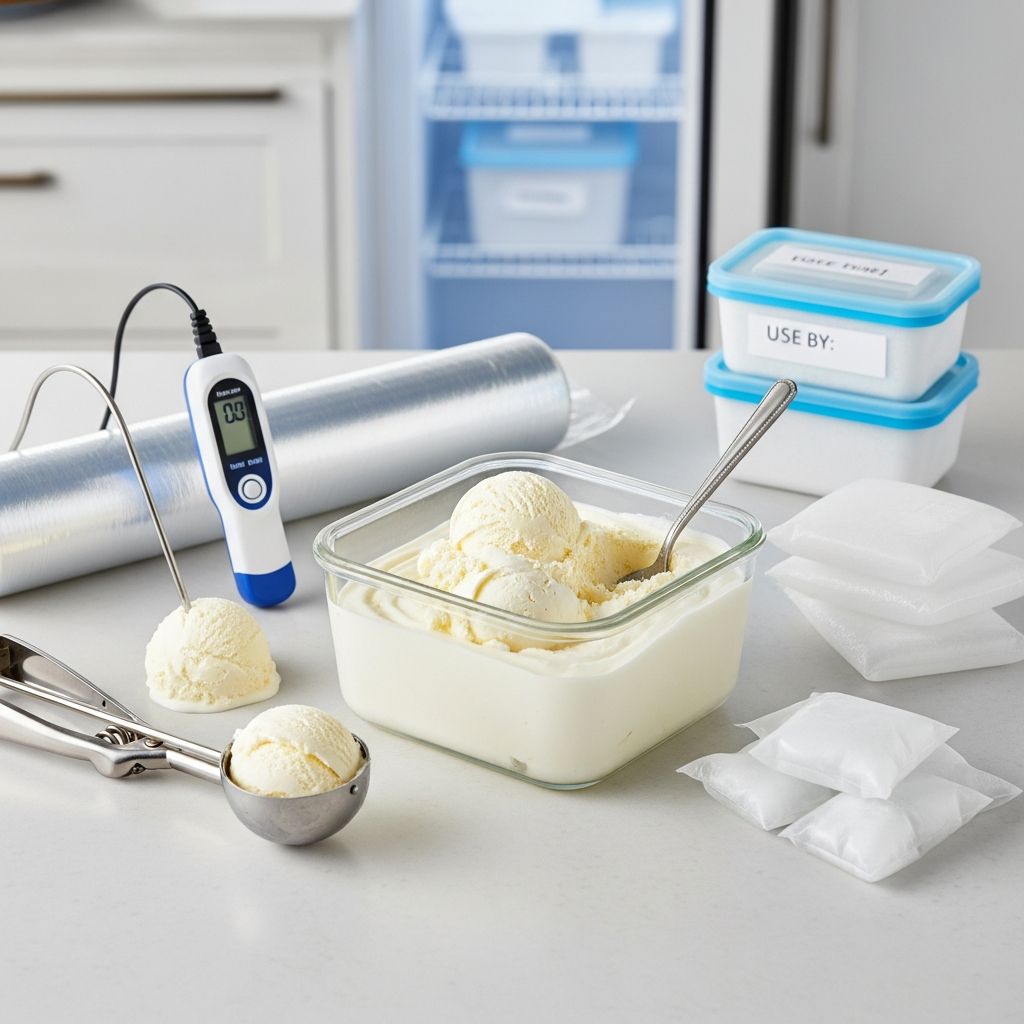
- Press a barrier onto the surface: Lay plastic wrap, parchment, or wax paper directly on the ice cream before sealing the lid to reduce contact with air.
- Seal tightly: Ensure the lid snaps or screws on firmly to prevent air leaks and odor transfer.
- Label and date: Mark the flavor and preparation date so you can track freshness and rotation.
Freezer Temperature and Placement
Temperature control is crucial. Ice cream quality declines fastest when storage temperature is too warm or fluctuates frequently.
Recommended Freezer Temperatures
- 0°F / -18°C or colder: This is widely recommended as a safe, general storage temperature for ice cream.
- -18°C to -20°C (0°F to -4°F): Helps preserve texture and flavor for several weeks, slowing ice crystal growth.
- Colder for very long storage: Commercial research shows that storage around -25°C (-13°F) or below further slows crystal growth and can extend shelf life, though most home freezers cannot reach these levels.
Best Placement in the Freezer
- Back or bottom shelf: Store ice cream away from the door, where temperatures stay more stable.
- Avoid the door racks: The door area warms slightly each time it is opened, encouraging partial thawing and refreezing.
- Minimize door openings: Frequent access causes small temperature swings that gradually damage texture.
Short-Term vs. Long-Term Storage
Homemade ice cream rarely lasts as long as commercial versions, but with careful storage you can still enjoy good quality for weeks.
Short-Term Storage (Up to 1–2 Weeks)
- Store at or below 0°F / -18°C in airtight containers.
- Open the container briefly and return it to the freezer quickly after each use.
- Expect texture similar to when it was first hardened, with minimal iciness if handled gently.
Medium to Long-Term Storage (2–8+ Weeks)
- Keep the ice cream in the coldest, most stable zone of the freezer.
- For longer storage, some experts suggest placing containers inside a larger freezer bag or wrapping them with freezer paper to reduce air exposure.
- Over time, even at good temperatures, expect gradual changes in texture, more ice crystals, and some flavor dulling.
Recognizing Quality Loss
- Excessive ice crystals on the surface or throughout the container.
- Dry, sandy, or crumbly texture instead of smooth and creamy.
- Off-odors or off-flavors from absorbing freezer smells or from oxidation of fats.
Re-Freezing Homemade Ice Cream Safely
Re-freezing homemade ice cream is sometimes necessary, but must be done with food safety and quality in mind. The key factor is how much the ice cream has warmed or melted and for how long.
When Re-Freezing is Generally Safe
Re-freezing is usually acceptable when:
- The ice cream has only slightly softened but remained below refrigerator temperature (below about 40°F / 4°C).
- The time spent out of the freezer was short (typically under 1 hour) and the ice cream was kept cold, such as on ice.
- You have not allowed it to fully melt into a liquid, especially if it contains eggs or dairy.
Even when it is safe, each cycle of softening and re-freezing will create larger crystals and a coarser texture, so limit this as much as possible.
When You Should Not Re-Freeze
For safety and quality, do not re-freeze if:
- The ice cream has completely melted and sat at room temperature.
- It has been out of the freezer for more than about 2 hours in the temperature “danger zone” (above 40°F / 4°C).
- It shows signs of separation, curdling, or sour smell, which can indicate bacterial growth or spoilage.
- The recipe contains raw eggs and has been allowed to warm significantly, increasing food safety risk.
How to Re-Freeze with the Least Quality Loss
- Cool quickly: If the ice cream has only softened, return it to the coldest area of the freezer immediately.
- Avoid stirring too much: Stirring a softened batch can knock out remaining air and worsen iciness; only smooth the top lightly if needed.
- Use smaller containers: Divide a softened batch into smaller, shallow containers to speed refreezing.
- Label the container: Note that it has been re-frozen and plan to consume it sooner, as quality declines faster.
Maintaining Texture and Flavor Over Time
Beyond basic safety, your goal is to keep ice cream creamy and flavorful for as long as possible. This requires controlling moisture migration, air content, and exposure to odors.
Preventing Ice Crystal Growth
- Freeze and store cold: Keep storage temperatures steady at or below 0°F / -18°C. Colder temperatures slow crystal growth.
- Avoid temperature swings: Repeated softening and re-freezing is the main cause of coarse, icy texture.
- Use surface barriers: Plastic wrap pressed directly on the ice cream helps limit moisture transfer and evaporation.
Preserving Flavor
- Limit air and light exposure: Airtight, opaque containers help keep flavors from oxidizing or fading.
- Keep away from strong-smelling foods: Ice cream easily absorbs odors from garlic, onions, and other pungent items if containers are not fully sealed.
- Enjoy within a few weeks: For peak flavor, most homemade ice creams are best eaten within 2–4 weeks of churning.
Portioning for Better Quality
- Store large batches in multiple small containers so you only open what you will actually eat.
- For frequent snacking, dedicate a smaller container as the “daily use” tub and keep the rest sealed.
- When scooping, warm the scoop, not the ice cream—dip in warm water rather than letting the ice cream sit out.
Food Safety Considerations
While freezing slows microbial growth dramatically, it does not kill all bacteria. Safe handling practices are especially important for homemade ice cream made with eggs, fresh fruit, or add-ins with limited shelf life.
Key Safety Guidelines
- Cook egg-based custards: If your recipe uses egg yolks, heat the base to a safe temperature (often around 160°F / 71°C) before chilling and churning.
- Chill the base quickly: After cooking, cool the mixture in an ice bath and refrigerate until thoroughly chilled before churning.
- Use pasteurized dairy: Choose pasteurized milk and cream to reduce risk of pathogens.
- Handle add-ins safely: Bake cookie dough, toast nuts, and wash or cook fruits when needed before mixing in.
Storage Time and Safety
- Properly stored homemade ice cream can remain safe for several weeks at constant freezing temperatures, though quality gradually declines.
- If you notice mold, sourness, strange colors, or strong off-odors, discard the ice cream.
- Never taste ice cream that has fully melted and been re-frozen; when in doubt, throw it out.
Troubleshooting: Common Problems and Fixes
The table below summarizes frequent storage and handling issues with homemade ice cream and practical ways to address them.
| Problem | Likely Cause | How to Fix or Prevent |
|---|---|---|
| Icy, crunchy texture | Slow freezing, temperature fluctuations, or repeated softening and re-freezing | Harden quickly after churning, store at or below 0°F / -18°C, keep containers in the coldest part of the freezer, avoid leaving the tub out while serving |
| Freezer burn on the surface | Exposure to air and evaporation over time | Use airtight containers, press plastic wrap or parchment directly on top, keep lids tightly sealed, consider over-wrapping containers for long storage |
| Absorbing freezer odors | Porous containers or poor seals near strong-smelling foods | Use high-quality freezer containers, keep ice cream away from aromatic foods, and ensure containers are fully closed |
| Rock-hard ice cream | Very low freezer temperature, high fat or low sugar formulas, or lack of stabilizers | Let the container sit in the refrigerator for 10–15 minutes before serving, or warm the scoop in hot water to avoid leaving the tub out at room temperature |
| Sour or off-flavors | Old dairy, long storage, or microbial spoilage | Use fresh ingredients, date containers, rotate older ice cream to the front, and discard any batch with unpleasant smells or taste |
Frequently Asked Questions (FAQs)
How long does homemade ice cream last in the freezer?
With proper storage at or below 0°F / -18°C in airtight containers, most homemade ice cream maintains good quality for about 2–4 weeks. It may remain safe for longer if kept continuously frozen, but texture and flavor gradually degrade, especially after several weeks.
Is it safe to eat homemade ice cream that has melted and been re-frozen?
If the ice cream has completely melted and stayed at room temperature or in the refrigerator for more than about 2 hours, it is safest to discard it rather than re-freeze. Bacteria can grow while it is warm, and freezing again does not reliably kill them. In addition, the texture will likely become very icy and unpleasant.
Can I re-freeze ice cream that only softened during a car ride?
If the ice cream remained cold and only partially softened during transport, and the total time out of the freezer was short, you can typically re-freeze it. Return it immediately to the coldest part of your freezer and expect a slight decline in smoothness. Avoid repeating this cycle multiple times.
Why does homemade ice cream get icy faster than store-bought?
Commercial ice cream is produced with specialized equipment that creates very small ice crystals and often includes stabilizers and emulsifiers that slow crystal growth and help maintain a creamy texture. Homemade ice cream lacks most of these aids, so it is more sensitive to slow freezing and temperature swings in a home freezer.
What type of container is best for storing homemade ice cream?
The ideal container is freezer-safe, airtight, and relatively shallow. Rectangular plastic or metal containers specifically designed for freezing work well. Avoid thin, disposable containers or cardboard cartons that allow air and odors to move in and out more easily.
How can I scoop ice cream without letting it melt too much?
Instead of leaving the container at room temperature, briefly move it to the refrigerator for 10–15 minutes before scooping, or use a sturdy metal scoop dipped in hot water between scoops. Return the container to the freezer as soon as you have what you need.
Conclusion
Handling, storing, and re-freezing homemade ice cream from a home ice cream maker calls for a balance of food safety, texture preservation, and flavor care. Immediate, clean transfer from the machine to airtight containers, followed by rapid hardening in the coldest part of the freezer, sets the base for good quality. From there, consistent low temperatures, minimal air exposure, and careful scooping habits help maintain creaminess.
Re-freezing is sometimes unavoidable, but limiting how often the ice cream softens and re-freezes will protect both safety and texture. When you are uncertain how long a batch has been warm, it is safer to discard it than to risk foodborne illness. By understanding how temperature, air, and time affect your homemade ice cream, you can make informed decisions at every step—from the churn to the last scoop.
Similar Articles






Read full bio of medha deb