
How Air Fryers Work: A Plain-English Guide to the Technology Inside
Understand the simple science, internal parts, and cooking process that make modern air fryers crisp food with minimal oil.
How Air Fryers Work: A Plain-English Guide to the Technology Behind Them
Air fryers promise crispy fries, wings, and snacks with far less oil than deep frying. To understand how they really work, you need to look at the science of heat transfer, the internal parts of the appliance, and what happens to your food while it cooks.
This guide breaks down the technology in simple language, shows how air fryers differ from regular ovens and deep fryers, and gives practical tips to use that science to your advantage in the kitchen.
Table of Contents
- What Exactly Is an Air Fryer?
- The Core Technology: Heat, Airflow, and Rapid Air
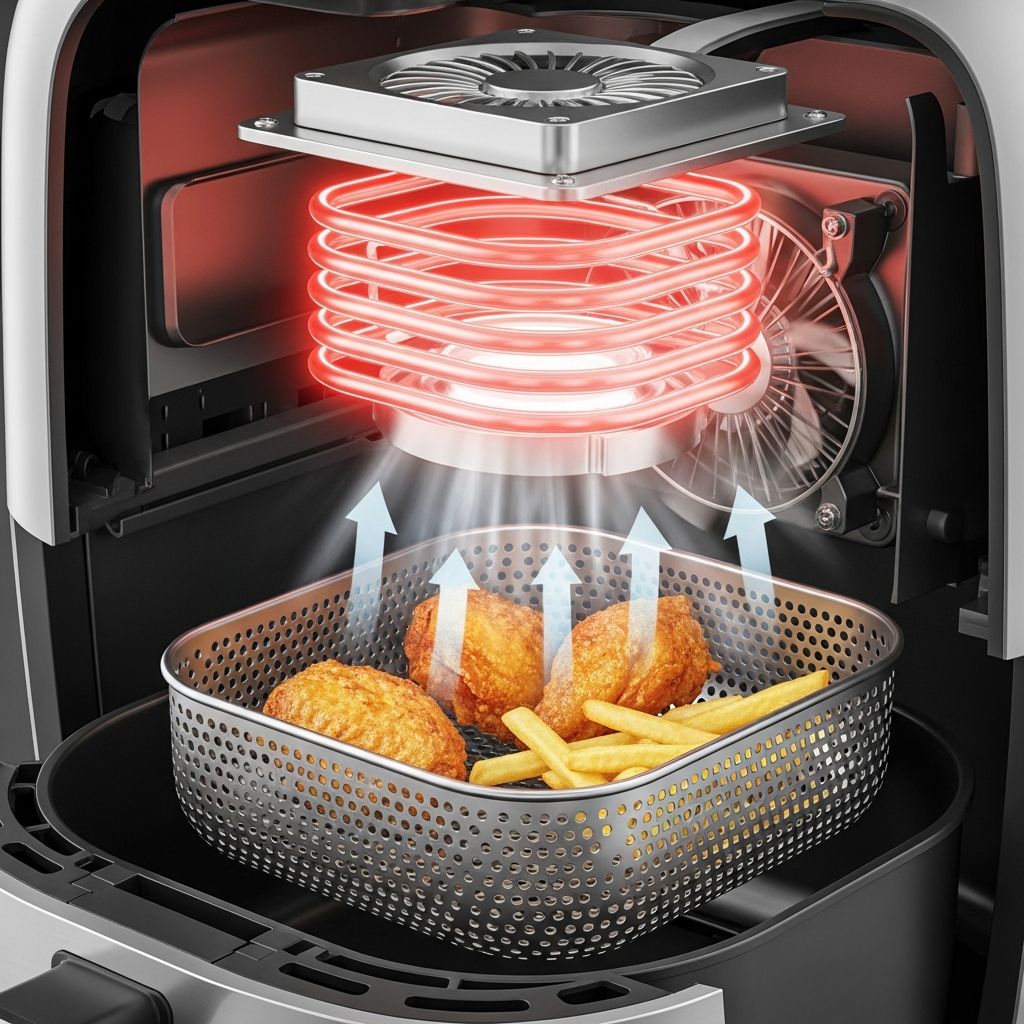
- Inside an Air Fryer: Key Components
- Step-by-Step: What Happens When You Air Fry Food
- Air Frying vs. Deep Frying
- Air Fryers vs. Convection Ovens
- The Science of Crispy: Maillard Reaction and Texture
- What Air Fryers Do Well (and Where They Struggle)
- Safety, Energy Use, and Maintenance
- Choosing and Using an Air Fryer Wisely
- Frequently Asked Questions (FAQs)
- Conclusion
What Exactly Is an Air Fryer?
Despite the name, an air fryer does not truly fry food in the traditional sense. It is best described as a compact, high-powered mini convection oven that sits on your countertop.
Instead of submerging food in hot oil, an air fryer uses:
- A powerful electric heating element to create high heat.
- A strong fan to rapidly blow that hot air around your food.
- A basket or tray with holes so air can reach all sides of the food.
This fast-moving hot air crisps the outside of your food and cooks the inside, giving you a result that looks and tastes similar to shallow or deep-fried food, but usually with much less oil.
The Core Technology: Heat, Airflow, and “Rapid Air”
Air fryers rely on a mix of common heat transfer methods used in cooking: radiation and convection.
Radiant heat from the heating element
At the top of most air fryers sits a metal heating coil, similar to what you might see in an electric oven or toaster.
- This coil gets very hot when electricity passes through it.
- It releases heat in the form of thermal radiation, which travels directly to the food surface.
Some models also use far-infrared radiation, which can penetrate a bit deeper into the food and speed up internal heating.
Convection: Fast-moving hot air
The second key piece is forced convection.
- A fan pulls air past the heating element, warming it up.
- That hot air is then blown quickly around and through the food in the basket.
- Because the cooking chamber is small, the air heats up and recirculates very efficiently.
Manufacturers often call this setup Rapid Air Technology or use similar marketing names, but the basic idea is simply strong airflow plus radiant heat in a compact space.
Why speed of airflow matters
Compared to liquid oil, air carries much less heat per unit of volume, so to get similar browning and crisping, the air must be moved very quickly.
- Fast air removes moisture from the surface of food, helping it dry and crisp.
- It also constantly brings hotter air into contact with cooler food, keeping the cooking rate high.
Inside an Air Fryer: Key Components
Most basket-style air fryers share a similar internal layout, even if they look different on the outside.
| Component | What It Does | Why It Matters |
|---|---|---|
| Heating element | Electric metal coil near the top that gets very hot. | Provides radiant heat and warms the air that the fan circulates. |
| Fan | High-speed fan just above or behind the heating element. | Drives convection, pushing hot air rapidly around food for even cooking. |
| Cooking chamber | Compact insulated cavity that houses basket or tray. | Small volume makes heating faster and more energy-efficient. |
| Basket or perforated tray | Pull-out drawer with mesh or holes for food placement. | Lets hot air reach the bottom and sides of food, mimicking immersion in oil. |
| Drip tray / fat collector | Solid tray beneath basket to catch fat and crumbs. | Keeps food from sitting in rendered fat and simplifies cleaning. |
| Controls and thermostat | Knobs or digital panel with temperature and timer; internal sensor. | Regulates heat, avoids overheating, and gives relatively consistent results. |
Some brands engineer special shapes in the base of the chamber (for example, a star-shaped pattern) to guide the airflow so that every part of the food gets similar heat.
Step-by-Step: What Happens When You Air Fry Food
From the moment you press “start” to the moment your food comes out crispy, several stages of heating and moisture transfer take place.
1. Preheating and airflow setup
- You set the temperature and time on the controls.
- The heating element turns on and begins to radiate heat.
- The fan kicks in, pulling room-temperature air past the heating element, then pushing it into the cooking chamber.
- Because the chamber is small, it reaches the target temperature quickly, sometimes with little or no preheat time.
2. Heat transfer to the food
Once your food is in the basket and the air fryer is running, three processes work together:
- Radiation from the heating element warms the top and exposed surfaces directly.
- Convection from moving hot air heats all sides and flows through openings in the basket.
- Conduction inside the food itself moves heat from the surface into the center.
3. Moisture loss and crust formation
As the surface of your food heats up:
- Water at the surface warms to boiling and turns to steam.
- Fast-moving hot air sweeps that steam away, drying the outer layer.
- A dry, hot surface allows browning reactions to occur, which improve flavor and color.
This is the same basic principle that makes roast potatoes or baked chicken skin crisp in a regular oven, but the process is faster and more intense in an air fryer because the air volume is small and the airflow is strong.
4. Maillard reaction and browning
Above roughly 140–165°C (about 285–330°F), the Maillard reaction starts to kick in.
- This is a series of chemical reactions between amino acids (from proteins) and sugars in the food.
- It creates hundreds of flavorful compounds and turns the exterior golden to brown.
- In air frying, a small amount of oil on the surface can help transfer heat and promote more even browning.
5. Fat rendering and drainage
For fatty foods like chicken wings or sausages:
- Heat melts some of the internal fat, which drips through the basket holes.
- This fat collects in the drip tray below, instead of being reabsorbed by the food as in shallow frying.
- The result is often a lower fat content compared to pan or deep frying, while still tasting rich.
6. Shaking or turning for even cooking
Because food pieces can block airflow and shadow one another, most manufacturers recommend:
- Shaking the basket partway through cooking.
- Turning or flipping larger items once during the cycle.
This exposes new surfaces to the hottest air stream and helps avoid pale spots or uneven crisping.
Air Frying vs. Deep Frying
Air fryers are often sold as a healthier replacement for deep fryers. From a technical standpoint, the main difference is the medium that carries the heat.
- Deep frying: food is submerged in liquid oil, which has a high heat capacity and transfers heat quickly, creating intense bubbling and a very crisp exterior.
- Air frying: food is surrounded by hot air, which holds less energy, so strong airflow is needed to get similar crisping.
Some key comparisons:
| Aspect | Air Fryer | Deep Fryer |
|---|---|---|
| Heating medium | Air moved by fan | Hot oil (usually 160–190°C) |
| Oil usage | Very small amount or spray on food | Large volume of oil bath |
| Texture | Crispy, often slightly drier crust | Very crisp, sometimes thicker, richer crust |
| Preheat time | Short, due to compact chamber | Longer; oil must heat fully |
| Cleanup | Basket and tray wash; no large oil disposal | Used oil must be cooled, filtered, and discarded |
Wet, flowing batters that work well in deep oil often perform poorly in an air fryer because the batter can drip through the basket before it sets. Instead, thicker coatings, dry breading, or par-cooked batters tend to work better.
Air Fryers vs. Convection Ovens
Air fryers and convection ovens are based on the same core idea: use a fan to blow hot air around the food.
The main differences are:
- Size of the chamber: Air fryers have a much smaller cooking space than a full-size oven, so they heat up faster and use less energy for small portions.
- Airflow intensity: The fan in an air fryer is typically more powerful relative to the chamber size, so the air moves faster around the food.
- Basket design: Air fryer baskets are specifically engineered with perforations and channels to let air hit all sides, including the underside.
Because of these features, many people find that air fryers brown and crisp foods more efficiently than a regular oven, especially for small batches like a single piece of pizza or a handful of fries.
The Science of Crispy: Maillard Reaction and Texture
The appealing golden-brown color and toasty flavor of air-fried foods comes mainly from the Maillard reaction and, to a lesser extent, caramelization.
- The Maillard reaction needs heat, low surface moisture, and the presence of amino acids and sugars.
- Air fryers promote this reaction by quickly drying the surface and keeping temperatures fairly high and even.
- A light coating of oil supports browning by improving heat transfer and helping seasonings stick.
At the same time, rapid moisture loss creates small pockets and cracks in the outer layer, which gives foods like fries and chicken their characteristic crunch. If the chamber is overcrowded or too much steam builds up, the surface stays wetter and you may get a softer, more steamed texture.
What Air Fryers Do Well (and Where They Struggle)
Understanding the underlying technology makes it clear which foods are best suited to air frying and which are not.
Best suited foods and uses
- Frozen convenience foods like fries, nuggets, fish sticks, and onion rings, which are often pre-fried and only need crisping and reheating.
- Small cuts of meat and poultry, such as wings, drumsticks, thighs, or pork chops.
- Roasted vegetables like potatoes, carrots, cauliflower, and Brussels sprouts.
- Reheating leftovers that benefit from restored crispness, such as pizza, fried chicken, or roast potatoes.
Challenging foods
- Wet batters (tempura-style coatings) that drip through the basket or blow around before they set.
- Very large roasts or whole birds that fill or exceed the basket space, making airflow uneven.
- Soufflés or delicate baked goods that may dry out due to intense airflow.
Because the appliance is small, you may need to cook in multiple batches for families or large gatherings.
Safety, Energy Use, and Maintenance
From an energy and safety perspective, air fryers have some practical advantages.
Energy use and efficiency
- The compact chamber means less air has to be heated, so cooking small portions can be more energy-efficient than firing up a large oven.
- Fast preheating and shorter cook times further reduce total energy used in many common tasks.
Safety considerations
- There is no large vat of hot oil, lowering the risk of severe splatter burns or oil fires.
- The exterior can still become very warm; clear space around vents and avoid blocking airflow.
- Overfilling with greasy foods can cause excess smoke; empty the drip tray as needed.
Cleaning and maintenance
- Most baskets and trays are removable and often dishwasher-safe; wiping them promptly helps prevent buildup.
- Occasional cleaning of the heating element area (when cool and unplugged) reduces smoke and odors.
- Keeping vents and fan inlets clear maintains strong airflow and consistent cooking performance.
Choosing and Using an Air Fryer Wisely
Knowing how the technology works can guide better purchasing and everyday use.
Key factors when selecting an air fryer
- Capacity: Larger baskets handle more food but take more counter space; smaller units heat faster and suit individuals or couples.
- Fan power and design: Strong airflow and thoughtful basket design help deliver more even results.
- Controls and presets: Digital settings and specific cooking functions (fries, chicken, vegetables) can simplify use but are not required for good results.
Science-based usage tips
- Avoid tightly packing the basket; leave space so air can circulate freely.
- Use a light coating of oil on the food if you want deeper browning and better texture.
- Shake or flip food halfway for even crisping, especially small pieces.
- Blot very wet or marinated foods before air frying to encourage crust formation.
Frequently Asked Questions (FAQs)
Q: Do air fryers truly fry food?
A: Technically, no. Frying means cooking in hot fat or oil. Air fryers use hot air and a bit of oil at most, so in scientific terms they are compact convection ovens designed to mimic the texture of fried foods.
Q: Why do some foods not get really crispy in an air fryer?
A: If the basket is overcrowded, too much steam builds up and the surface stays moist, which delays browning and crisping. Very wet batters or heavily sauced foods also tend to steam rather than crisp.
Q: Is air frying automatically healthy?
A: Air frying usually uses far less added fat than deep frying and allows excess fat to drip away, which can reduce overall calories and fat intake. However, health also depends on what you cook and how often you eat it; an air-fried doughnut is still a doughnut.
Q: Do I always need to preheat an air fryer?
A: Many air fryers heat up so quickly that preheating is short or optional for basic tasks. For more precise or repeatable results, a brief preheat can help the food start cooking and browning immediately.
Q: Can an air fryer replace my oven?
A: For small batches and quick snacks, an air fryer can often stand in for an oven and work more efficiently. For large roasts, tray bakes, or baking several dishes at once, a full-sized oven is still more practical.
Conclusion
Air fryers work by combining a strong heating element with powerful, directed airflow in a compact chamber. Radiant heat from the coil and forced convection from the fan bring food quickly into the temperature range where moisture evaporates, surfaces dry, and the Maillard reaction creates complex flavors and a crisp, browned crust.
Because air is the heat carrier instead of a deep bath of oil, air fryers usually achieve fried-like textures with far less added fat, fast preheat times, and relatively easy cleanup. They shine with small portions of foods that benefit from dry, hot air and room for circulation, such as frozen snacks, vegetables, and modest cuts of meat.
Understanding the underlying technology—radiation and convection, airflow paths, and moisture loss—helps set realistic expectations and guides smarter use. With that knowledge, it becomes easier to decide when an air fryer suits your kitchen, what foods to cook in it, and how to adjust techniques to get the best possible texture and flavor from this now-common countertop tool.
Similar Articles






Read full bio of Sneha Tete