
Power, Motor Strength, and Freezing Performance in Electric Ice Cream Makers
Understand how power, motor strength, and freezing performance work together to shape results in electric ice cream and soft serve makers.
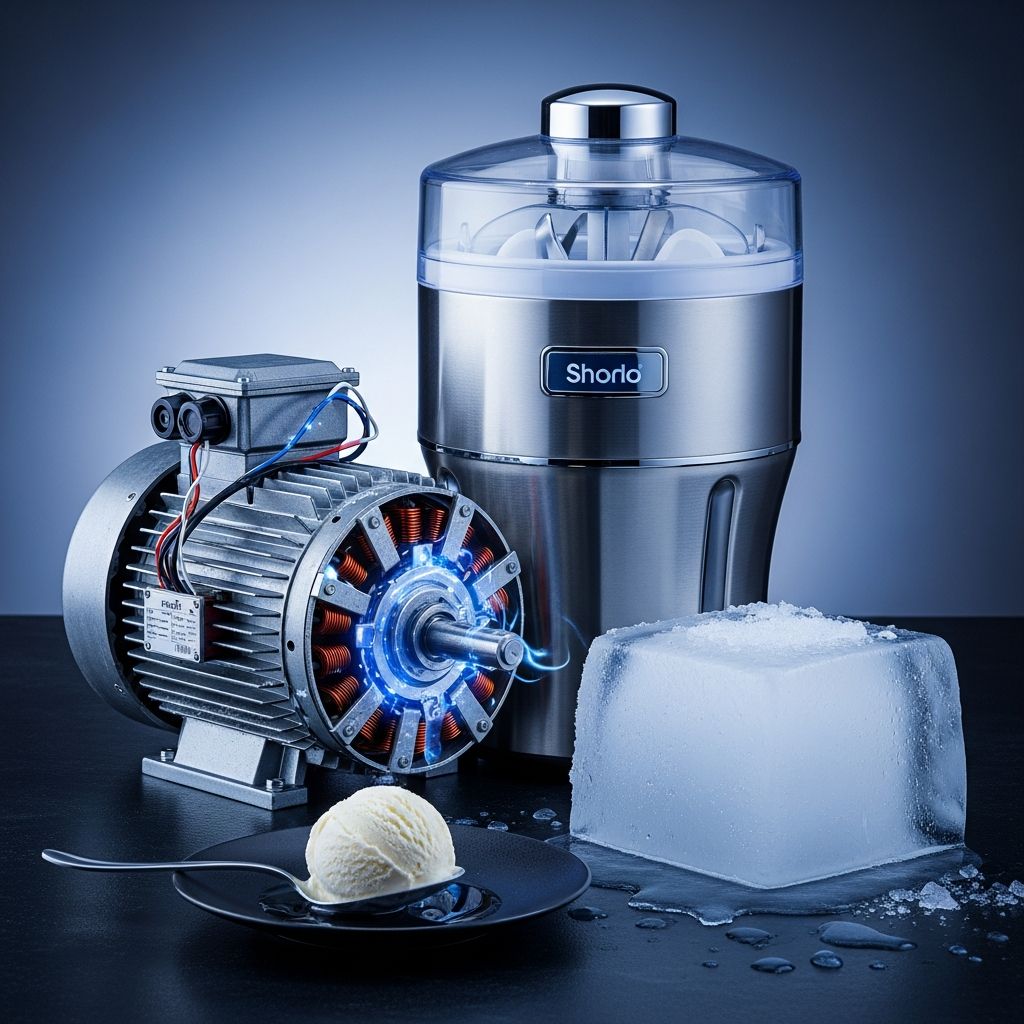
Modern electric ice cream makers, from compact countertop models to large commercial soft serve machines, depend on a carefully balanced combination of power, motor strength, and freezing performance. These factors determine how fast the machine can freeze a mix, how smooth the final texture will be, how much product it can handle, and how reliably it will run over long sessions.
Understanding this relationship helps consumers, food truck operators, and shop owners choose the right equipment for their needs and power supply, and it also helps avoid common problems like underpowered machines, poor texture, or tripped breakers.
Table of Contents
- Key Components That Drive Performance
- Power, Wattage, and Voltage Basics
- Motor Strength and Churning Capacity
- Freezing Performance and Refrigeration Systems
- Home vs. Commercial Electric Ice Cream Makers
- Capacity, Output Rate, and Power Matching
- Electrical Considerations and Safety
- How to Evaluate Specs Before You Buy
- Maintenance, Efficiency, and Long-Term Performance
- Frequently Asked Questions (FAQs)
- Conclusion
Key Components That Drive Performance
Electric ice cream and soft serve machines use a combination of mechanical and refrigeration components. Their performance is the result of how power is distributed among these parts and how strongly they are engineered.
- Drive motor: Turns the dasher or auger that churns the mix and incorporates air.
- Compressor: Circulates refrigerant to remove heat from the freezing cylinder, forming ice crystals and setting texture.
- Control system: Adjusts motor speed, monitors temperature or viscosity, and manages standby or defrost cycles.
- Power supply: Voltage, amperage, and total wattage available to the machine.
In well-designed machines, motor strength and compressor capacity are matched to the intended batch size and output per hour. An imbalance, such as a strong motor with a weak compressor, can lead to inconsistent texture or overworked components.
Power, Wattage, and Voltage Basics
Power in electric ice cream makers is usually expressed in watts or kilowatts and reflects how much electrical energy the machine can draw at full load.
For commercial soft serve machines, typical ranges and examples include:
- Soft serve machines often fall between about 1500 and 5000 watts depending on size and output.
- A floor-standing twin-flavor soft serve unit can be rated around 2500 W with production capacity near 38 L/h.
- A compact commercial soft serve maker may use roughly 1200 W at 115 V for 18–22 L/h output.
Voltage is closely tied to where and how a machine can be used.
- Most full-size commercial soft serve machines run on 208/230–240 V single-phase power and cannot be plugged into a normal 110–120 V outlet.
- Some lighter-duty machines are designed for 110–115 V and can use a standard outlet but are generally low power, low capacity, and often limited to a single flavor.
More power usually allows faster freezing, higher hourly output, and better recovery during busy periods, but it also increases electrical requirements and heat rejection into the room.
How Wattage Influences Freezing Speed and Texture
Wattage affects both the compressor and motor performance. At a practical level:
- Higher wattage machines can often freeze larger volumes faster, cutting batch time and improving service during rushes.
- Insufficient power can lead to longer freeze times and mixed texture, especially if the mix warms while waiting to be fully frozen.
- Power margins also matter when running off generators; experts advise choosing a generator with at least about 20% more wattage than the machine requires to handle startup surges and avoid overloads.
Motor Strength and Churning Capacity
Motor strength, often indicated in horsepower (HP) or through wattage devoted to the drive, determines how effectively the machine can churn increasingly thick mix.
- A twin-tank floor model may use a motor around 1.25 HP to drive two freezing cylinders.
- Some compact commercial machines pair a roughly 1200 W system with a strong mixing motor to maintain continuous soft serve output.
Strong drive motors are essential for:
- Preventing stalling when the mix becomes very viscous as it freezes.
- Maintaining uniform overrun (air incorporation), which influences lightness and yield.
- Handling higher butterfat and solids mixes that freeze harder and place more load on the drive.
Signs a Motor Is Underpowered
Indicators that a machine’s motor may be undersized for the job include:
- Frequent tripping of motor overload protection during peak demand.
- Slow or uneven rotation of the dasher under full load.
- Inconsistent texture from batch to batch, especially when the machine is full.
When comparing machines, looking at both the motor rating and the intended output capacity helps ensure the system is balanced and not operating at its limit under normal use.
Freezing Performance and Refrigeration Systems
Freezing performance refers to how quickly and consistently the machine can remove heat from the mix and maintain the desired dispensing temperature or hardness.
Key elements that define freezing performance include:
- Compressor capacity and refrigerant type (such as R404A or R410A in commercial units).
- Evaporator design around the cylinder to maximize contact area.
- Air or water cooling for the condenser, with minimum clearances around air-cooled models to ensure good airflow.
- Control logic that switches between freezing, holding, and standby modes.
Air-Cooled vs Water-Cooled Systems
Most small home machines and many commercial units are air cooled. A typical specification might require at least about 300 mm of clearance on sides and rear for proper airflow in an air-cooled floor model.
Air-cooled systems are simpler to install but add heat to the surrounding room and depend heavily on adequate ventilation. Water-cooled systems, more common in larger or built-in commercial machines, remove heat more efficiently but require a plumbed water connection.
Standby Modes and Hold Temperatures
Some commercial soft serve makers include a standby function, where the machine lowers its energy use and maintains the mix at safe temperatures when not dispensing. For example, a machine may automatically enter standby after a period of inactivity and resume normal operation when a key or handle is activated.
This combination of temperature control and intelligent power management supports both food safety and component longevity.
Home vs. Commercial Electric Ice Cream Makers
Home and commercial machines differ markedly in power, motor strength, and freezing performance. These differences reflect their intended use, batch size, and duty cycle.
| Feature | Home Electric Ice Cream Makers | Commercial Soft Serve / Ice Cream Machines |
|---|---|---|
| Typical Voltage | 110–120 V, standard outlet | 208/230–240 V single-phase (some 115 V light-duty models) |
| Power Range | Often below 500–800 W | About 1500–5000 W depending on capacity |
| Motor Strength | Designed for small batches, occasional use | Stronger motors (often 1 HP+), continuous-duty rated |
| Output | Single batch, intermittent use | Continuous or semi-continuous service, tens of liters per hour |
| Cooling | Air-cooled, often small condensers | Larger air-cooled systems or dedicated water-cooled options |
Consumers moving from a home machine to a commercial unit must plan for higher power draw, heavier construction, and more demanding electrical requirements. Conversely, small 115 V commercial machines can be convenient where higher voltage is not available but typically sacrifice capacity or multi-flavor capability.
Capacity, Output Rate, and Power Matching
In ice cream makers, capacity (volume of mix that can be held and frozen) must be aligned with motor and compressor power. Examples from commercial equipment include:
- A twin-flavor floor model with two 12 L hoppers, two 2 L freezing cylinders, and about 38 L/h production, driven by a 2500 W system and around 1.25 HP motor.
- A compact dual-hopper machine with 7 L storage and 1.8 L cylinder capacity per side, producing about 18–22 L/h with a 1200 W power rating at 115 V.
As capacity and hourly output climb, power requirements increase proportionally. Matching these correctly yields:
- Shorter recovery time between servings or batches.
- Stable texture across a full day of operation.
- Less risk of overheating or stalling under heavy load.
Oversizing capacity relative to power leads to long freeze cycles and unsatisfactory output, while oversizing power relative to capacity can waste energy or cause rapid freezing that is hard to control.
Electrical Considerations and Safety
Power, motor strength, and freezing performance are only useful if the machine is connected to an appropriate and stable electrical supply.
Voltage and Circuit Requirements
Many commercial machines require dedicated circuits and specific voltage ranges.
- Soft serve machines are commonly specified for 208/230–240 V single-phase and cannot use ordinary household plugs.
- Some manufacturers note that equipment can operate within about ±10% of rated voltage, such as 104–126 V for a 115 V machine, but performance is best near the nominal rating.
- Floor models may specify minimum ampacity and maximum fuse size for safe installation.
Improper voltage can cause sluggish motors, poor freezing, or premature wear on compressors. Consulting a qualified electrician is recommended when installing high-powered commercial equipment.
Running on Generators
Operators of mobile ice cream trucks often power soft serve machines from generators. In these cases:
- Typical machine wattage between 1500 and 5000 W must be matched to generator capacity.
- Experts and electricians frequently advise choosing a generator whose continuous output exceeds the machine’s running wattage by at least about 20% to absorb startup surges and maintain stable voltage.
- A well-matched generator setup helps maintain smooth motor operation and stable compressor cycling, both of which directly affect texture and reliability.
How to Evaluate Specs Before You Buy
When selecting an electric ice cream maker or soft serve machine, buyers should read the specification sheet as a guide to real-world performance. Important fields typically include voltage, power, motor rating, refrigerant, capacity, and output rate.
Key Specifications to Compare
- Voltage and phase: Confirm compatibility with your location’s power (e.g., 115 V vs 220–240 V, single-phase).
- Total power (W or kW): Indicates overall freezing and churning capability, especially relative to capacity.
- Motor horsepower: Higher HP supports thicker mixes and continuous use without stalling.
- Hopper and cylinder capacity: Determine maximum batch size and mix storage.
- Production capacity (L/h or gal/h): Shows how many servings per hour the machine is designed to deliver.
- Cooling type and clearance requirements: Particularly important for air-cooled models in tight spaces.
Balancing Needs and Constraints
A good choice balances performance against available electrical infrastructure and typical demand.
- Small cafes or events with simple electrical access may favor lower-wattage, 115 V machines with modest output.
- Busy shops or trucks that serve high volumes benefit from higher power units with stronger motors and compressors, provided wiring or generators are appropriately sized.
- When two machines with similar capacity differ in power rating, the higher power model will generally freeze faster and recover more quickly between servings, at the cost of higher energy consumption.
Maintenance, Efficiency, and Long-Term Performance
Even well-designed machines rely on proper maintenance to sustain power delivery, motor strength, and freezing performance over years of operation.
Practices That Protect Performance
- Keep condenser coils and air inlets clean to preserve cooling efficiency in air-cooled units.
- Follow manufacturer guidelines for lubrication or inspection of drive components.
- Monitor for unusual noises, overheating, or tripped breakers that might indicate electrical or mechanical stress.
- Use recommended cleaning cycles or auto-clean functions when provided to maintain sanitary operation and reduce mechanical drag.
Stable power delivery and well-maintained cooling systems reduce load on the motor and compressor, maintaining freezing performance and minimizing downtime.
Frequently Asked Questions (FAQs)
Q1: Does higher wattage always mean better ice cream?
Higher wattage usually allows faster freezing and higher output, but it must be matched to cylinder size and motor strength. Oversized power for a small capacity can be inefficient without noticeably improving texture, whereas balanced systems typically produce the best results.
Q2: Why are most commercial soft serve machines not 115 V?
Because manufacturing soft serve quickly at high volumes requires more power than a standard 115 V circuit can comfortably provide. As a result, most high-capacity machines run on 208/230–240 V circuits, while only lighter-duty, single-flavor units are offered for 115 V outlets.
Q3: How does motor strength affect overrun and texture?
A stronger drive motor can churn viscous mix consistently, incorporating air evenly and preventing stalls. This supports uniform overrun and a smoother texture, especially in thicker or higher-fat recipes and during continuous service.
Q4: Can I run a soft serve machine on a generator?
Yes, many operators do so, but the generator must exceed the machine’s wattage by a comfortable margin, often around 20%, to handle startup surges and maintain stable voltage. Proper sizing and setup are important to avoid poor performance or equipment damage.
Q5: What happens if my voltage is slightly higher or lower than specified?
Many machines are designed to operate within about ±10% of their rated voltage, but performance and reliability are best near the specified value. Persistent over- or under-voltage can lead to overheating, sluggish freezing, or shortened component life.
Conclusion
Power, motor strength, and freezing performance in electric ice cream makers are closely interrelated. Wattage determines how much energy is available to the compressor and drive motor, motor strength governs how effectively the machine can churn thickening mix, and the refrigeration system’s design dictates how quickly and evenly heat is removed.
Balanced machines match these elements to their cylinder size, hopper capacity, and intended output. Commercial units typically combine higher voltages, stronger motors, and more robust compressors to support continuous service, while home and light-duty models optimize for convenience and modest electrical requirements.
Evaluating voltage, wattage, motor ratings, capacity, and cooling design together provides a clear framework for choosing an ice cream maker that fits both demand and available power. With the right match and consistent maintenance, users can expect reliable freezing performance and consistent texture, whether serving occasional home batches or running a busy soft serve operation.
Similar Articles






Read full bio of medha deb