
Signs Your Ice Cream Maker Is Nearing the End of Its Useful Life
Learn how to recognize performance, mechanical, and safety warning signs that your ice cream maker may be close to retirement.
Introduction
Ice cream makers, whether small countertop models for home use or heavy-duty commercial machines, do not last forever. Over time, internal components wear out, performance slowly declines, and you may start to notice changes in texture, output, and reliability. While regular cleaning and maintenance can significantly extend an ice cream maker’s lifespan, there comes a point where repair is no longer economical and the machine is effectively at the end of its useful life.
Understanding the typical lifespan of an ice cream maker, and the warning signs that it is failing, helps you avoid sudden breakdowns, food safety issues, lost sales in a business setting, and repeated frustration at home. This guide explains the main indicators that your ice cream maker is nearing retirement, how to distinguish between minor fixable issues and serious wear, and how to evaluate whether to repair or replace.
Typical Lifespan of Ice Cream Makers
Actual lifespan depends on factors such as build quality, frequency of use, cleaning habits, and water quality. Commercial ice and ice cream machines in busy environments often have shorter lives than lightly used home units, even though they are built more robustly.
Industry guidance for similar refrigeration and ice-making equipment indicates:
- Commercial ice machines commonly last about 4 to 10 years, depending heavily on maintenance and water quality.
- Many commercial ice machines average 4 to 5 years before repair costs begin to rise sharply, even with good care.
- Premium commercial soft-serve and ice cream machines, when well maintained, can remain reliable for 10 to 15 years.
Home ice cream makers often experience a slightly different pattern. They typically see fewer hours of operation but may receive less consistent maintenance. Cheaper units may show serious performance decline after a few seasons of frequent use, while higher-end compressor models can last many years if kept clean and serviced as recommended.
An ice cream maker is usually considered at the end of its useful life when it can no longer maintain proper temperature, texture, and output without frequent repairs, or when critical parts are worn beyond practical replacement.
Table of Contents
- Performance Decline: Output and Freezing Issues
- Changes in Texture and Product Quality
- Unusual Noises, Vibrations, and Overheating
- Leaks, Rust, and Visible Wear
- Electrical, Control, and Temperature Problems
- Frequent Breakdowns and Rising Repair Costs
- Parts, Maintenance, and When They Are Not Enough
- Hygiene, Health, and Food Safety Concerns
- Repair Versus Replace: How to Decide
- Tips to Extend the Remaining Life of Your Machine
- Conclusion
- Frequently Asked Questions (FAQs)
Performance Decline: Output and Freezing Issues
One of the clearest early signs that an ice cream maker is approaching the end of its useful life is a noticeable decline in performance, especially in freezing efficiency and output.
Slow or Incomplete Freezing
When a machine that used to churn smooth ice cream in 20 to 30 minutes starts taking much longer, or never quite firms up the mix, internal components may be wearing out. For commercial machines, similar signs occur with slow ice production, which can be caused by mechanical wear, refrigerant problems, or restricted water flow.
Watch for these changes:
- Cycles taking significantly longer than they used to, even with the same recipe and room temperature.
- Ice cream remaining soft and soupy even after the recommended churn time.
- Soft-serve machines struggling to recover between servings, staying in a semi-melted state.
Reduced Output
A worn machine may still function but produce far less ice cream or soft serve than before. In a commercial context, this often shows up as reduced ice or product output compared with normal operation.
Key signs include:
- Smaller batches than advertised capacity.
- Need to run multiple cycles to get the amount previously produced in one.
- Commercial units that can no longer keep up with peak demand even after cleaning and basic maintenance.
This type of decline may signal an aging compressor, worn beater motor, refrigerant loss, or heavy internal scale and residue that simple cleaning cannot fully correct.
Changes in Texture and Product Quality
Ice cream texture is very sensitive to freezing performance, mechanical action, and temperature control. When these systems deteriorate, the texture and quality of your ice cream will often show it first.
Inconsistent Texture
Manufacturers and commercial maintenance guides note that irregular or inconsistent product texture is a common indicator that an ice cream machine needs professional attention or more serious repair.
Warning signs include:
- Grainy or icy texture that persists despite correct recipes and pre-chilled mix.
- Large ice crystals forming quickly in finished ice cream.
- Soft-serve that alternates between overly soft and excessively stiff during the same day.
Failure to Hold Texture
If ice cream used to stay smooth and scoopable in the freezer but now becomes dense, hard, or icy much faster, it may indicate weaker churning or temperature inconsistency in the freezing stage. While storage conditions also matter, an aging machine that cannot freeze quickly and evenly tends to create more ice crystal formation later.
Changes in Taste and Quality
For ice and ice cream machines, taste and clarity of the product are important quality indicators. Strange flavors, off odors, or cloudy and soft cubes can reflect filtration or internal contamination issues. In an ice cream maker, similar problems might show as:
- Persistent off flavors that remain even after thorough cleaning.
- Frequent need to discard batches due to unusual taste or texture.
- Residual flavors from previous batches because the machine interior has become difficult to clean effectively.
Unusual Noises, Vibrations, and Overheating
A healthy ice cream maker generally operates with a consistent hum or gentle churning sound. As internal parts wear out, new and often louder noises may appear.
Strange or Louder Operating Sounds
Commercial guidance for ice and ice cream machines emphasizes that unusual noises are a strong indicator of mechanical trouble. These may include:
- Grinding or scraping sounds from worn gears or misaligned paddles.
- Clicking or buzzing indicating failing relays, fans, or compressor components.
- Loud rattling or vibration suggesting loose hardware or deteriorated mounts.
If noises appear suddenly or grow worse over time, and routine maintenance such as cleaning and lubrication does not resolve them, internal parts may be close to failure.
Excessive Vibration
Vibration beyond what you have historically observed can be caused by a worn motor, imbalanced rotating parts, or failing bearings. Commercial resources list unusual vibrations as a key sign the machine needs professional attention. In older machines, vibration may also indicate structural fatigue or deteriorating mounts, both of which make long-term repair less attractive.
Overheating and Hot Surfaces
Another visible warning sign is excessive heat radiating from the machine. For ice machines, excessive heat around the unit often means the condenser or cooling system is working overtime or failing. An ice cream maker that becomes much hotter to the touch than before, or that repeatedly shuts down due to thermal protection, may be nearing its operational limit.
Leaks, Rust, and Visible Wear
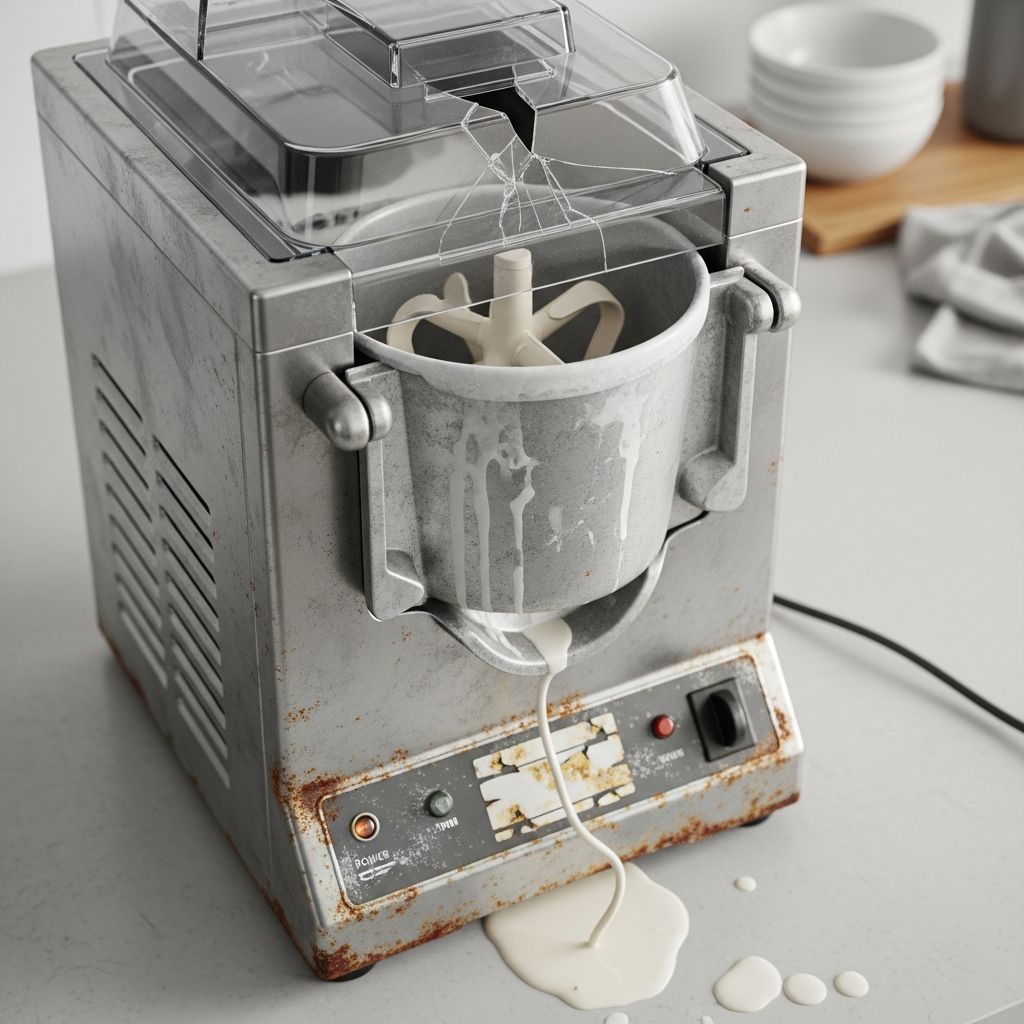
With age, seals, gaskets, and structural components deteriorate. When that happens, the exterior of the machine often shows visible clues.
Leaks and Pooling Liquids
Water leaks or internal pooling in ice and ice cream machines are typically associated with worn seals, cracked lines, or failing internal components. In any type of ice cream maker, you should pay attention to:
- Liquid seeping around the base of the unit during or after use.
- Repeated appearance of puddles inside or underneath the machine.
- Product leakage into areas that should remain dry, such as under panels or near powered components.
Small leaks may come from a single gasket or hose, which can sometimes be replaced. However, widespread leakage, particularly when combined with corrosion, suggests deeper structural decline.
Rust, Corrosion, and Structural Damage
Commercial ice equipment guidelines identify rust and corrosion, especially near seams and drainage points, as signs of internal deterioration. For any ice cream maker, visible corrosion can indicate:
- Long-term moisture exposure in areas that are difficult to clean and dry.
- Breakdown of protective coatings and metal surfaces.
- Increased risk of contamination, leaks, or mechanical failure.
Once corrosion affects internal frames, evaporators, or critical load-bearing parts, the cost and complexity of repair often exceed the value of the machine.
Electrical, Control, and Temperature Problems
As machines age, electrical components, sensors, and control boards can become less reliable. This is particularly important for ice cream makers, which rely on precise temperature and timing control.
Erratic Controls or Display Issues
Signs of control problems may include:
- Buttons or dials that do not respond consistently.
- Digital displays flickering, showing error codes, or going blank unexpectedly.
- Programs or cycles that stop or reset without clear cause.
Some of these issues can be resolved by replacing specific electrical parts, but in older units where control systems are obsolete or expensive, they often contribute to the decision to retire the machine.
Temperature Instability
Refrigeration guidance notes that failure to maintain consistent temperatures is a sign of trouble in cooling equipment, often involving thermostats or refrigerant problems. In an ice cream maker, similar issues may show as:
- Ice cream that freezes unevenly within one batch.
- Frequent cycling between over-freezing and under-freezing.
- Soft-serve machines that cannot hold product at safe and stable serving temperatures.
When these temperature control issues persist after basic service, they often indicate aging refrigeration components, which may be costly to replace.
Frequent Breakdowns and Rising Repair Costs
Another clear indicator that an ice cream maker is near the end of its life is a pattern of frequent failures and service calls. Commercial ice machine guidance points out that when breakdowns become routine, the unit is likely reaching the end of its usable life.
Recurring Problems
Common patterns include:
- The same part or system failing repeatedly within a short period.
- Different systems (mechanical, electrical, refrigeration) beginning to fail one after another.
- Increased downtime between uses due to troubleshooting and repairs.
Cost Threshold for Replacement
Guidance for commercial ice machines suggests that when a repair costs more than about half the price of a new unit, replacement is generally the more practical option, especially if the machine is already near the end of its typical lifespan. A similar principle applies to home ice cream makers: if the cost of parts and labor is a large fraction of the cost of a new, more efficient model, retirement makes sense.
Parts, Maintenance, and When They Are Not Enough
Regular cleaning, lubrication, and component replacement can significantly extend the useful life of an ice cream maker. However, even well-maintained machines eventually reach a point where maintenance cannot fully offset age-related wear.
Wear on Seals, Gaskets, and Blades
Industry recommendations for ice cream machines emphasize periodic replacement of seals, gaskets, and scraper or beater blades. Some commercial sources suggest gaskets and similar parts be inspected frequently and replaced every few months in high-use settings to prevent leaks and loss of efficiency. Blades and scraper components also need replacement when dull or worn, as they greatly affect consistency and performance.
Signs these parts are no longer enough include:
- New seals quickly begin to leak or lose elasticity.
- New blades still cannot achieve smooth texture or complete scraping.
- Critical components are discontinued or difficult to obtain at reasonable cost.
Maintenance Becoming Excessively Frequent
Standard best practices recommend regular cleaning, lubrication, and calibration to maintain performance and extend lifespan. When you find that you must perform deep cleanings or part replacements far more often than the manufacturer suggests just to keep the machine functioning, it may indicate that the underlying systems are worn out.
Hygiene, Health, and Food Safety Concerns
For any appliance that handles dairy and frozen desserts, hygiene and food safety are critical. Aging ice cream makers can develop sanitation problems that are difficult or impossible to fully correct.
Persistent Build-Up and Hard-to-Clean Areas
Commercial guidance stresses the importance of regular cleaning and descaling to prevent mold, scale, and biofilm in ice and ice cream machines. Over time, worn surfaces, tiny cracks, and corroded areas can trap residue and harbor bacteria, making thorough cleaning increasingly difficult.
Warning signs include:
- Recurring mold, slime, or residue even after following recommended cleaning procedures.
- Persistent off flavors or odors from the machine, especially in neutral-flavored mixes.
- Hidden areas you can no longer access easily for sanitation due to damage or warping.
Food Safety Risk
If you suspect that an older machine is posing a food safety risk, especially in a commercial environment, retirement is often the safest and most responsible choice, even if the machine technically still runs.
Repair Versus Replace: How to Decide
When you notice several of the warning signs above, the next step is deciding whether further repairs are justified or if replacement is more rational.
| Factor | Repair Favors | Replace Favors |
|---|---|---|
| Age vs. Typical Lifespan | Machine is still well within expected lifespan. | Machine is near or past its average lifespan for similar units. |
| Cost of Current Repair | Repair cost is modest relative to replacement price. | Repair cost approaches or exceeds about 50% of a comparable new unit. |
| Frequency of Failures | Issue appears isolated and not recurring. | Breakdowns are frequent and affect multiple systems. |
| Parts Availability | Parts are readily available and reasonably priced. | Key parts are obsolete, delayed, or very expensive. |
| Performance After Repair | Machine likely to perform near original spec. | Even with repair, performance and reliability remain uncertain. |
In both home and commercial settings, consider any efficiency gains, warranty coverage, and reliability you may gain from a newer model. For businesses, also account for the cost of downtime and potential product loss.
Tips to Extend the Remaining Life of Your Machine
If your ice cream maker is showing early signs of age but still fundamentally sound, certain habits can help you get the most remaining life out of it.
- Follow the manufacturer’s cleaning schedule carefully, including daily or per-use cleaning and sanitizing of commercial soft-serve machines.
- Descale and remove mineral deposits regularly, especially in areas with hard water, to avoid buildup that reduces efficiency and damages internal components.
- Inspect seals, gaskets, and scraper blades on a routine basis, replacing them according to recommended intervals or whenever you notice wear or leakage.
- Lubricate moving parts as instructed in the manual to reduce friction-related wear and noise.
- Monitor for early changes in noise, vibration, or performance so that minor problems can be addressed before they cause major damage.
These steps can delay, but not completely prevent, the eventual end of the machine’s service life.
Conclusion
Ice cream makers, like all mechanical and refrigeration equipment, have a finite working life. Over time, declining performance, inconsistent texture, unusual noises, leaks, corrosion, and recurring failures all point toward an aging machine whose key components are wearing out. Even with excellent care, internal parts eventually reach the point where maintenance and individual replacements can no longer restore original reliability.
Recognizing these warning signs early allows you to plan ahead rather than reacting to a sudden breakdown at a critical moment. By comparing repair costs to replacement prices, considering the machine’s age relative to typical lifespans, and evaluating how well it still meets your needs, you can make a measured decision about when to retire your current unit.
A thoughtful approach focuses on safety, consistent product quality, and long-term value. Whether you choose to maintain your current ice cream maker a bit longer or move on to a newer model, understanding the signs of end-of-life ensures that choice is informed, deliberate, and aligned with how you actually use the machine.
Frequently Asked Questions (FAQs)
How long should an ice cream maker last?
Commercial ice and ice cream machines often last around 4 to 10 years, depending on maintenance, usage intensity, and water quality. Premium machines with excellent care can operate effectively for a decade or more. Home ice cream makers vary widely, but performance decline after several years of frequent use is common, particularly in lower-cost models.
What is the clearest sign that it is time to replace an ice cream maker?
A combination of factors usually makes the answer clear: frequent breakdowns, noticeable performance loss, increasing repair bills, and visible wear such as leaks or corrosion. When repairs begin to cost a large fraction of a new unit and the machine is near or past its typical lifespan, replacement is often the more sensible option.
Can replacing seals and blades make an old machine like new?
Replacing worn seals, gaskets, and scraper blades can greatly improve performance and reduce leaks, especially if those parts have been neglected. However, if compressors, motors, or control systems are also aging, these part replacements may only provide partial and temporary improvement.
Are strange noises always a sign of end-of-life?
Not always. Unusual noises can sometimes be resolved by cleaning, lubrication, or tightening loose hardware. However, persistent grinding, clunking, or loud buzzing after basic service often indicates serious wear in motors, gears, or compressors, which may be costly to fix, especially on older machines.
How important is cleaning for extending the life of an ice cream maker?
Cleaning is vital. Regular cleaning, sanitation, and descaling help prevent mold, scale buildup, and premature wear in both home and commercial machines. Proper upkeep can significantly extend useful life and delay many of the problems that eventually lead to replacement.
Similar Articles






Read full bio of medha deb