Comparing Spray, Liquid, and Wipe Forms of All-Purpose Cleaners for Every Surface
Understand spray, liquid, and wipe all-purpose cleaners so you can match each format to the right surface, task, and cleaning routine.
Spray, Liquid, and Wipe Forms of All-Purpose Cleaners: A Complete Guide
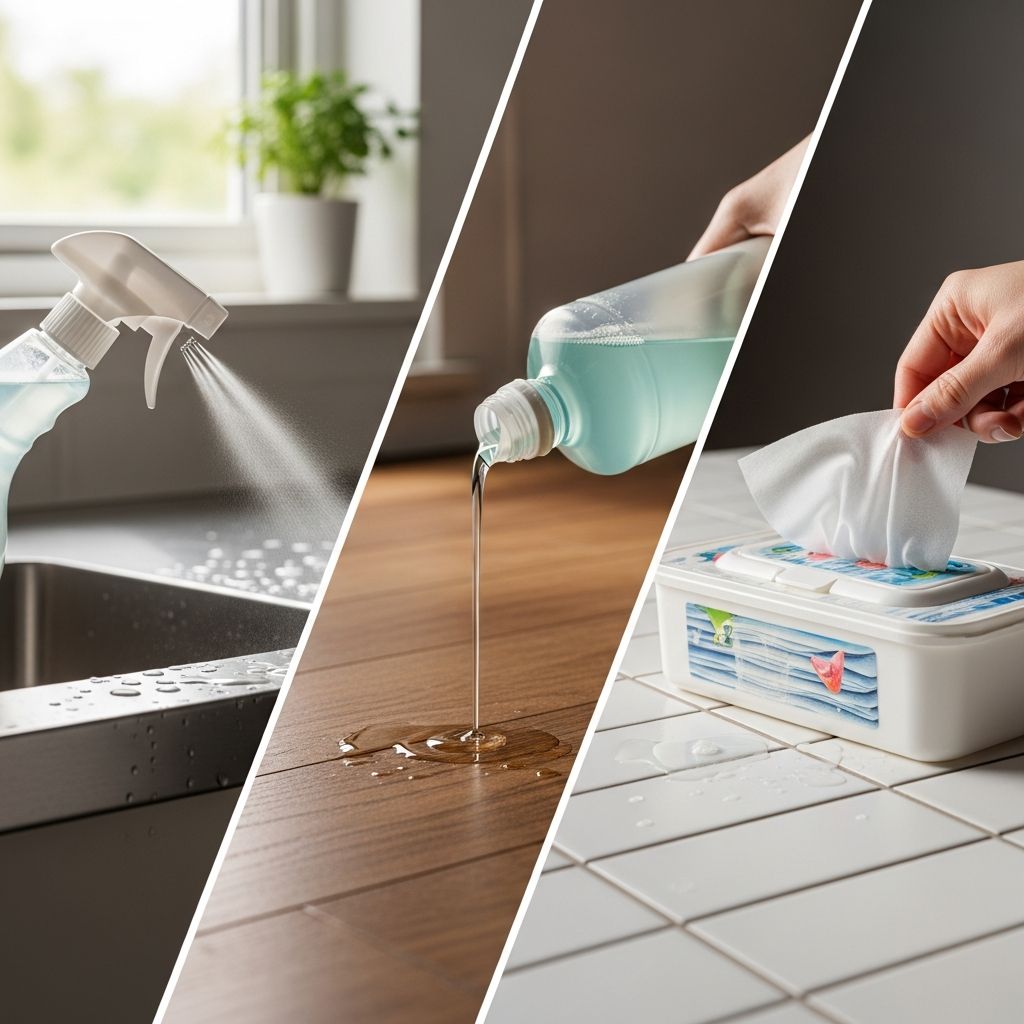
All-purpose cleaners are designed to handle a wide variety of everyday messes across many surfaces, but they do not all come in the same form. Today, most households rely on three main formats: spray cleaners, liquid concentrates or ready-to-use liquids, and pre-moistened wipes. Each format offers unique advantages, trade-offs, and ideal use cases, from deep cleaning kitchens to quick wipe-downs in shared spaces.
Table of Contents
- Overview of All-Purpose Cleaner Formats
- Spray All-Purpose Cleaners
- Liquid All-Purpose Cleaners
- All-Purpose Cleaning Wipes
- Side-by-Side Comparison Table
- How to Choose the Right Format for Your Needs
- Safety, Health, and Environmental Considerations
- Best Practices for Effective Cleaning and Disinfecting
- Frequently Asked Questions (FAQs)
- Conclusion
Overview of All-Purpose Cleaner Formats
All-purpose cleaners are versatile formulations that remove everyday soils such as dust, light grease, food spills, and household grime from multiple surfaces like countertops, sealed floors, appliances, and tiles. While the core cleaning chemistry can be similar, the format changes how the product is dispensed, used, and disposed of.
The three key formats are:
- Spray cleaners – liquid solutions delivered via trigger or aerosol bottles for direct application to surfaces, usually followed by wiping with a cloth.
- Liquid cleaners – concentrates or ready-to-use liquids that are poured, diluted, or used in buckets, spray bottles, or mop systems for larger areas and heavier cleaning.
- Pre-moistened wipes – disposable cloths pre-saturated with an all-purpose or disinfecting solution, used straight from the pack for quick, convenient cleaning.
Choosing between these formats is less about which is universally “better” and more about matching the product to the task, surface, and frequency of cleaning.
Spray All-Purpose Cleaners
Spray all-purpose cleaners are among the most common household options. They are typically packaged in trigger bottles that distribute a fine mist or stream directly onto the surface, where the liquid clings, dissolves soil, and is then wiped away with a cloth or paper towel.
Common Uses for Spray All-Purpose Cleaners
- Kitchen counters, cabinet fronts, and appliance exteriors
- Bathroom sinks, tiles, and fixtures (when formula is suitable)
- Door handles, switch plates, and other frequently touched areas
- Spot cleaning on walls and sealed wood or laminate surfaces
Advantages of Spray Cleaners
- Targeted application: Sprays allow direct, controlled placement of cleaner on stained or high-touch zones without saturating the entire surface.
- Versatility: A wide range of formulations exists, from general all-purpose to degreasers, disinfectants, glass-safe formulas, and specialty options.
- Cost-effectiveness: Refillable or concentrated sprays can be economical, especially when purchased as concentrates or tablets that are diluted in reusable bottles.
- Good for larger surfaces: When used with reusable cloths or microfiber, sprays can handle larger countertops and appliances more efficiently than wipes.
Disadvantages of Spray Cleaners
- Chemical mist exposure: Spraying creates airborne droplets that can be inhaled, which is a concern with stronger disinfectants or fragranced formulas.
- Overuse risk: Excessive spraying can waste product and leave residue, requiring extra wiping to achieve a streak-free finish.
- Requires additional tools: You typically need cloths or paper towels, which must be cleaned or disposed of properly to avoid cross-contamination.
When Spray All-Purpose Cleaners Are the Best Choice
- Routine cleaning of medium to large surfaces (kitchens, bathrooms, appliances)
- Situations where you want to minimize waste from disposable wipes
- Tasks that need good soil removal and, when labeled, disinfection with proper dwell time
- Households using reusable microfiber cloths to reduce paper use
Liquid All-Purpose Cleaners
Liquid all-purpose cleaners include both concentrated and ready-to-use (RTU) liquids. Concentrates are typically diluted with water for buckets, mop systems, or refillable spray bottles; RTU liquids may be poured directly onto cloths or surfaces. They are often favored for floors, large surface areas, and professional or commercial cleaning.
Common Uses for Liquid All-Purpose Cleaners
- Cleaning large floor areas with a mop and bucket
- General cleaning of walls, baseboards, and large tiled surfaces
- Refilling spray bottles for routine housekeeping or janitorial work
- High-traffic zones in workplaces, schools, and gyms where cost and coverage matter
Advantages of Liquid Cleaners
- Excellent cost efficiency: Concentrates are often more economical over time, because a small amount makes many liters of cleaning solution.
- Flexible dilution: Users can adjust dilution ratios for light, routine cleaning versus heavier soil, within manufacturer guidelines.
- Ideal for large areas: Buckets and mop systems make it easier to clean expansive floors compared with sprays or wipes.
- Lower packaging waste per use: Concentrated liquids typically use less plastic per cleaning session than individually packaged wipes.
Disadvantages of Liquid Cleaners
- More steps and equipment: You may need measuring tools, buckets, mop heads, or refillable bottles, increasing complexity compared with grab-and-go wipes.
- Risk of incorrect dilution: Using too much or too little concentrate can reduce cleaning performance or leave residue.
- Cross-contamination risk: Reused mop water or cloths can spread soil and microbes if not changed or laundered correctly.
When Liquid All-Purpose Cleaners Are the Best Choice
- Cleaning large floors and extended surface areas regularly
- Commercial, institutional, or professional cleaning operations
- Households wanting to minimize per-use packaging and cost
- Situations where control over dilution strength is beneficial
All-Purpose Cleaning Wipes
Pre-moistened all-purpose wipes are disposable cloths saturated with cleaning or disinfecting solution and sealed in canisters, tubs, or soft packs to stay moist. To use them, you simply pull a wipe from the container, wipe the surface, and discard the wipe.
Common Uses for Cleaning Wipes
- Quick cleanups of spills on counters, tables, or desks
- Wiping high-touch surfaces such as door handles, light switches, keyboards, and gym equipment
- On-the-go cleaning in cars, strollers, travel bags, or workplaces
- Shared facilities where simple, one-step disinfection is needed and users may not have access to cloths or sprays
Advantages of Cleaning Wipes
- Maximum convenience: Wipes are ready to use straight from the pack with no mixing, measuring, or additional tools.
- Lower cross-contamination risk: Because each wipe is single-use, there is less chance of transferring germs from surface to surface, especially with disinfectant wipes.
- Portability: Compact packs make wipes easy to carry in bags, vehicles, or facility dispensers.
- Reduced inhalation of mist: Wipes avoid overspray and airborne droplets, which can be safer for users sensitive to chemical mists.
Disadvantages of Cleaning Wipes
- Higher cost per use: Compared with liquids and sprays, wipes often cost more per square meter of surface cleaned over time.
- Limited coverage: A single wipe may not be enough for large messes or big surfaces, leading to multiple wipes being used.
- Potential residue: Some wipes leave a sticky or filmy residue, especially on glossy or glass surfaces, requiring a follow-up wipe.
- Environmental impact: Disposable wipes contribute to solid waste and may contain synthetic fibers that do not readily break down.
When All-Purpose Wipes Are the Best Choice
- Fast, frequent wipe-downs of small or high-touch surfaces
- Public or shared spaces where ease of use and hygiene are priorities (gyms, offices, healthcare waiting areas)
- Travel or situations without ready access to water, cloths, or spray bottles
- Environments where minimizing aerosolized chemicals is important
Side-by-Side Comparison Table
| Feature | Spray Cleaners | Liquid Cleaners | Pre-Moistened Wipes |
|---|---|---|---|
| Typical use | Medium surfaces, spot cleaning, general household tasks | Large floors and extended surfaces, refilling bottles | Small, frequent, and on-the-go cleaning; high-touch areas |
| Convenience | Moderate – requires cloths or towels | Lower – requires dilution and tools (bucket, mop, cloths) | High – one-step use and disposal |
| Cost per use | Low to moderate, especially with concentrates | Low – concentrates are generally most economical | Higher – more expensive per cleaning session over time |
| Chemical exposure | Potential inhalation of mist and overspray | Lower airborne exposure but higher skin contact when mixing | Lower mist exposure, mainly skin contact via the wipe |
| Waste generation | Plastic bottles and used cloths or towels | Less packaging per use with concentrates; cloths reusable | Single-use wipes plus packaging; higher solid waste |
| Cross-contamination risk | Moderate – depends on cloth hygiene and technique | Moderate to higher if mop water or cloths are reused improperly | Lower – single-use application limits re-spreading germs |
| Best for | Routine surface cleaning with control and versatility | High-volume or large-area cleaning at low cost | Fast, simple, hygienic cleaning in small areas |
How to Choose the Right Format for Your Needs
Selecting the ideal form of all-purpose cleaner involves weighing your priorities: surface type, hygiene level, time, cost, and environmental concerns. No single format excels at everything.
Key Questions to Ask
- How large is the area I need to clean regularly?
- Do I primarily need to clean (remove dirt) or also sanitize/disinfect (reduce or kill germs)?
- How important are convenience and speed compared with cost and waste?
- Am I working in a home, workplace, school, or healthcare setting with specific hygiene standards?
Typical Scenarios and Recommended Formats
- Busy household kitchen and bathroom: Use spray cleaners or liquid-filled spray bottles for routine cleaning of counters and fixtures; keep a small pack of wipes for quick spills and handle wipe-downs.
- Office or shared workspace: Provide wipes at desks and shared equipment for quick, user-friendly sanitizing; use sprays or liquids for scheduled deep cleaning of larger areas.
- Large commercial floor areas: Rely mainly on liquid concentrates with mop systems or autoscrubbers; consider sprays for spot cleaning and wipes for high-touch points.
- Travel, cars, and on-the-go: Pack compact wipe containers; they require no water, cloths, or spray bottles.
Safety, Health, and Environmental Considerations
Regardless of format, all-purpose cleaners should be used following label directions, especially when products also sanitize or disinfect. Overuse or misuse can affect both health and the environment.
Cleaning vs. Sanitizing vs. Disinfecting
- Cleaning removes visible dirt and many germs from surfaces using detergents, but does not necessarily kill microorganisms.
- Sanitizing reduces the number of germs on surfaces to safe levels according to public health standards.
- Disinfecting uses chemicals to kill a broad spectrum of microorganisms on hard surfaces, when used with the required contact (dwell) time.
Some all-purpose products are cleaners only, while others are labeled as sanitizing or disinfecting as well. The format (spray, liquid, or wipe) must be used according to those directions for the promised antimicrobial performance to be valid.
Health and Safety Tips
- Ensure good ventilation when using spray disinfectants, especially in enclosed spaces.
- Wear gloves when handling concentrates or if you have sensitive skin.
- Do not mix different cleaners or disinfectants together.
- Store all products out of reach of children and pets.
Environmental Impact
- Consider concentrates and refill systems to reduce plastic waste and transportation emissions.
- Use reusable microfiber cloths with sprays or liquids where appropriate instead of disposable paper towels.
- Reserve disposable wipes for situations where hygiene, convenience, or regulations justify the extra waste.
Best Practices for Effective Cleaning and Disinfecting
How you use spray, liquid, or wipe cleaners can matter as much as which format you choose. Good technique improves both cleaning results and hygiene.
General Steps for All Formats
- Remove loose debris first (crumbs, dust) to avoid smearing soil.
- Apply the cleaner (spray, liquid, or wipe) so that the surface is evenly wet.
- Allow the product to sit for the recommended contact time if sanitizing or disinfecting is desired.
- Wipe in one direction and change cloths or sides frequently to avoid re-depositing soil.
- Allow surfaces to air-dry if the label instructs this for disinfection.
Format-Specific Tips
- Sprays: Avoid spraying directly near electronics; spray onto a cloth first. Do not oversaturate porous materials. To reduce inhalation, spray close to the surface and wipe promptly.
- Liquids: Measure concentrates carefully. Replace mop solution frequently in high-soil or high-germ areas to minimize cross-contamination.
- Wipes: Use a fresh wipe for each small area or when visibly soiled. Ensure the surface stays wet for the full contact time for sanitizing or disinfecting claims.
Frequently Asked Questions (FAQs)
Are wipes more effective than sprays at killing germs?
For products with the same disinfectant formulation, wipes and sprays can achieve similar germ kill when used correctly and allowed the required dwell time. Wipes often reduce the risk of cross-contamination because they are single-use, but the underlying antimicrobial performance depends on the active ingredients and correct use, not the format alone.
Which format is most economical for regular home cleaning?
In most cases, liquid concentrates and refillable sprays are the most cost-effective for ongoing use, especially for larger surfaces such as floors and big countertops. Wipes are usually more expensive per use but may be worth the cost for specific high-convenience or high-hygiene tasks.
Do all-purpose cleaners disinfect automatically?
No. Many all-purpose cleaners are designed primarily for soil removal and general cleaning. Only products labeled as sanitizers or disinfectants and used exactly as directed (including contact time) provide those specific germ-killing benefits.
Are cleaning wipes bad for the environment?
Pre-moistened wipes generate more solid waste than reusable cloths and often contain synthetic fibers that do not readily break down. Using them strategically—when their hygiene and convenience advantages are needed—and relying on reusable methods for routine tasks can help reduce environmental impact.
Can I use the same format for every surface in my home?
Not always. Some surfaces, such as natural stone, unsealed wood, or specialty finishes, require specific cleaners and may be damaged by certain chemicals or excessive moisture. Check the product label for surface compatibility, and when in doubt, test on a small, inconspicuous area first.
Conclusion
Spray, liquid, and wipe forms of all-purpose cleaners each bring distinct strengths to everyday cleaning. Sprays excel at targeted, versatile cleaning of medium-sized areas, liquids are especially efficient for large surfaces and cost-conscious routines, and wipes are unmatched for convenience and reducing cross-contamination in small or high-touch zones.
Deciding which format to use starts with understanding your space: how big it is, how often it is cleaned, which surfaces are present, and whether you must simply remove soil or also reduce germs to a specific standard. A balanced approach that uses liquids for large-scale maintenance, sprays for focused routine cleaning, and wipes for fast, hygienic touch-ups can provide effective results while managing cost, time, and environmental impact.
By matching each cleaning task to the most appropriate format, and by following label directions for safe and effective use, you can build a cleaning routine that is practical, hygienic, and well-suited to the demands of both homes and shared environments.
Similar Articles





Read full bio of Sneha Tete