Transferring Ice Cream From Maker to Freezer: Containers, Covering, and Firming Time
Master the critical steps between churning and freezing to keep homemade ice cream smooth, creamy, and free from ice crystals.
Transferring Ice Cream From the Maker to the Freezer: Containers, Covering, and Firming Time
Once your homemade ice cream finishes churning, what you do in the next few minutes has a huge impact on whether it stays creamy or turns icy. The transfer from the ice cream maker to the freezer is not just a formality; it is a critical quality step that affects texture, flavor, and shelf life. This guide explains how to choose the right containers, how to cover and pack ice cream properly, and how long to let it firm up for the best possible scoop.
Table of Contents
- Why the Transfer Step Matters for Texture and Quality
- Choosing the Best Containers for Ice Cream
- Preparing and Filling Containers Effectively
- Covering Ice Cream to Prevent Freezer Burn and Odors
- Optimal Freezer Setup and Temperature
- Firming Time: How Long to Freeze After Churning
- Storage Duration and Quality Over Time
- Troubleshooting Common Problems After Freezing
- Frequently Asked Questions
- Conclusion
Why the Transfer Step Matters for Texture and Quality
Freshly churned ice cream from a home machine is usually at a soft-serve consistency, with small ice crystals and tiny air bubbles. At this point, the ice cream is only partially frozen. The way you harden it in the freezer determines how well that delicate structure is preserved.
Research on ice cream storage shows that keeping ice cream as cold as possible and freezing it quickly slows down ice crystal growth, which helps maintain a smooth texture over time. Slower or uneven freezing, air exposure, and temperature fluctuations all encourage recrystallisation: small ice crystals melt and refreeze into larger, coarser ones, making the ice cream feel icy rather than creamy.
A well-managed transfer step therefore aims to
- Move ice cream quickly from the churner to a prepared cold container
- Eliminate or minimize air gaps in the container
- Seal the surface to prevent moisture loss and freezer burn
- Place the container in the coldest, most stable part of the freezer for rapid firming
Choosing the Best Containers for Ice Cream
The container you choose affects freezing rate, protection from air, and long-term quality. Professional guidance for ice cream storage emphasizes the importance of airtight, moisture-vapor resistant packaging to preserve texture and prevent volume loss.
Key Criteria for Ice Cream Containers
- Material that tolerates low temperatures without cracking
- Good barrier to air and moisture (to reduce freezer burn and odor absorption)
- Size that matches your batch to avoid large air pockets
- Shape that allows even freezing and easy scooping
- Tight-fitting lid that can be opened and closed repeatedly
Common Container Options Compared
| Container Type | Pros | Cons | Best Use |
|---|---|---|---|
| Shallow, rectangular plastic container (freezer-safe) | Promotes faster, more even freezing; easy scooping; reusable | Needs extra surface covering if lid is not snug | General homemade ice cream, frequent use |
| Metal loaf pan (aluminum or stainless steel) | Excellent heat transfer for quick firming; easy to spoon mix-ins | No built-in lid; must wrap very well to avoid freezer burn | Rapid hardening; short- to medium-term storage |
| Commercial-style paper ice cream tubs | Designed for frozen foods; good barrier; stackable | Single-purpose; may not be perfectly airtight after repeated openings | Gifting, longer storage, multiple small batches |
| Glass container with tight lid (tempered, freezer-safe) | Odor-resistant; good seal; reusable | Slower freezing; heavy; extra care to prevent thermal shock | Small batches, when odor protection is a priority |
What to Avoid
- Thin, brittle plastic not labeled freezer-safe, which can crack or warp
- Containers that are not moisture-vapor resistant, as they can allow volume loss and a sticky surface over time
- Oversized containers for small batches, which leave large headspace and accelerate ice crystal formation
Preparing and Filling Containers Effectively
Preparing your containers before you turn off the ice cream machine helps you transfer the ice cream quickly, limiting the time it spends at a half-frozen, unstable temperature.
Pre-Chill and Stage Containers
- Place empty containers and lids in the freezer for 10 to 20 minutes before churning finishes, if space allows. A cold container slows melting during transfer and promotes faster hardening once filled.
- Clear space in the coldest part of your freezer in advance so the filled container can go straight in.
Step-by-Step: Moving Ice Cream From Maker to Container
- Turn off the machine when the ice cream reaches a thick soft-serve consistency.
- Remove the dasher (paddle) and bowl insert from the machine as quickly as possible.
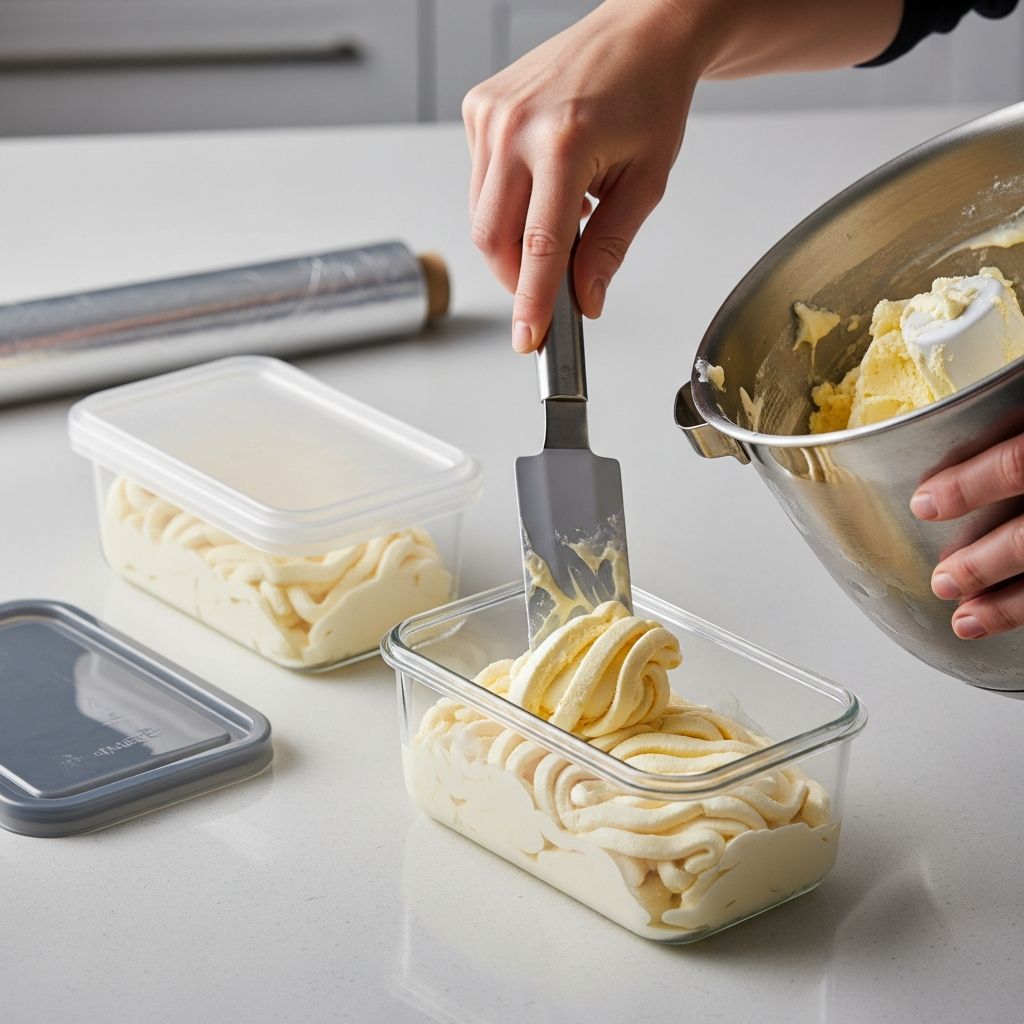
- Scrape the ice cream into your chilled container using a flexible spatula, minimizing time at room temperature.
- Gently press the ice cream into the corners to eliminate pockets of air.
- If adding mix-ins (nuts, chocolate chunks, swirls), fold them in quickly in a cool environment, then smooth the surface.
Minimizing Air Gaps
Air gaps in the container encourage sublimation (moisture leaving the ice cream) and lead to ice crystal growth on the surface. Practical storage guidelines emphasize avoiding gaps when filling containers to reduce ice crystal formation and preserve quality.
- Fill the container as close to the top as possible without overflowing.
- For partially filled containers, press a piece of plastic wrap or parchment directly on the surface before adding the lid.
Covering Ice Cream to Prevent Freezer Burn and Odors
Covering is a two-part strategy: protecting the surface of the ice cream and shielding the container from external air and odors. National home food preservation guidance recommends moisture-vapor resistant wrapping for longer storage to prevent volume loss, sticky surfaces, and flavor changes.
Direct Surface Covering
A direct contact layer on the ice cream surface helps
- Reduce freezer burn (dry, icy patches on top)
- Limit the formation of surface ice crystals
- Protect delicate flavors from oxidation
Good options include
- Plastic wrap pressed gently onto the surface
- Waxed paper or parchment cut to fit and laid directly on the ice cream
- Reusable silicone lids or sheets pressed to eliminate air pockets
Outer Container Covering
Even if a container has a lid, an additional barrier can significantly improve long-term quality. When commercial ice cream must be stored longer than a month, over-wrapping the container with freezer paper or plastic wrap is recommended to prevent volume loss and texture changes.
- Ensure the lid is fully sealed and snapped on all sides.
- For extended storage, wrap the entire container in freezer paper, aluminum foil, or heavy plastic wrap to block air and odors.
- Label the container with flavor and date so you can monitor shelf life.
Optimal Freezer Setup and Temperature
Freezer temperature and location dramatically influence how quickly your ice cream hardens and how long it stays smooth. Studies on ice cream storage show that lower storage temperatures slow recrystallisation and extend shelf life, while fluctuating temperatures accelerate coarseness and iciness.
Ideal Freezer Temperature
- Home storage and manufacturer recommendations generally agree that ice cream should be stored at about 0°F (-18°C) or colder for optimal quality.
- Guidance from dairy and cold storage experts notes that 0°F (-18°C) or below keeps ice cream safely frozen and helps maintain freshness.
- Lower temperatures, such as around -4°F (-20°C), can further slow texture deterioration for longer storage.
In practice, keeping the freezer between about -5°F and 0°F provides a good balance between scoopability and long-term quality.
Best Placement in the Freezer
- Place the ice cream at the back of the freezer or in the coldest section for faster hardening and more stable temperatures.
- Avoid the freezer door, where temperatures fluctuate most with every opening.
- If your freezer is tightly packed, ensure there is still some air circulation so cold air can reach the new container efficiently.
Maintaining Consistent Temperature
Research indicates that ice cream stored at constant low temperatures retains small ice crystals much longer than ice cream exposed to temperature cycling. Frequent warming and re-cooling encourage recrystallisation and coarse texture.
- Limit how often you open the freezer, especially in the first few hours while the ice cream is hardening.
- Return the ice cream to the freezer promptly after serving, rather than letting it soften on the counter.
Firming Time: How Long to Freeze After Churning
After transfer and covering, the ice cream enters the “static freezing” or hardening stage. During this period, the partially frozen mixture solidifies enough for clean scoops and more stable storage.
Typical Firming Times for Homemade Ice Cream
- Most home freezers need about 2 to 4 hours for a freshly churned batch to firm to a scoopable consistency.
- Deeper, denser containers or very large batches may require 4 to 6 hours or more.
- For very firm ice cream (for defined scoops and neat slices), overnight freezing is often ideal.
Hardening more quickly, especially to temperatures at or below about 0°F (-18°C), helps limit ice crystal growth in the early hours after churning.
Factors That Affect Firming Time
- Container shape and depth – Shallow containers freeze faster than deep, narrow ones because they present more surface area to cold air.
- Freezer temperature – A colder freezer will harden the ice cream more rapidly.
- Batch size – Larger volumes take longer to reach equilibrium temperature throughout.
- Recipe composition – High-fat or high-sugar recipes remain softer at a given temperature; low-fat mixes may seem firmer.
Testing for Proper Firmness
- Press the surface gently with a spoon. For most uses, the spoon should meet some resistance but still glide through without excessive force.
- If the center is noticeably softer than the edges, allow more time to equalize; this signals that the core has not fully hardened.
Storage Duration and Quality Over Time
Even with ideal containers and covering, homemade ice cream slowly changes in texture and flavor as it sits in the freezer. The main concerns are ice crystal growth, air bubble coarsening, and flavor loss over time.
Recommended Storage Time for Homemade Ice Cream
- Many home ice cream makers report best quality within the first 1 to 4 weeks.
- Guidance for homemade ice cream often cites a typical shelf life of about 2 to 3 months in a well-sealed container at a consistent freezer temperature.
- After this period, increasing iciness, dryness at the surface, or muted flavors are more likely even if the ice cream remains safe to eat when kept frozen.
Signs of Deteriorating Quality
- Large, crunchy ice crystals, especially on the surface or along the edges
- Dry, flaky, or sandy texture, sometimes accompanied by a sticky surface
- Noticeable absorption of freezer odors (fishy, oniony, or stale smells)
- Loss of vibrant flavors or development of off-flavors over time
Troubleshooting Common Problems After Freezing
Even when you follow best practices, homemade ice cream may sometimes turn out too hard, too soft, or icy after firming. Many of these issues tie back to container choice, covering, or how the transfer and hardening steps were handled.
Ice Cream Too Icy
Likely causes include
- Slow hardening because of a warm freezer or warm containers
- Large air gaps in the container or poor surface coverage
- Temperature fluctuations from frequent freezer opening or from softening and refreezing the same container repeatedly
To improve future batches
- Pre-chill containers and ensure the freezer is at 0°F (-18°C) or colder.
- Fill containers more fully and press surface coverings directly onto the ice cream.
- Keep storage locations consistent in the coldest part of the freezer.
Ice Cream Too Hard to Scoop
Possible reasons
- Very low freezer temperature, such as below -10°F (-23°C)
- Low sugar or low fat content in the recipe, which leads to a harder freeze
Practical approaches
- Let the container sit in the refrigerator for 10 to 15 minutes before scooping, rather than at room temperature, to avoid partial melting and refreezing.
- If your freezer is significantly below 0°F, consider moving the ice cream to a slightly warmer shelf just before serving.
Off-Flavors or Freezer Odors
Common sources include
- Storage too close to pungent foods in a shared freezer
- Containers that are not truly airtight or moisture-vapor resistant
- Very long storage exceeding recommended times
To reduce future issues
- Use high-quality, freezer-rated containers with tight seals.
- Consider double-wrapping containers for batches meant to be stored more than a month.
- Rotate ice cream so older batches are enjoyed first, and label them with dates.
Frequently Asked Questions
How soon should I transfer ice cream from the maker to the freezer?
You should transfer the ice cream immediately after churning, while it is at soft-serve consistency. Delaying the transfer or leaving it at room temperature allows partial melting, which encourages larger ice crystals during refreezing and leads to a coarser texture.
Is it safe to keep ice cream in the machine bowl in the freezer?
Some machine bowls can be placed briefly in the freezer, but they are not ideal for long-term storage. Most do not seal tightly, and they are not designed for repeated opening and closing. It is better to move ice cream into a dedicated, airtight freezer container after churning for optimal texture and protection.
What is the best temperature for storing homemade ice cream?
Guidelines from dairy and frozen food experts recommend storing ice cream at about 0°F (-18°C) or colder for quality and safety. Lower temperatures, such as around -4°F (-20°C), slow textural changes even more, but may make scooping harder. For many home freezers, a range of -5°F to 0°F works well.
How long does homemade ice cream last in the freezer?
With proper storage in airtight, moisture-vapor resistant containers at a stable, cold temperature, homemade ice cream can typically maintain good quality for around 2 to 3 months. Beyond that, it may gradually become icier, drier, or less flavorful even though it remains frozen.
Do I really need both plastic wrap and a lid?
For short-term storage (a few days), a well-fitting lid alone is often sufficient. For longer storage or for freezers that are opened frequently, pressing plastic wrap or parchment directly onto the surface plus an external lid or over-wrap gives better protection against freezer burn, ice crystal formation, and off-odors.
Conclusion
The path from the ice cream maker to the freezer is more than a simple transfer; it is a controlled step that determines how well your homemade ice cream preserves the fine ice crystals and air structure created during churning. Choosing a freezer-safe, moisture-vapor resistant container, filling it fully, and covering the surface directly all help limit air exposure and slow ice crystal growth.
Once the container is sealed, placing it immediately in the coldest, most stable part of a freezer set to about 0°F (-18°C) or lower supports quick firming and extends the period during which the ice cream remains smooth and creamy. Attention to firming time, temperature consistency, and reasonable storage duration helps your ice cream retain its best texture and flavor for weeks rather than days.
By planning containers and coverings ahead of churning and handling the transfer step deliberately, you align home practice with principles supported by ice cream storage research. The result is homemade ice cream that not only tastes fresh on day one but also holds its quality each time you open the freezer for another scoop.
Similar Articles






Read full bio of medha deb