Troubleshooting Leaks From Freezer-Bowls and Buckets in Ice Cream Makers
Identify, diagnose, and safely fix leaks in freezer bowls and salt-ice buckets to keep your ice cream maker performing reliably.
Introduction
Leaks from freezer-bowls and buckets are among the most common and frustrating problems home users face with ice cream makers. Whether you own a countertop machine with a pre-frozen bowl or a traditional salt-and-ice bucket model, leaking liquid, gel, or brine can quickly turn an ice cream session into a mess and may even damage your appliance or countertop.
This guide explains how to systematically troubleshoot leaks from both modern freezer bowls and classic bucket-style ice cream makers. You will learn how these systems are built, what typically causes leaks, how to determine if your bowl has “gone bad,” and what you can realistically repair yourself versus when to replace parts or contact the manufacturer.
Table of Contents
- How Ice Cream Maker Freezing Systems Work
- Common Leak Scenarios
- Diagnosing Leaks in Freezer Bowls
- Diagnosing Leaks in Bucket-Style Ice Cream Makers
- Step-by-Step Troubleshooting Checklist
- Safety Considerations and When to Stop Using the Bowl
- Prevention: How to Avoid Future Leaks
- Repair Options and When to Replace
- Frequently Asked Questions (FAQs)
- Conclusion
How Ice Cream Maker Freezing Systems Work
Understanding how your ice cream maker creates cold helps you identify where leaks originate and what they mean for performance.
Freezer-Bowl Style Ice Cream Makers
Many popular home ice cream makers use a removable freezer bowl that must be pre-frozen before churning. Inside the double walls of this bowl is a special freezable liquid or gel, typically a mixture of water and salts or similar compounds that freezes at low temperatures and stores cold energy.
- The inner and outer walls of the bowl are sealed around this liquid or gel.
- When fully frozen, the liquid or gel becomes solid or slushy and absorbs heat from your ice cream mixture as it churns.
- If the internal liquid leaks out, the bowl loses its ability to hold cold and will no longer freeze the mixture efficiently.
Some manufacturers mention that if the bowl has lost a significant amount of this internal liquid, the freezer bowl may be considered defective and must be replaced.
Bucket-Style Ice Cream Makers (Salt and Ice)
Traditional and large-capacity ice cream makers often use a metal canister surrounded by a bucket filled with crushed ice and rock salt. In this design:
- The ice cream mix goes inside the sealed metal canister.
- Ice and rock salt form a freezing brine in the outer bucket, pulling heat from the canister.
- Some brine leakage through small drain holes in the bucket is normal, while leaks from the canister or drive shaft seals are not.
Understanding whether the leak is coming from the brine, the canister, or the drive shaft area is key in diagnosing bucket-style units.
Common Leak Scenarios
Leaks can originate from different parts of your ice cream maker and can vary from harmless drips to serious failures that demand replacement or service.
For Freezer Bowls
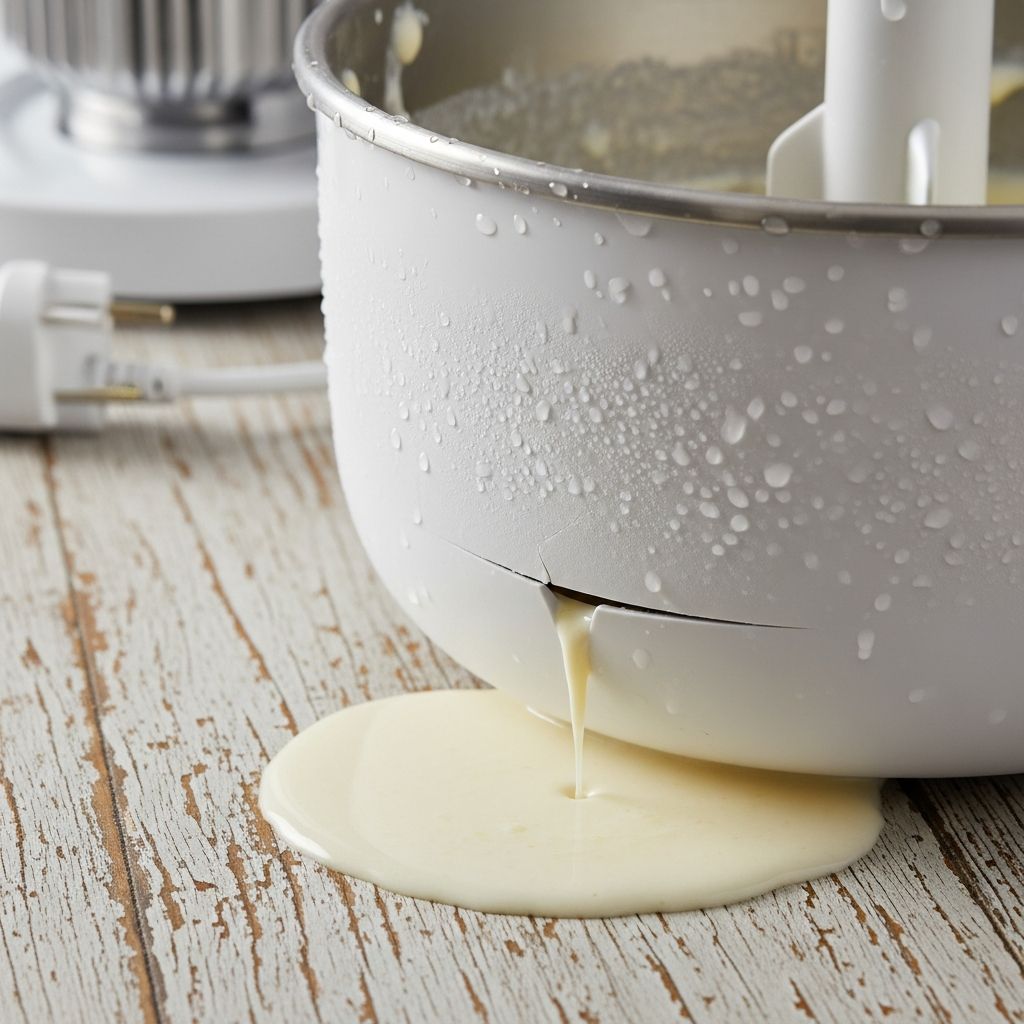
- Blue or colored gel leaking from seam or crack – Many freezer bowls, including popular stand mixer attachments, contain colored cooling gel. Manufacturers state that this gel is non-toxic but that any bowl that leaks it should no longer be used and should be replaced.
- Clear or slightly cloudy liquid appearing after freezing – This may indicate a slow leak of the internal freezing solution, especially if it seeps from the seam between the inner and outer walls.
- Condensation mistaken for leaks – Heavy condensation or frost melt can create small puddles that look like leaks but are actually just water from the air.
- Ice cream mix leaking over the rim – Overfilling the bowl can cause mix to spill during churning, especially when it expands and thickens.
For Bucket-Style Ice Cream Makers
- Brine dripping from the bottom of the bucket – Many buckets include drain holes near the bottom so meltwater can escape. Some dripping is therefore normal, as long as it is from the outer bucket area.
- Ice cream mixture leaking out of the canister – If mix appears in the salt-ice brine, the canister or its lid seal may be compromised.
- Leak at the drive shaft or dasher hub – A worn gasket or seal where the dasher shaft enters the canister or lid can let ice cream mix leak outward.
Diagnosing Leaks in Freezer Bowls
Freezer bowls can sometimes “go bad” if their internal freezing liquid or gel escapes through a crack or seam. Careful inspection helps distinguish a real leak from harmless water.
Step 1: Visual Inspection at Room Temperature
- Check the outside of the bowl for visible cracks, chips, or deep scratches, especially around seams and the bottom.
- Inspect the rim and base for separation between inner and outer walls.
- Look for dried streaks of colored residue (often blue) that may mark previous gel leakage.
Step 2: Weighing the Bowl
Some manufacturers suggest comparing the bowl’s weight to its original specification to detect loss of internal liquid.
- Place the completely dry bowl on a kitchen scale.
- Compare the weight to the value in the manual or, if not listed, contact customer support for the expected weight.
- A significant reduction in weight suggests that some of the internal liquid has leaked, reducing freezing capacity.
Step 3: Filling with Water for a Static Leak Test
This test helps identify cracks in the inner or outer wall:
- Allow the bowl to fully warm to room temperature.
- Dry the bowl thoroughly.
- Fill the bowl with cool water (not hot) up to a safe level, avoiding the rim seam.
- Place the bowl on a dry towel or paper and let it sit for at least 30–60 minutes.
If water appears under the bowl, especially in a consistent area, there may be a crack in the inner or outer wall. Note that this test might not expose very small leaks from the internal gel compartment, but it can confirm obvious structural damage.
Step 4: Observing Behavior in the Freezer
Performance symptoms often accompany internal leaks:
- The bowl never freezes completely solid, even after 24 hours in a properly cold freezer.
- You hear sloshing inside even after a full freeze, when previously it became solid.
- Ice cream mix remains soupy or becomes only a thin milkshake, despite following all other directions (cold mix, correct quantity, correct sugar level).
If you have confirmed proper freezer temperature and technique and the bowl still underperforms, leakage of the internal freezing fluid is a strong possibility.
Step 5: Distinguishing Condensation From Actual Leaks
To determine whether the liquid around your bowl is condensation or a true leak:
- Place a frozen, empty bowl on a dry plate at room temperature.
- Wait 20–30 minutes and observe the liquid that forms.
- Condensation typically forms evenly around the outside and is clear water.
- Localized wet spots, colored fluid, or continuous dripping from a specific seam point to a real leak.
Diagnosing Leaks in Bucket-Style Ice Cream Makers
Bucket-style machines introduce more possible leak points: the canister, the bucket, and the drive shaft or lid seals.
Identifying the Source of Fluid
- Is it brine? – Brine (water, salt, and melted ice) feels salty and may contain ice fragments; it usually comes from the outer bucket area.
- Is it ice cream mix? – Ice cream mix will be creamy in texture and may be sweet or flavored. If you see mix outside the canister, there is a seal or canister issue.
Testing the Canister for Leaks
- Fill the clean canister with water.
- Seal it with the lid and place it upright on a dry surface.
- Check for drips around the base, seams, or side walls after 30–60 minutes.
- Gently tilt or invert over a sink to check if the lid or shaft areas leak significantly.
Any visible dripping from seams or welds indicates the canister should be replaced or professionally repaired.
Inspecting the Drive Shaft and Lid Seal
- Examine the rubber or silicone gaskets where the dasher shaft passes through the lid or canister.
- Look for cracks, flattening, brittleness, or missing pieces.
- Check that the shaft fits snugly; excessive wobble may open a path for leaks.
Worn gaskets are often replaceable and may be available as inexpensive spare parts from the manufacturer.
Step-by-Step Troubleshooting Checklist
The following checklist provides a practical, sequential approach to diagnosing and addressing leaks from your ice cream maker.
1. Confirm Proper Use and Conditions
- Verify the freezer temperature is cold enough, typically around -18 °C (0 °F) for freezer bowls.
- Ensure the bowl has been frozen for the full time recommended in the manual, often at least 16–24 hours.
- Make sure your ice cream mixture is thoroughly chilled to refrigerator temperature before churning.
- Check that you are not overfilling the bowl or canister. Most bowls require leaving space at the top for expansion.
2. Identify the Type of Leak
| Observation | Likely Leak Type | Typical Action |
|---|---|---|
| Colored gel (often blue) seeping from a seam | Internal freezer bowl gel leak | Stop using; replace bowl; contact manufacturer |
| Clear water around frozen bowl | Condensation or frost melt | Normal; use towel or tray for moisture |
| Sweet, creamy liquid outside canister | Ice cream mix leakage | Inspect canister, lid, and shaft seals |
| Salty brine dripping from bucket bottom | Salt-ice meltwater draining | Often normal if from drain holes; protect surfaces |
3. Inspect for Physical Damage
- Look for dents, warping, or cracks from drops or impacts.
- Check that the freezer bowl has not been washed in a dishwasher, which can damage seals and is typically not recommended by manufacturers.
- Inspect plastic parts and rims for hairline cracks that may open under cold stress.
4. Perform Leak Tests
- Static water fill test for canisters and inner bowls at room temperature.
- Frozen condensation test to separate normal moisture from structural leakage.
- Weight comparison against manufacturer specifications for freezer bowls, if available.
5. Decide on Repair, Replacement, or Service
- If the internal gel of a freezer bowl is leaking, manufacturers generally advise replacement rather than repair.
- If a bucket canister is leaking at a weld or seam, replacement is usually more reliable than DIY patching for food safety.
- Replace worn gaskets, seals, and O-rings where available.
- If the appliance is under warranty or the leak is severe, contact customer service or an authorized repair center.
Safety Considerations and When to Stop Using the Bowl
While manufacturers often state that the internal cooling gel is non-toxic, safety and performance still require caution.
- If you see colored gel leaking from the freezer bowl, discontinue use immediately and contact the manufacturer or replace the bowl.
- Do not continue using a bowl with visible cracks or ongoing leakage, even if you do not see gel; the structure may worsen and fail during use.
- A bowl that never freezes properly can allow your ice cream mixture to sit at unsafe temperatures for extended periods; discard any mix that has stayed in the food danger zone for too long.
- Avoid ingesting any leaked gel or brine and keep children and pets away from spills until cleaned thoroughly.
Prevention: How to Avoid Future Leaks
Preventive habits significantly extend the life of both freezer bowls and bucket-style ice cream makers.
Care for Freezer Bowls
- Always wash the bowl by hand with mild detergent and warm (not hot) water, only after it has returned to room temperature.
- Never put the freezer bowl in the dishwasher, as high heat and harsh detergents can damage seals and cause leaks.
- Avoid hitting, dropping, or prying frozen contents with metal utensils, which can cause micro-cracks.
- Store the bowl in the freezer only when it is completely dry to prevent ice expansion in seams.
- Follow manufacturer guidance about long-term storage and always freeze for the recommended duration before use.
Care for Bucket-Style Units
- Rinse salt and brine from the bucket and canister thoroughly after each use to prevent corrosion.
- Dry metal parts completely before storage to limit rust around seams and welds.
- Inspect gaskets and seals periodically and replace them if they appear worn or brittle.
- Use the ice and salt ratios recommended by the manufacturer to avoid excessive brine levels that might stress seals and joints.
Repair Options and When to Replace
Not every leak requires replacing the entire appliance, but some components are not designed to be repaired at home.
Freezer Bowls
- Internal freezing fluid compartments are sealed at the factory and are not intended to be opened or refilled.
- Adhesives or sealants applied externally rarely restore full performance and may not be food safe.
- If the internal gel is leaking, replacement of the bowl with an original manufacturer part is the recommended fix.
Bucket-Style Canisters and Buckets
- Minor external bucket leaks at drain holes are often by design; use trays or towels to protect surfaces.
- Leaking canister seams or welds are best resolved by replacing the canister, especially when the leak contacts food.
- Drive shaft seals, O-rings, and lid gaskets are usually replaceable and relatively inexpensive.
When to Contact the Manufacturer or Service
- If your unit is still under warranty and you suspect a manufacturing defect.
- When there is a leak of colored gel or a structural failure in the freezer bowl.
- If there is evidence of electrical issues due to leaks (for example, moisture near the motor housing).
Frequently Asked Questions (FAQs)
Q: My freezer bowl makes a sloshing sound even after 24 hours in the freezer. Is that a leak?
A: Many designs allow the internal liquid to remain slightly slushy rather than rock solid, so some sloshing can be normal. However, if you also notice reduced freezing performance or visible cracks, it may indicate internal leakage and reduced capacity.
Q: Blue liquid is leaking from my stand mixer ice cream attachment. Is it dangerous?
A: Manufacturers state that the blue gel inside some freeze bowls is non-toxic but recommend that any leaking bowl be retired from use and replaced. Do not attempt to repair the gel compartment yourself.
Q: My ice cream maker bowl does not leak, but it no longer freezes the mixture properly. Could it still have a hidden leak?
A: Yes. If some internal freezing liquid has escaped, the bowl’s weight may be lower and its capacity to store cold reduced, even without obvious external dripping. Verifying freezer temperature, bowl freezing time, and mixture temperature first is essential; if those are correct, a partially leaked bowl is a strong possibility.
Q: Is it normal for my bucket-style ice cream maker to leak water and salt from the bottom?
A: Some dripping of brine from drain holes in the outer bucket is normal and helps prevent overflow. Place the unit on a tray, in a sink, or on towels to protect surfaces. Only be concerned if you see sweet, creamy ice cream mix leaking out of the canister, which suggests a seal or canister problem.
Q: Can I seal a crack in my freezer bowl with food-grade epoxy?
A: Even with food-grade sealants, repairing the outer surface rarely restores the sealed internal freezing compartment, and performance will likely remain compromised. For safety and reliable freezing, replacing the bowl with an original part is generally recommended.
Conclusion
Leaks in ice cream maker freezer bowls and buckets are inconvenient, but they also offer important clues about the condition and safety of your equipment. By carefully identifying whether the fluid is condensation, brine, internal gel, or ice cream mix, you can quickly narrow down the true source of the problem.
Freezer bowls that leak internal gel or show a clear loss of freezing performance after proper use are usually at the end of their service life and should be replaced. Bucket-style machines often allow more straightforward maintenance through replaceable gaskets and canisters, though brine dripping from drain holes is typically normal. Consistent cleaning, gentle handling, and adherence to manufacturer instructions—especially avoiding dishwashers for freezer bowls—go a long way toward preventing leaks in the first place.
A thoughtful approach combines observation, simple tests, and an understanding of how your specific model is designed to handle moisture and cooling. With these troubleshooting steps, you can decide confidently when a small drip is harmless, when a simple gasket swap is enough, and when a leaking component must be retired to keep your ice cream making safe and reliable.
Similar Articles




Read full bio of Sneha Tete