
Types of Air Fryers Explained: Basket, Oven-Style, Dual-Zone and More
Understand basket, oven-style, dual-zone and specialty air fryers so you can match the right design, size and features to how you actually cook.
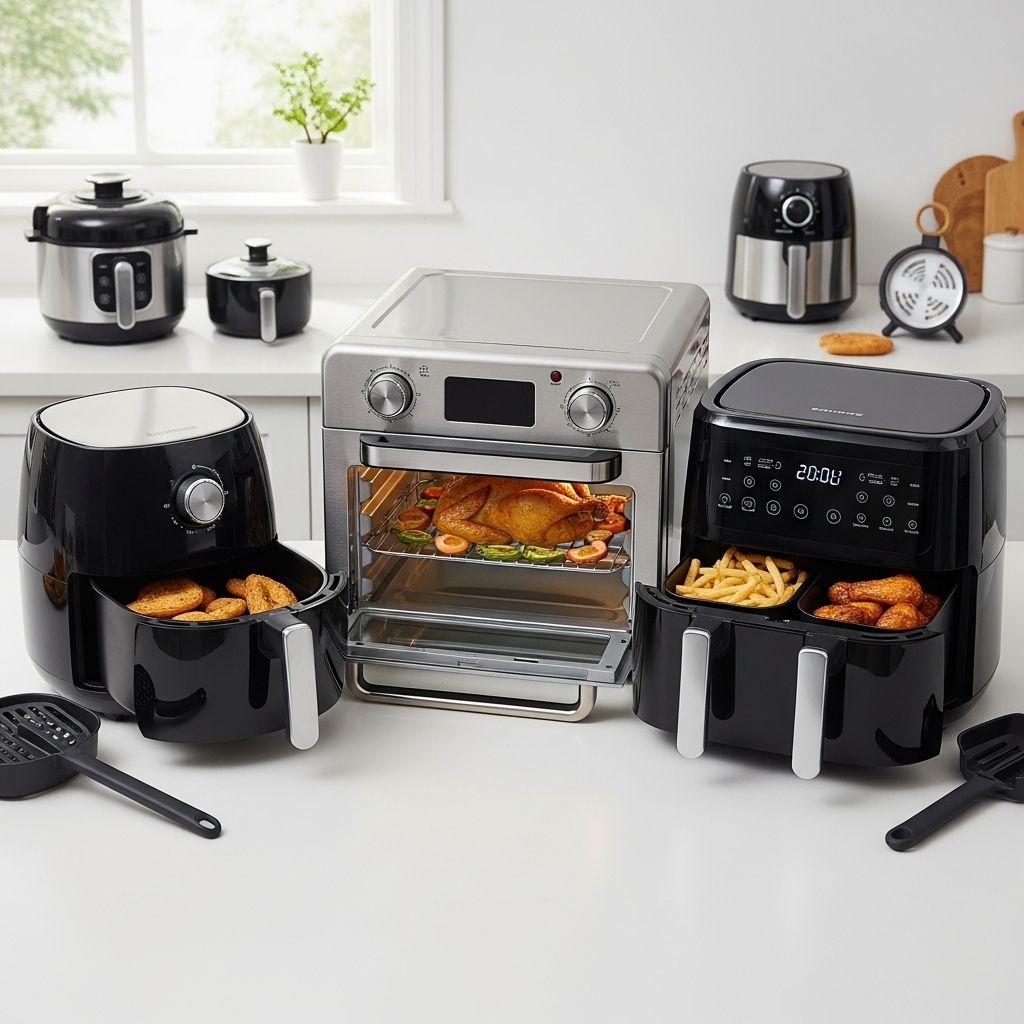
Air fryers have evolved from simple countertop gadgets into a wide family of appliances with different shapes, capacities and cooking features. Modern models range from compact basket units for singles to large dual-zone and oven-style designs that can replace a second oven in a busy kitchen. Understanding the main types will help you decide which one truly fits your space, recipes and household size.
This guide explains the most common types of air fryers, how they work, their strengths and trade-offs, and who each style is best suited for. It also covers key buying criteria and answers frequently asked questions so you can choose with confidence.
Table of Contents
- How Air Fryers Work in Simple Terms
- Basket Air Fryers
- Oven-Style Air Fryers
- Dual-Zone and Dual-Basket Air Fryers
- Multifunction, Grill and Multi-Cooker Air Fryers
- Compact, Mini and Portable Air Fryers
- Key Buying Factors Across All Types
- Comparison Table: Main Types of Air Fryers
- Frequently Asked Questions (FAQs)
- Conclusion
How Air Fryers Work in Simple Terms
Despite the name, air fryers do not actually fry food in oil. They are compact convection ovens that rapidly circulate hot air around food. A heating element warms the air, and a powerful fan moves it quickly across the surface of your food, creating a crisp exterior similar to deep frying but with much less oil.
Core parts most air fryers share include:
- An electric heating element, usually on the top
- A fan that circulates hot air at high speed
- A cooking chamber (basket, rack or trays)
- Controls for temperature, time and presets
Differences between air fryer types mainly come down to the shape of the cooking chamber, how food is arranged (basket versus racks), size, and how many independent cooking zones you get.
Basket Air Fryers
Basket air fryers are the original and still the most popular type. They look like compact countertop appliances with a pull-out drawer and a removable basket inside.
Main Characteristics of Basket Air Fryers
- Deep pull-out basket or drawer where food sits, often with a perforated crisper plate
- Hot air circulates around food from the top heating element and fan
- Available in various sizes, from about 2 to over 7 quarts
- Typically one cooking zone (single basket), though some offer dividers
Pros of Basket Air Fryers
- Usually compact and space-saving, ideal for small kitchens or apartments
- Simple to operate, with straightforward controls and presets
- Basket design encourages good air circulation for crisp results, especially on fries and frozen snacks
- Often faster preheat and cook times than larger oven-style units
- Many have dishwasher-safe baskets and crisper plates for easier cleaning
Cons of Basket Air Fryers
- Limited cooking surface area, which can make it harder to cook large items like whole chickens in small models
- Foods usually need to be shaken or turned partway through cooking to ensure even crisping
- Not ideal for baking multiple layers or cooking on several racks at once
Best Uses and Ideal Users
Basket air fryers are well suited to:
- Singles, couples and small families cooking for 1–4 people
- Frozen foods like fries, nuggets, fish sticks and onion rings
- Quick weeknight sides and snacks
- People who want a low-maintenance, plug-and-cook appliance
Independent testing often highlights medium-sized basket air fryers (around 5–6 quarts) as a sweet spot between capacity and countertop footprint.
Oven-Style Air Fryers
Oven-style air fryers, sometimes called air fryer ovens, look more like mini countertop ovens. They have a front door and multiple rack positions rather than a pull-out basket.
Main Characteristics of Oven-Style Air Fryers
- Front-opening door with glass window for viewing food
- One or more wire racks, trays or a rotating basket inside
- Often have functions beyond air frying, such as bake, broil, toast, dehydrate or rotisserie
- Typically larger on the counter, with higher internal capacity than compact basket models
Pros of Oven-Style Air Fryers
- More flat cooking surface area for foods that need to be spread out
- Easier to cook multiple foods at once using two racks (though you may need to rotate them for evenness)
- Great for baking, roasting whole chickens and family-sized meals
- Viewing window lets you monitor browning without opening the door
Cons of Oven-Style Air Fryers
- Larger footprint, so they demand more counter or storage space
- Can take longer to preheat than compact basket units
- Multiple racks and accessories mean more pieces to clean
Best Uses and Ideal Users
Oven-style air fryers work well for:
- Families who cook for 4 or more people regularly
- People wanting a multi-purpose appliance that can replace a toaster oven
- Cooking whole chickens, sheet-pan style meals and baked goods
- Home cooks who like to see food as it cooks through a glass door
Consumer testing often highlights that these models excel in versatility, especially when you need to toast, bake and air fry in one machine.
Dual-Zone and Dual-Basket Air Fryers
Dual-zone air fryers are one of the most significant design developments in recent years. They feature two separate cooking areas that can run different programs at the same time.
What Is a Dual-Zone Air Fryer?
In a dual-zone or dual-basket air fryer, the appliance includes two separate baskets or chambers, each with its own time and temperature controls. Some models can sync both zones to finish cooking simultaneously, even if they started at different settings.
Main Characteristics
- Two independent baskets or zones, typically side by side
- Separate controls so you can set different temperatures and times for each zone
- Sync or match functions that align finish times for both zones
- Total capacity frequently ranges from around 8 to 10 quarts or more
Pros of Dual-Zone Air Fryers
- Cook a main dish and side dish at once without flavor transfer when the zones are fully separate
- Flexible for different cooking times (for example, chicken in one drawer, fries in the other)
- Large total capacity for families or batch cooking
Cons of Dual-Zone Air Fryers
- Wider and heavier than single-basket models, requiring more counter space
- More expensive than basic basket air fryers
- Some models with a shared cavity and divider may have slight heat transfer between sides
Best Uses and Ideal Users
Dual-zone air fryers are ideal for:
- Families that regularly cook complete meals in an air fryer
- Meal preppers who want to cook different foods at the same time
- Households that want to replace a second oven with a flexible countertop setup
Independent lab tests and expert reviews frequently recommend dual-zone models for their convenience and ability to simplify cooking multiple components of a meal.
Multifunction, Grill and Multi-Cooker Air Fryers
Beyond traditional air fryers, many appliances now combine air frying with other cooking methods. These include air fryer grills, pressure cooker-air fryer combos and multi-cookers that can sauté, steam and slow cook as well as air fry.
Common Multifunction Types
- Air fryer plus grill or griddle plate
- Air fryer plus pressure cooker and slow cooker (multi-cooker style)
- Air fryer plus toaster oven functions (bake, broil, toast, dehydrate)
Pros of Multifunction Air Fryers
- Consolidate several appliances into one unit, saving space overall
- Highly versatile for different cooking techniques beyond air frying alone
- Useful for small kitchens where you cannot accommodate many separate devices
Cons of Multifunction Air Fryers
- Often more complex controls with more presets and modes
- Can be bulkier and heavier
- Not everyone needs all the extra modes, so some features may go unused
Best Uses and Ideal Users
Multifunction and combo air fryers suit:
- Home cooks who like experimenting with multiple cooking methods
- People wanting to replace separate slow cookers, grills or toaster ovens
- Families that rely on one main appliance for most daily cooking
Compact, Mini and Portable Air Fryers
Compact and mini air fryers are scaled-down versions of basket models designed for very small kitchens, dorm rooms or occasional use.
Main Characteristics
- Smaller capacity, often in the 1.5–3 quart range
- Lighter and easier to move or store
- Simplified controls, sometimes with just a dial for time and temperature
Pros of Compact Air Fryers
- Minimal counter and storage space required
- Typically more affordable than large models
- Efficient for single servings or occasional snacks
Cons of Compact Air Fryers
- Very limited capacity, not practical for full family meals
- Food often needs to be cooked in several batches when cooking for more than one or two people
Best Uses and Ideal Users
Compact and mini air fryers are best for:
- Single users or students in dorms
- Small kitchens with almost no spare counter space
- Secondary use at offices, RVs or vacation homes
Key Buying Factors Across All Types
Regardless of which type you choose, certain considerations will help you match an air fryer to your needs.
1. Capacity and Household Size
- 1.5–3 quarts: best for one person or very small portions
- 4–6 quarts: suitable for most couples and small families
- 7–10 quarts and up: best for larger families or cooking full meals in one go
Remember that basket shape matters too: wide, square baskets provide more usable surface than narrow, tall ones of similar volume.
2. Available Counter and Storage Space
- Measure your counter depth and cabinet clearance before choosing a large oven-style or dual-zone unit.
- Consider the weight if you expect to move the appliance in and out of storage.
3. Controls and Presets
- Basic models have manual dials for time and temperature.
- Digital models add preset programs (fries, chicken, fish, bake, reheat, dehydrate, and more).
- Some higher-end units include internal temperature probes and shake reminders.
4. Ease of Cleaning
- Look for removable, non-stick baskets, racks and trays.
- Check whether parts are dishwasher-safe, and how easy corners and mesh areas are to scrub.
5. Noise, Build Quality and Safety
- Most air fryers produce fan noise similar to a microwave or small range hood.
- Quality models have solid-feeling doors or drawers, stable feet and good insulation.
- Safety features can include auto shut-off, cool-touch exterior and overheating protection.
Comparison Table: Main Types of Air Fryers
| Type | Typical Capacity | Best For | Key Advantages | Key Trade-Offs |
|---|---|---|---|---|
| Basket air fryer | 2–7 quarts | Singles, couples, small families | Compact, easy to use, great for snacks and sides | Limited cooking surface; usually single zone |
| Oven-style air fryer | 10–26 liters (varies) | Families, bakers, multi-use kitchens | Multiple racks, viewing window, more versatile | Larger footprint, more accessories to clean |
| Dual-zone / dual-basket | 8–10+ quarts total | Families cooking full meals at once | Two independent zones, sync functions, high capacity | Wider size, higher cost |
| Multifunction / combo | Varies (often medium–large) | Users wanting one appliance to do many tasks | Replaces several appliances, multiple modes | More complex controls, can be bulky |
| Compact / mini | 1.5–3 quarts | Single users, dorms, RVs | Very small, affordable, lightweight | Small batches only, not ideal for families |
Frequently Asked Questions (FAQs)
Q1: Is an air fryer just a small convection oven?
In principle, yes. Both air fryers and convection ovens use a fan to circulate hot air around food. Air fryers are typically more compact, with faster air circulation and a design focused on crisping foods efficiently in a smaller space.
Q2: Which type of air fryer is best for a family of four?
For a family of four, a medium to large basket model (around 5–7 quarts) or a dual-zone air fryer provides enough space to cook mains and sides without constant batching. If you prefer to bake and toast in the same appliance, an oven-style air fryer with multiple racks is also a strong option.
Q3: Do dual-zone air fryers cook faster than single-basket models?
Dual-zone air fryers do not necessarily cook individual foods faster, but they can cook more components at once. Their main benefit is flexibility: you can run different settings in each zone and still have everything ready at the same time using sync features.
Q4: Are oven-style air fryers less efficient because they are bigger?
Oven-style air fryers may take slightly longer to preheat due to their larger internal volume, but they can be more efficient when cooking larger amounts of food because you can use multiple racks. For small single portions, a compact basket model is usually quicker and more energy-efficient.
Q5: What capacity should I choose if I cook mainly snacks and sides?
If you primarily heat frozen snacks or make small sides, a 3–5 quart basket air fryer is usually sufficient. It will heat quickly, take up less space and still provide enough room to spread out a tray of fries or wings.
Conclusion
Choosing between basket, oven-style, dual-zone and other air fryer designs starts with an honest look at what and how much you cook. Basket models excel at speed and simplicity for one to four people, while oven-style versions add versatility and space for baking, roasting and multi-rack cooking. Dual-zone units shine when you want to prepare entire meals simultaneously, and multifunction appliances are useful if you prefer one machine that can grill, slow cook or bake as well as air fry.
A thoughtful choice balances capacity with kitchen space, and convenience features with how often you will use them. Matching the type of air fryer to your routine—quick snacks, family dinners, batch meal prep or all of the above—will ensure that whichever style you select becomes a genuinely useful tool rather than just another countertop gadget.
By focusing on capacity, layout (basket versus racks), number of zones and practical features such as ease of cleaning and intuitive controls, you can navigate the growing air fryer market and select the model that best supports the way you like to cook.
Similar Articles






Read full bio of Sneha Tete