Types of Warming Drawers for Home Kitchens: Built-In, Under-Counter, and Integrated Options
Explore built-in, under-counter, and integrated warming drawer designs to match your kitchen layout, cooking style, and design goals.
Introduction to Warming Drawers in Home Kitchens
Warming drawers are specialized kitchen appliances designed to keep cooked food at a safe, steady serving temperature without drying it out or overcooking it. Unlike a conventional oven, a warming drawer operates at lower, tightly controlled temperatures and often allows some form of humidity or moisture control. Many models can also proof bread dough or even slow cook, adding extra versatility.
In modern home kitchens, warming drawers are valued for their ability to coordinate meals, simplify entertaining, and make everyday cooking more flexible. You can finish dishes ahead of time, keep plates warm, or hold food for guests arriving late, all while maintaining flavor and texture.
This article focuses on the main installation types you will encounter when planning a home kitchen: built-in, under-counter, and fully integrated warming drawer designs. Understanding these categories will help you match the right appliance to your layout, budget, and design goals.
Table of Contents
- What Is a Warming Drawer and How It Works
- Key Benefits of Adding a Warming Drawer
- Main Types of Warming Drawers by Installation
- Built-In Warming Drawers
- Under-Counter Warming Drawers
- Integrated and Panel-Ready Warming Drawers
- Feature and Design Comparison Table
- How to Choose the Right Type for Your Kitchen
- Installation, Power, and Safety Considerations
- Care, Cleaning, and Longevity
- Frequently Asked Questions
- Conclusion
What Is a Warming Drawer and How It Works
A warming drawer is a shallow, slide-out compartment that uses electric heating elements and thermostatic controls to maintain food at serving temperatures, typically in the range of about 80°F to 200°F (roughly 30°C to 95°C or a bit higher depending on the model). This is lower than a standard oven, which is why it can hold dishes safely for extended periods without cooking them further.
Many residential warming drawers include:
- Adjustable temperature settings for different foods and uses.
- Moisture or humidity controls to keep items either moist or crisp.
- Special modes for bread proofing or low-temperature slow cooking.
The appliance is usually installed into cabinetry, similar to a wall oven, under a cooktop, or beneath a built-in coffee system or microwave. Some ranges also include a warming drawer in the base, effectively combining functions in one appliance.
Key Benefits of Adding a Warming Drawer
Home cooks and designers add warming drawers to kitchens for several practical reasons.
- Meal coordination: Keep side dishes, sauces, and main courses hot so everything can be served at once, even when cooking in stages.
- Entertaining convenience: Hold appetizers or plated dishes for guests arriving at different times, without reheating cycles that can dry out food.
- Food quality: Steady, lower temperatures and optional humidity help preserve texture and flavor compared with repeated oven or microwave reheating.
- Versatility: Many drawers can proof dough, melt chocolate gently, or function as a slow cooker with dedicated modes.
- Energy efficiency: Warming drawers typically use less energy than heating a full-size oven to keep food warm.
- Design flexibility: Multiple configuration options (built-in, under-counter, integrated) allow the drawer to fit various layouts and design styles.
Main Types of Warming Drawers by Installation
While warming drawers share core functionality, they differ in how they are installed and how they relate to the surrounding cabinetry and appliances. For home kitchens, three main configuration types are most relevant:
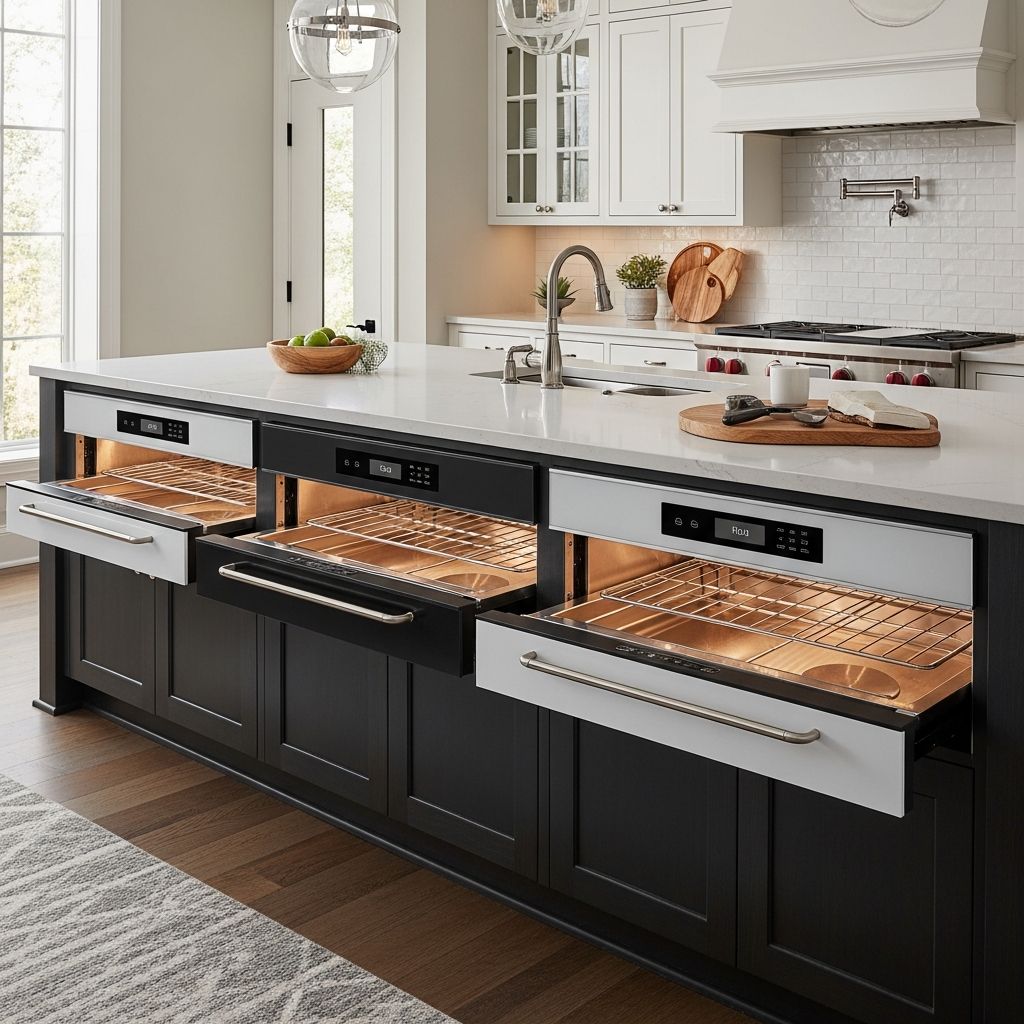
- Built-in warming drawers mounted in wall cabinetry, often above or below wall ovens.
- Under-counter warming drawers placed beneath counters or cooktops, often in islands or peninsulas.
- Integrated or panel-ready warming drawers that accept custom cabinet fronts for a seamless, furniture-like appearance.
Each type can usually be found in various widths (commonly around 24 to 30 inches) and finishes such as stainless steel, black stainless, or color-matched designs. Some premium brands emphasize matching warming drawers to their wall ovens and ranges for a unified look.
Built-In Warming Drawers
Built-in warming drawers are installed directly into wall or tall cabinetry, often stacked with other built-in appliances like single or double wall ovens, speed ovens, or coffee systems. This is a popular choice in larger kitchens and custom renovations.
Typical Locations for Built-In Models
- Directly below a single wall oven to create a compact cooking tower.
- Between double ovens or under a microwave or speed oven in a vertical stack.
- In a tall cabinet near the dining room, functioning as a serving station.
- In a butler’s pantry or prep kitchen to support entertaining and catering.
Key Advantages of Built-In Warming Drawers
- Ergonomic placement: Eye-level or waist-high installation reduces bending, making it easier to load and unload heavy dishes.
- Appliance wall design: Seamlessly integrates into a wall of ovens and other built-ins for a professional, cohesive look.
- Efficient workflow: Positioned near primary cooking appliances, it simplifies moving dishes from oven to warming drawer.
Potential Drawbacks
- Requires suitable wall cabinet space and rough-in dimensions.
- May be less convenient for secondary serving areas, such as an island across the room.
- Installation changes can be more complex in small or existing kitchens compared to under-counter options.
Built-in models are especially appealing in new construction or major remodels where cabinetry can be designed around a full appliance suite.
Under-Counter Warming Drawers
Under-counter warming drawers are installed beneath countertop level, similar to a standard drawer or built-in under-counter appliance. They are especially popular in islands, peninsulas, and along base cabinet runs.
Common Under-Counter Locations
- In a kitchen island near a seating overhang for buffet-style serving.
- Under a cooktop to simplify moving pans and dishes directly from the cooking surface.
- Near a breakfast nook to keep plates and breakfast foods warm.
- In a secondary prep zone, such as a bar or snack area, for appetizers and small bites.
Advantages of Under-Counter Installations
- Space efficiency: Uses base cabinet space that might otherwise be a standard drawer, providing extra functionality without new walls.
- Serving convenience: Ideal for casual dining, islands, and buffet setups where guests help themselves.
- Flexible placement: Easier to incorporate into existing kitchens where wall cabinet space is limited.
Considerations and Trade-Offs
- Requires more bending to access, especially for larger or heavier dishes.
- Needs clear space in base cabinetry and proper structural support.
- Must be coordinated carefully with plumbing, electrical, and other under-counter appliances.
Under-counter models are an excellent choice when you want warming capability close to casual seating or prep areas without dedicating a tall cabinet.
Integrated and Panel-Ready Warming Drawers
Integrated or panel-ready warming drawers are designed to accept a custom cabinet panel on the front, allowing them to blend in with surrounding drawers and doors. When closed, these appliances can be nearly indistinguishable from standard cabinetry.
Design Characteristics
- Face panel matches cabinet finish, color, and hardware for a cohesive aesthetic.
- Often paired with other integrated appliances (refrigeration drawers, dishwashers, coffee systems) in high-end kitchens.
- Controls may be hidden inside the drawer or at the top edge for a clean external appearance.
Benefits of Integrated Designs
- Seamless look: Ideal for minimal or contemporary kitchens that avoid visible stainless-steel appliance fronts.
- Customizable: Homeowners and designers can tailor the appearance to match furniture-style cabinetry or specific design themes.
- Discreet functionality: Offers all the performance of a warming drawer without visually dominating the room.
Points to Note
- Usually found in mid- to high-end price ranges due to custom panel work.
- Requires careful coordination between cabinetmaker and appliance specs.
- Still needs proper ventilation clearances and access for service, even though it looks like cabinetry.
Integrated warming drawers are most appealing when visual continuity is a top priority, such as in open-plan spaces where the kitchen flows into living and dining areas.
Feature and Design Comparison Table
The following table summarizes typical differences among built-in, under-counter, and integrated warming drawer configurations, focusing on installation and design characteristics rather than brand-specific features.
| Type | Typical Location | Design Focus | Main Advantages | Primary Considerations |
|---|---|---|---|---|
| Built-In | Wall or tall cabinetry, often under or near wall ovens | Matches appliance stack; prominent in appliance wall | Ergonomic height; efficient oven-to-drawer workflow | Needs tall cabinet space; more planning in small kitchens |
| Under-Counter | Base cabinets, islands, peninsulas, under cooktops | Convenient to prep and serving areas | Great for islands and casual dining; flexible retrofit option | More bending required; competes with base storage space |
| Integrated / Panel-Ready | Either wall or under-counter, with custom cabinet fronts | Seamless cabinetry look; hidden appliance appearance | Design continuity in open-plan spaces; fully customizable style | Higher cost; requires custom panel and precise installation |
How to Choose the Right Type for Your Kitchen
Selecting between built-in, under-counter, and integrated warming drawer designs involves balancing layout, cooking habits, and design style.
1. Evaluate Your Kitchen Layout
- If you are planning an appliance wall with built-in ovens, a built-in warming drawer beneath or beside the oven can be the most efficient choice.
- If you have a large island used for dining or buffets, an under-counter drawer in the island can simplify serving and plate warming.
- In smaller renovations where tall cabinet space is limited, under-counter installations often fit more easily into existing cabinetry.
2. Consider How You Cook and Entertain
- Frequent entertainers or large families benefit from a drawer near the primary cooking zone to keep multiple dishes ready.
- Bakers may prefer a model with dedicated proofing and moisture controls located near prep counters.
- If you frequently host buffet-style gatherings, storing dishes in an island or near a dining area may be most practical.
3. Align with Design and Aesthetic Goals
- For a professional, stainless-steel look, matching built-in drawers from brands that also supply ovens and ranges is a strong option.
- For a minimal or furniture-style kitchen, consider integrated, panel-ready drawers that blend with surrounding cabinetry.
- Coordinate handle styles, finishes, and control layouts for visual consistency across all built-in appliances.
4. Review Feature Sets and Technology
- Look for temperature range broad enough to handle plate warming, food holding, and proofing.
- Prioritize humidity control if you plan to hold bread, pastries, or fried foods frequently.
- Some advanced models offer smart connectivity, app-based control, or integrated sensors to optimize energy use and convenience.
- Check for safety features such as automatic shut-off and child-lock options, especially in family homes.
5. Budget and Long-Term Value
- Standard stainless built-in or under-counter models are often more budget-friendly than fully integrated designs.
- Panel-ready drawers involve additional cost for custom cabinet panels and hardware.
- Assess how frequently you will use the appliance; regular entertainers and serious home cooks tend to get the most value from a warming drawer.
Installation, Power, and Safety Considerations
Regardless of type, most residential warming drawers are electric units that do not require gas connections or special venting. However, proper electrical service and adherence to manufacturer specifications are essential.
Electrical Requirements
- Dedicated circuit may be required, depending on local codes and the drawer’s power rating.
- Verify voltage and amperage requirements against your kitchen’s electrical plan.
- Position outlets according to manufacturer instructions to avoid interference with drawer movement and to maintain access for service.
Cabinetry and Clearances
- Follow cutout dimensions and support requirements carefully to ensure the drawer operates smoothly and safely.
- Maintain any specified ventilation or clearance gaps around the unit to prevent overheating.
- For integrated designs, coordinate with your cabinet professional to align reveals, panel thickness, and hardware placement.
Safety and Use
- Use oven-safe, heat-resistant dishes and pans compatible with the drawer’s temperature range.
- Avoid placing plastic or non-heatproof items inside the drawer when it is operating.
- Use moisture settings appropriately to maintain food quality and reduce the risk of drying out or over-softening foods.
- Educate household members on safe operation, especially if the drawer is installed at a low, under-counter height.
Care, Cleaning, and Longevity
Warming drawers typically have relatively simple interiors, which makes them easier to maintain than full-size ovens. Good care supports both performance and appearance over time.
- Allow the drawer to cool completely before cleaning.
- Wipe interior surfaces with a damp cloth and mild detergent; avoid abrasive pads that might damage finishes.
- Remove and clean racks, pans, or dividers according to manufacturer instructions.
- Check gaskets and seals periodically to ensure proper fit and heat retention.
- Inspect the control panel for any damage or error messages and consult service if the drawer fails to heat or shuts off unexpectedly.
Because warming drawers occupy a fixed cabinet opening, choosing a quality brand and model that fits your anticipated use is important; replacing them later can require cabinetry modifications.
Frequently Asked Questions
Q1: Do I really need a warming drawer if I already have a good oven?
A: A standard oven can keep food warm, but it typically operates at higher, less precise temperatures and may dry food out or continue cooking it. A warming drawer is designed specifically for gentle holding, reheating, and proofing, with tighter control over temperature and, in many models, humidity.
Q2: Can a warming drawer be installed under a cooktop?
A: Yes, many under-counter warming drawers are designed to be installed beneath an electric or gas cooktop, provided that clearances and electrical requirements are met. Always check both the cooktop and drawer installation guides to confirm compatibility.
Q3: Is a warming drawer the same as a warming zone on a range?
A: No. A warming drawer is an enclosed compartment that maintains even heat around the food, while a warming zone on a cooktop or range is usually a single heated surface. The drawer offers better insulation and humidity control, which helps preserve texture and flavor.
Q4: Can I use a warming drawer to slow cook?
A: Some residential warming drawers include a dedicated slow-cook mode and are designed to function similarly to a slow cooker at lower, controlled temperatures. If slow cooking is important to you, verify that the model you are considering officially supports this feature.
Q5: Which type is best for a small kitchen?
A: In smaller kitchens without tall cabinet space, an under-counter warming drawer integrated into a base cabinet or island often works best, as it uses space that might otherwise be a regular drawer. If visual simplicity is critical, a panel-ready integrated drawer can blend in with cabinetry to avoid making the room feel crowded.
Conclusion
Built-in, under-counter, and integrated warming drawers all serve the same core purpose: maintaining food at ideal serving temperatures without sacrificing texture or flavor. They accomplish this through lower, more carefully controlled temperatures and, in many models, humidity management. The differences lie mainly in how they interact with your kitchen layout, cabinetry, and visual design.
Choosing among these types begins with an honest look at how you cook and entertain, and how your kitchen is arranged. Built-in models pair naturally with oven stacks, under-counter designs support islands and everyday serving zones, and integrated panel-ready drawers prioritize a seamless, furniture-like aesthetic. Factoring in electrical requirements, installation details, and desired features such as proofing, slow cooking, or smart controls helps refine the decision.
A thoughtful selection considers not only immediate convenience but also long-term use, maintenance, and how the appliance complements the rest of the kitchen. When aligned with your layout and cooking style, any of these warming drawer configurations can become a quiet yet highly effective tool for better meals and smoother entertaining.
Similar Articles





Read full bio of Sneha Tete