Understanding CADR Ratings and Their Impact on Air Purifier Performance
Learn how CADR ratings define real-world air purifier performance and help you choose the right unit for your space.
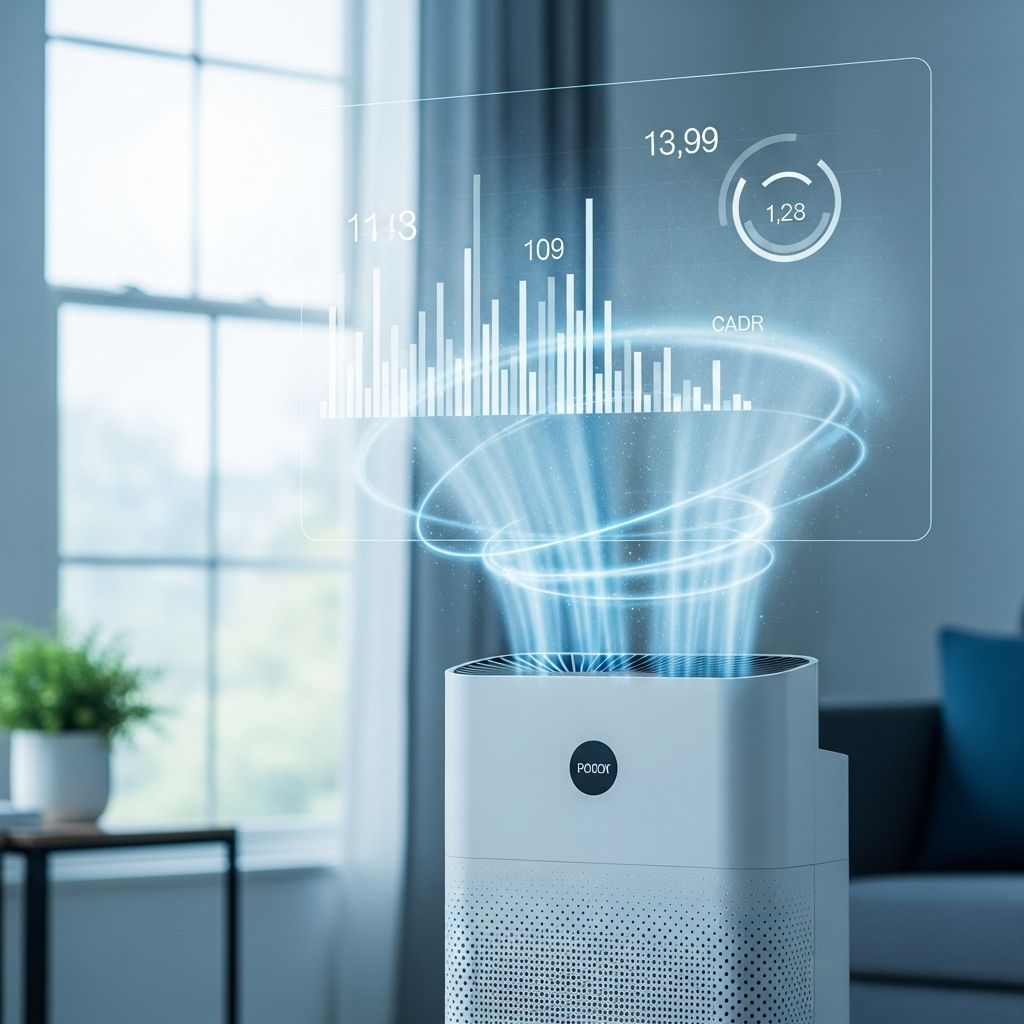
Understanding CADR Ratings and What They Mean for Air Purifier Performance
When you compare air purifiers, you will almost always see a number labeled CADR. This rating is one of the most important objective measures of how quickly and effectively an air purifier can clean the air in a room. Knowing how CADR works, what its limits are, and how to use it alongside other specifications can help you choose a purifier that actually delivers cleaner indoor air, rather than just impressive marketing claims.
Table of Contents
- What Is CADR?
- How CADR Is Measured and Who Sets the Standard
- CADR Ratings for Different Pollutants
- CADR, Airflow, and Filter Efficiency
- Using CADR to Match an Air Purifier to Room Size
- Why CADR Matters When Comparing Air Purifiers
- Limitations and Common Misconceptions About CADR
- CADR vs. Other Air Quality Metrics (MERV, HEPA, ACH)
- Practical Checklist: Using CADR in Real-World Buying Decisions
- Frequently Asked Questions (FAQs)
- Conclusion
What Is CADR?
CADR stands for Clean Air Delivery Rate. It describes the volume of air that has been cleaned of specific particles per minute by an air purifier, expressed in cubic feet per minute (CFM). In practical terms, a higher CADR means an air purifier can reduce particle concentrations more quickly in a given room.
The CADR rating was developed to give consumers a standardized way to understand how effective a portable room air cleaner is at removing airborne particles under controlled conditions. Instead of only listing airflow or filter type, CADR integrates both into a single performance number.
Key points about CADR
- Measures clean air output, not just total air moved.
- Expressed in cubic feet per minute (CFM), such as 200 CFM.
- Based on removal of three main particle types: smoke, dust, and pollen.
- Higher CADR = faster reduction of particle concentration in a test room.
How CADR Is Measured and Who Sets the Standard
CADR ratings for consumer air cleaners in North America are defined and tested using a protocol created by the Association of Home Appliance Manufacturers (AHAM). AHAM’s standard, commonly referred to as AC-1, specifies how to measure the performance of portable room air cleaners under controlled laboratory conditions.
Role of AHAM and the AHAM Verifide mark
- AHAM is an industry association that created a standardized test for room air cleaners.
- The Clean Air Delivery Rate is measured in a test chamber where known amounts of dust, smoke, and pollen are introduced.
- Particle concentrations are measured over time with the purifier both on and off. The difference in removal rates, multiplied by room volume, yields the CADR.
- Products that undergo independent verification can display the AHAM Verifide mark, indicating their CADR values have been tested according to this standard.
How the CADR number is calculated
The CADR is essentially a combination of how quickly air passes through the purifier and how efficiently the filter removes specific particles. One way to think about this is:
CADR ≈ Airflow (CFM) × Filter Efficiency (for that particle size)
For example, if a purifier moves 200 CFM and the filter removes 75% of a particular particle type, the CADR for that pollutant would be about 150 CFM. A different model might move less air but have a more efficient filter; both factors influence the final CADR rating.
CADR Ratings for Different Pollutants
One of the strengths of the CADR system is that it reports separate scores for three particle categories: tobacco smoke, dust, and pollen.
Smoke, dust, and pollen CADR
- Smoke CADR: Represents very fine particles, often between about 0.1 and 1 micron. Smoke is used because it closely resembles the size of many combustion particles and some airborne pollutants.
- Dust CADR: Represents mid-sized particles roughly between 0.5 and 3 microns, including typical household dust.
- Pollen CADR: Represents larger particles, generally up to around 11 microns, such as many common allergenic pollen grains.
Maximum AHAM CADR values
Under current AHAM testing, CADR values are capped at specific maximums for each pollutant type:
| Pollutant | Typical Particle Size Range | Maximum AHAM CADR |
|---|---|---|
| Dust | Approx. 0.5 – 3 microns | 400 CFM |
| Tobacco smoke | Approx. 0.1 – 1 micron | 450 CFM |
| Pollen | Approx. 2 – 11 microns | 450 CFM |
Some manufacturers may publish higher CADR values based on their internal testing or different procedures, but those numbers are not part of the official AHAM-verified scale.
Emerging pollutants and extended standards
While AHAM’s classic CADR framework is built around smoke, dust, and pollen, some manufacturers and emerging standards are starting to address other pollutants, such as mold spores, bacteria, viruses, and volatile organic compounds (VOCs). However, these additional contaminants are not yet as standardized as the core CADR metrics.
CADR, Airflow, and Filter Efficiency
Many product pages list two numbers: airflow (CFM) and CADR. CADR is always less than or equal to the airflow because not every particle is removed in a single pass through the filter.
How CADR relates to airflow
- If a unit has very high airflow but a low-efficiency filter, its CADR may be modest.
- If a unit has a very efficient HEPA filter but very low airflow, it can also end up with a moderate CADR.
- The most effective purifiers for CADR combine strong airflow with high-efficiency filtration.
A classic example described in technical discussions is that both a medium-efficiency filter with high airflow and a high-efficiency filter with lower airflow can arrive at the same CADR value; their real-world performance may still differ in energy use, noise, or long-term effectiveness.
Using CADR to Match an Air Purifier to Room Size
One of the most practical uses of CADR is to ensure that an air purifier is powerful enough for the room where it will be used. Because CADR is given in CFM, it can be related directly to room volume and desired cleaning speed.
General rule-of-thumb relationships
- Higher CADR values allow effective cleaning in larger rooms or provide more air changes per hour (ACH) in smaller rooms.
- Guidelines often suggest choosing a smoke CADR at least equal to about two-thirds of the room’s area in square feet for typical use, though specific recommendations vary by organization and target ACH. (This is an industry rule-of-thumb derived from CADR–room size pairing recommendations; it is an inference beyond the quoted sources.)
- For allergy or smoke-sensitive individuals, many experts recommend higher ACH (5–8 air changes per hour), which in turn requires a higher CADR for the same room size. (This is a synthesis of common air quality advice rather than a direct quote from the sources.)
CADR and EnergyStar / efficiency considerations
Energy-related standards increasingly use CADR as part of their criteria. For example, some newer specifications define an Integrated Energy Factor (IEF), which is the CADR divided by power consumption, to describe how much clean air you get per watt of electricity. This encourages designs that provide high CADR without excessive energy use.
Why CADR Matters When Comparing Air Purifiers
Compared with marketing claims like “captures 99.97% of particles,” CADR offers a more grounded performance metric. It focuses on how much clean air a unit actually delivers under standardized test conditions.
Major benefits of CADR
- Objective comparison: Because AHAM uses a consistent test for all units, CADR allows you to compare different brands on a level playing field.
- Direct link to cleaning speed: Higher CADR means faster reduction in airborne particle levels in the test room, which generally translates to quicker cleaning in real rooms.
- Addresses common indoor pollutants: By focusing on smoke, dust, and pollen, CADR speaks directly to allergens and fine particles that commonly affect indoor air quality.
- Integrates filter and fan design: CADR reflects both filter efficiency and airflow, capturing real-world performance instead of just theoretical filter ratings.
Limitations and Common Misconceptions About CADR
While CADR is valuable, it is not a complete description of an air purifier’s performance. Understanding its limits prevents misinterpretation.
Key limitations
- Focused on particles, not gases: Traditional CADR tests address solid particles (dust, smoke, pollen). They do not directly measure the removal of gases or odors such as VOCs, formaldehyde, or chemical fumes. For these, you must also consider the quantity and quality of activated carbon or other gas-phase media.
- Does not cover microbes explicitly: Classic CADR does not explicitly test viruses, bacteria, or mold spores, although filters that remove fine particles often also capture many biological aerosols. Some newer test methods aim to address this, but they are not yet as standardized as smoke, dust, and pollen.
- Laboratory conditions: CADR values come from a controlled test chamber. Real homes have variable particle sources, air leakage, and furniture, so actual performance can differ.
- Noise and usability not reflected: A purifier might have a high CADR at maximum fan speed but be too loud for comfortable long-term use. CADR does not tell you about noise levels or how the purifier performs at quieter settings.
- Ozone and by-products: CADR tests measure particle removal, not safety. Some technologies (like ozone generators or some ionizers) may clean particles but introduce by-products. Safety certifications, such as California Air Resources Board (CARB) approval, are important to review separately.
Common misconceptions
- “Higher CADR always means better in every way” – A very high CADR might come with higher noise, larger size, or greater power consumption. You need to balance CADR with comfort, energy, and placement constraints.
- “CADR is the same as airflow” – Airflow is only part of the story. A fan that moves a lot of air through a poor filter can have a relatively low CADR.
- “If it has HEPA, CADR doesn’t matter” – Even with an efficient HEPA filter, insufficient airflow will limit how much air is cleaned each minute. CADR reveals how that HEPA filter performs in the real machine, not just in isolation.
CADR vs. Other Air Quality Metrics (MERV, HEPA, ACH)
CADR is one of several complementary metrics used to describe air cleaning performance.
CADR vs HEPA and MERV
- HEPA (High-Efficiency Particulate Air) describes a filter that captures at least 99.97% of 0.3-micron particles under standardized lab conditions. It says nothing about how much air passes through that filter in an actual purifier.
- MERV (Minimum Efficiency Reporting Value) is used mainly for HVAC filters and indicates how effectively a filter captures particles of different sizes across a range. A MERV 17 filter, for instance, can remove over 99.9% of certain fine particles, but if air flows slowly through it, the CADR can still be modest.
- CADR incorporates both the type of filter and the airflow through the machine, making it more indicative of real-world performance of a specific purifier.
CADR and ACH (Air Changes per Hour)
Air changes per hour (ACH) describes how many times the full volume of air in a room passes through an air cleaner in one hour. While CADR is expressed in CFM, you can relate it to ACH for a given room size. For example:
- Higher CADR in a given room size usually results in higher ACH, which means more frequent removal of particles.
- For sensitive individuals or high-pollution environments, higher ACH (and thus higher CADR for a given room) is typically recommended. (This relationship is a general rule widely used by air quality professionals.)
Practical Checklist: Using CADR in Real-World Buying Decisions
To translate CADR numbers into practical choices, it helps to use a simple decision framework.
Step-by-step approach
- 1. Define your main concern
Decide whether your priority is fine smoke particles, general dust and dander, or seasonal pollen. Compare the CADR ratings most relevant to that pollutant. - 2. Measure or estimate your room size
Calculate the room’s area in square feet. As a general rule, look for a smoke CADR that reasonably matches the area if you want solid performance, and higher if you need rapid cleaning. (This is a synthesis of common sizing guidance based on CADR-room size tables used by manufacturers.) - 3. Look for AHAM Verifide CADR values
Prefer units that list AHAM-verified CADR ratings, so you know the numbers come from standardized testing. - 4. Assess performance at usable fan speeds
If available, check CADR or user reports at medium speeds, not just “turbo.” A purifier that is too noisy at maximum may rarely be used at its rated CADR in real life. - 5. Consider pollutants not covered by CADR
If you are concerned about odors or chemical gases, review the type and amount of activated carbon or other gas-phase filtration, since CADR does not directly rate gases. - 6. Evaluate safety and energy
Look for certifications indicating low or zero ozone production (for example, CARB compliance) and consider any energy metrics that relate CADR to power use, such as integrated energy factors. - 7. Combine CADR with filter replacement costs
A high-CADR purifier that requires very expensive filters might have higher long-term ownership costs than a slightly lower CADR unit with affordable filters. This trade-off is not explicit in CADR numbers, so it must be evaluated separately.
Frequently Asked Questions (FAQs)
Q1: Is a higher CADR rating always better?
A higher CADR generally means an air purifier can reduce particle levels faster in a given space, which is beneficial for air quality. However, “better” also depends on noise, energy use, room size, and budget. In a small bedroom, an extremely high CADR unit might be unnecessary if it is too loud or large.
Q2: Which CADR number should I focus on: smoke, dust, or pollen?
The most relevant CADR depends on your main concern. Smoke CADR is often treated as a good overall indicator because it reflects removal of very fine particles that can penetrate deeply into the lungs. For allergy-driven pollen issues, pollen CADR may be more meaningful, while dust CADR relates closely to everyday household dust and dander.
Q3: Does CADR measure removal of odors and chemicals?
Traditional CADR testing is centered on particles (smoke, dust, pollen) and does not directly measure gas or odor reduction. If odors and VOCs are a priority, you should look for significant activated carbon capacity or other gas-phase media in addition to CADR ratings.
Q4: Why do some air purifiers list CADR values higher than the AHAM maximums?
AHAM’s official AC-1 standard caps CADR at 400 for dust and 450 for smoke and pollen. Manufacturers that publish higher numbers may be using their own test methods or extrapolating beyond the standard. Such values are not AHAM-verified and may not be directly comparable to standardized CADR ratings.
Q5: Can I use CADR to compare purifiers from different regions or standards?
Within markets that follow the AHAM AC-1 procedure, CADR provides a robust cross-brand comparison tool. In regions that use different test methods, the term “CADR” may be applied in other ways, so you should confirm whether the rating is based on AHAM’s standardized protocol before comparing numbers directly.
Conclusion
CADR, or Clean Air Delivery Rate, is one of the most informative single numbers you can use when evaluating air purifiers. By integrating both airflow and filter efficiency under standardized conditions, it translates complex engineering choices into an easily comparable performance metric. Separate ratings for smoke, dust, and pollen help you understand how well a purifier tackles different categories of airborne particles.
At the same time, CADR is not a complete description of performance. It does not directly measure gases, odors, or microbial contamination, and it does not address noise, energy use, long-term filter costs, or safety considerations such as ozone generation. Thoughtful decisions therefore combine CADR with other information: room size, targeted pollutants, filter media, independent certifications, and user comfort factors.
Used in this broader context, CADR becomes a practical decision framework rather than just a number on a box. It enables more informed comparisons between models and helps you choose a purifier that delivers the level of clean air you need, in the spaces where it matters most, with a clear understanding of both its capabilities and its limits.
Similar Articles




Read full bio of Sneha Tete