
Understanding Mixture Temperature and Chilling: Why a Pre-Chilled Base Matters for Ice Cream Makers
Learn how mixture temperature, rapid chilling, and a pre-chilled base transform the texture, flavor, and safety of homemade ice cream.
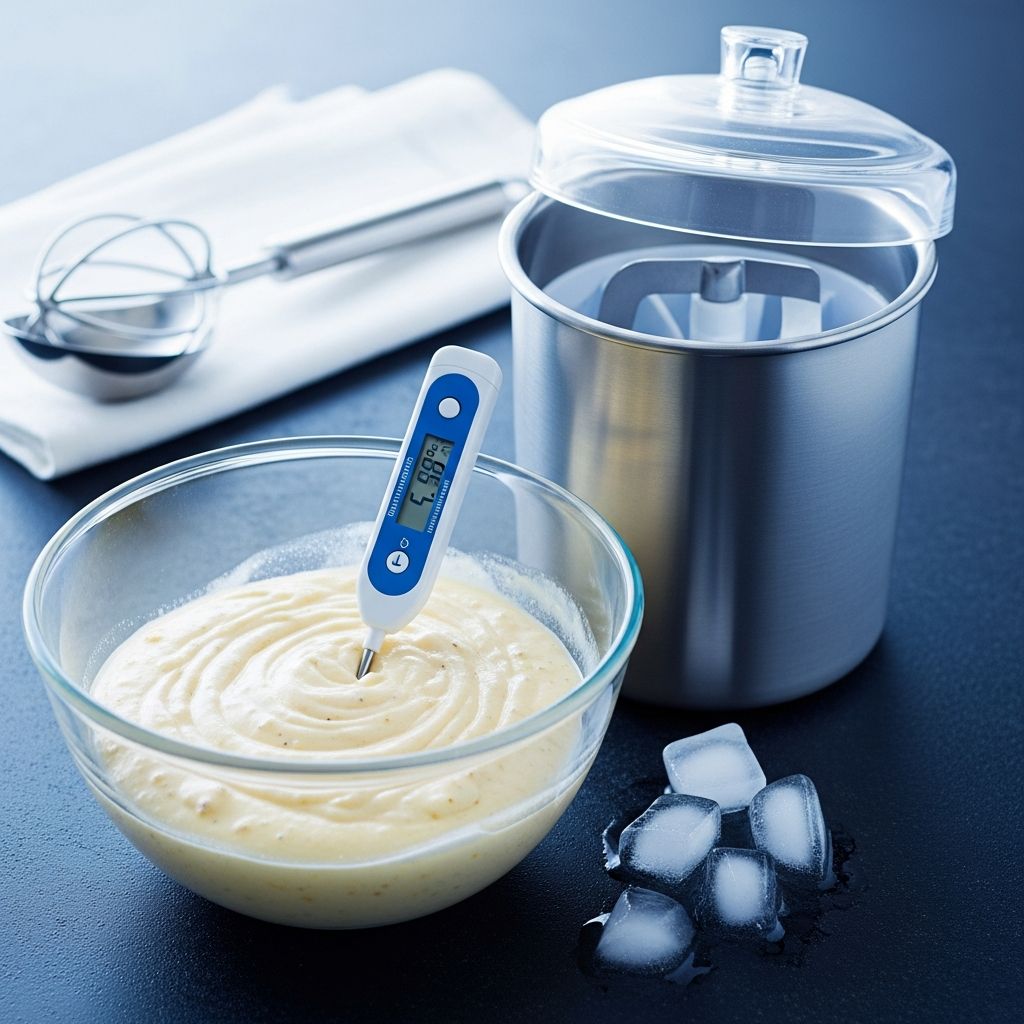
Understanding Mixture Temperature and Chilling: Why Pre-Chilled Base Matters for Ice Cream Makers
Temperature management is one of the most important yet overlooked aspects of ice cream making. From food safety and crystallization to texture and overrun, the temperature of your ice cream mixture at every stage determines how smooth, creamy, and stable the final product will be. A key part of this process is starting with a properly pre-chilled base before you pour it into your ice cream maker.
Table of Contents
- The Role of Temperature in Ice Cream Making
- Pasteurization, Cooling, and Food Safety
- Aging the Mix: What Pre-Chilling Really Means
- Dynamic Freezing, Draw Temperature, and Ice Crystal Size
- Why a Pre-Chilled Base Is Critical for Ice Cream Makers
- Practical Temperature Targets and Timing
- Home Machines vs Commercial Freezers
- Common Temperature Mistakes and How to Fix Them
- Frequently Asked Questions (FAQs)
- Conclusion
The Role of Temperature in Ice Cream Making
Ice cream is a frozen foam made of tiny ice crystals, fat droplets, air bubbles, and a concentrated sugar solution. The size and distribution of these crystals and droplets are dictated by how the mixture is cooled and frozen. Because of dissolved sugars and milk solids, the freezing point of ice cream mix is several degrees below 0°C, so water does not all freeze at once but over a range of temperatures.
Key temperature-related goals in ice cream making include:
- Safe heat treatment (pasteurization) of the mix to reduce pathogens.
- Rapid cooling through the food safety danger zone.
- Aging and pre-chilling at low refrigerator temperatures to hydrate stabilizers and partially crystallize fat.
- Dynamic freezing in an ice cream maker to create small ice crystals while incorporating air.
- Hardening and storage at low freezer temperatures to stabilize structure and slow melting.
Every one of these stages has its own recommended temperature range, and skipping or rushing the pre-chilling phase is one of the biggest reasons for icy, coarse, or soft homemade ice cream.
Pasteurization, Cooling, and Food Safety
Many ice cream bases are heated for two main reasons: food safety and texture improvement. Heating denatures whey proteins, improves emulsification, and helps bind water, which all contribute to smoother texture. At the same time, it reduces microbial load when done at pasteurization conditions.
Typical pasteurization guidelines for ice cream mixes include:
- Heating to approximately 72°C–85°C (around 160°F–185°F) for short times (for example, 15–25 seconds in industrial systems) to pasteurize and then rapidly cooling the mix to below about 4°C (40°F).
- Alternative combinations such as around 65–72°C held for longer times are also used in some formulations to balance safety and protein functionality.
The critical step after heating is rapid cooling. Holding the mix warm for too long keeps it in the bacterial “danger zone” (roughly 5°C–65°C), where microbes can multiply quickly. Many professional processes use heat exchangers to bring the mix down to refrigerator temperatures (around 2°C–5°C) as soon as possible.
Rapid Cooling and Why It Matters
After heating, the mix should be cooled quickly to refrigerator temperature before aging. Techniques include:
- Placing the pot or bag of hot mix in an ice bath and stirring until it reaches about 10°C or cooler.
- Transferring to a shallow, wide metal container so heat dissipates faster, then refrigerating.
- Using a chiller or heat exchanger in professional settings.
By quickly lowering the temperature below 4°C, you prepare the mix for the next stage: aging and pre-chilling.
Aging the Mix: What Pre-Chilling Really Means
In ice cream terminology, “aging” is the period where the pasteurized mix is stored cold, usually between about 2°C and 5°C (36°F–41°F), for several hours. During this time, several important changes occur:
- Fat crystallization: Fat globules partially solidify, improving body and whipping properties.
- Protein and stabilizer hydration: Milk proteins and stabilizers (like guar gum, carrageenan, or gelatin) fully hydrate, increasing viscosity and water-binding capacity.
- Flavor development: Flavors meld and mature, leading to a more balanced taste.
Professional guidance often recommends aging for a few hours and up to about 24 hours in a cold environment. Some sources consider up to 72 hours acceptable, provided the mix remains below approximately 5°C and is occasionally agitated so solids do not settle.
Pre-chilling is therefore not just about making the mix “cold” before churning. It is a structured step that:
- Brings the base to stable refrigerator temperature (usually around 2°C–4°C).
- Allows the mix to rest and structurally develop.
- Ensures that when it enters the ice cream maker, it is at or only slightly above its freezing point.
Dynamic Freezing, Draw Temperature, and Ice Crystal Size
The next key stage is dynamic freezing, which happens inside the ice cream machine. Here, the mix is chilled while being agitated. Several critical phenomena occur:
- A thin layer of ice forms on the cold wall of the freezer bowl and is scraped off by the dasher.
- These tiny crystals are continuously mixed back into the center of the bowl, where they grow slightly.
- Air is incorporated, creating the characteristic foam structure of ice cream.
In commercial machines, the mixture typically enters slightly above its freezing point and is churned until it reaches a “draw temperature” of around -5°C to -6°C (23°F to 21°F). At this stage it is semi-solid and spoonably soft, ready to be transferred to containers for hardening.
The goal in dynamic freezing is to reach draw temperature as quickly as possible while keeping ice crystals small. The faster the cooling, the more nucleation (birth of new small ice crystals) versus growth (enlargement of existing crystals). Small crystals give a smooth, creamy texture; slow freezing promotes larger, coarse crystals and an icy mouthfeel.
Freezer Bowl Wall Temperature
In both home and commercial machines, the wall temperature of the freezing chamber plays a major role. For removable bowl machines that pre-freeze the bowl, a wall temperature somewhere around -23°C to -29°C is often recommended. Colder walls drive faster heat removal, shorter freezing times, and finer crystals. If the wall is too warm (for example, bowls stored in a freezer at around -18°C), ice cream may take much longer to reach draw temperature, and crystals can grow large.
Why a Pre-Chilled Base Is Critical for Ice Cream Makers
When you add a mix that is still warm or only slightly cool into the ice cream maker, the machine must first remove all this extra heat before any ice can form. This has several negative consequences:
- Longer residence time in the machine, which promotes ice crystal growth and coarser texture.
- Partial melting of the freezer bowl wall, especially in pre-frozen bowls, which reduces their effective cold capacity.
- Reduced overrun (incorporated air) because the mix remains fluid for longer and does not support stable foam formation.
- Soft or slushy ice cream that does not reach proper draw consistency before the bowl warms up.
By contrast, when the base is properly pre-chilled to refrigerator temperature (generally in the range of about 2°C–5°C), several advantages appear:
- The mixture starts close to its freezing point, so ice nucleation begins sooner.
- The residence time in the ice cream maker is shorter, typically leading to smaller ice crystals and smoother texture.
- The freezer bowl or compressor has to do less work, so the temperature of the wall stays lower throughout the batch.
- Air incorporation is more efficient because the thickened, aged mix can support a finer foam structure.
Many manufacturers of home ice cream maker attachments explicitly instruct users to chill the mixture to refrigerator temperature before churning, often emphasizing that both “cooked” and “uncooked” mixes must be cold for best results.
Effect on Ice Crystal Size and Texture
Pre-chilled mixes contribute directly to ice crystal size in two ways:
- Faster transition from liquid to semi-solid leads to more nucleation sites.
- Shorter overall freezing time limits how large individual crystals can grow.
The result is a product that feels smoother on the tongue, with less detectable ice grains and a more stable structure during storage and serving.
Practical Temperature Targets and Timing
The following table summarizes typical temperature stages for a custard-style or dairy-based ice cream:
| Stage | Typical Temperature Range | Purpose |
|---|---|---|
| Heating / Pasteurization | Approx. 72°C–85°C (160°F–185°F) | Food safety, protein denaturation, texture improvement |
| Rapid Cooling | Down to < 4°C (40°F) as quickly as possible | Food safety, preparation for aging |
| Aging / Pre-Chilling | Approx. 2°C–5°C (36°F–41°F) | Fat crystallization, hydration, flavor development |
| Dynamic Freezing (Churning) | Starts at 2°C–5°C, ends near -5°C to -6°C (23°F–21°F) | Ice crystal formation, air incorporation |
| Hardening / Storage | Below about -18°C (0°F), often -20°C or colder | Stabilize structure, minimize recrystallization |
| Serving Temperature | Approx. -12°C to -14°C (10°F to 7°F) | Optimal scoopability and flavor release |
In practical home use, a good workflow looks like this:
- Heat the base if using eggs or wanting pasteurization.
- Cool quickly in an ice bath to around room temperature or cooler.
- Refrigerate until the mix is thoroughly chilled, ideally several hours or overnight.
- Ensure the ice cream maker bowl (if pre-frozen) is frozen solid, often 12–24 hours at a cold freezer setting.
- Churn the fully chilled mix until thick and soft-serve consistency.
- Transfer to a pre-chilled container and harden in the freezer.
Home Machines vs Commercial Freezers
The importance of a pre-chilled base is even more pronounced in home ice cream makers than in large commercial machines because domestic equipment has less cooling power and thermal mass.
Home Ice Cream Makers
There are two main types of home machines:
- Removable pre-frozen bowls: The bowl contains a freezing solution that must be frozen before use. Its capacity is limited, so adding warm mix quickly warms the bowl and leads to poor freezing and large crystals.
- Compressor-based machines: These have built-in refrigeration. They can be pre-cooled 10–20 minutes before adding the mix to lower the internal wall temperature and improve performance.
In both cases, starting with a cold base reduces the work the machine must do and prevents the mixture from sitting too long in a semi-frozen state, where large crystals and grainy textures form.
Commercial Freezers
Commercial continuous freezers and batch freezers are designed to handle larger loads and have more powerful refrigeration systems. They still rely on:
- Mixes that have been aged at low temperature (around +5°C or below).
- Rapid cooling and controlled residence time so the product exits the freezer at around -5°C to -6°C.
Even at industrial scale, operators monitor inlet mix temperature carefully, because warmer inlet mix increases draw time and can alter overrun and crystal size.
Common Temperature Mistakes and How to Fix Them
1. Adding Warm or Lukewarm Mix to the Machine
Problem: Slow freezing, icy texture, and partially frozen product.
Fix:
- Always cool the mixture to refrigerator temperature before churning.
- Use an ice bath right after cooking to shorten the time it spends warm.
2. Insufficient Aging Time
Problem: Thin, watery mouthfeel and poor body.
Fix:
- Allow at least 4–6 hours of chilling, and preferably overnight, at 2°C–5°C.
- Stir the mix occasionally if possible to prevent separation.
3. Freezer Bowl Not Cold Enough
Problem: Extended churn time; mix never fully thickens.
Fix:
- Freeze the bowl for 12–24 hours in a cold freezer, ideally at or below about -23°C if possible.
- Avoid frequent opening of the freezer and do not store the bowl near the door.
4. Overfilling the Machine
Problem: Poor circulation, uneven freezing, and inadequate air incorporation.
Fix:
- Respect the manufacturer’s recommended maximum volume, often about half to two-thirds of bowl capacity to allow for expansion.
5. Skipping the Hardening Step
Problem: Ice cream melts too fast and feels soft and unstable.
Fix:
- Transfer churned ice cream at draw temperature to a cold container.
- Place in a freezer at or below about -18°C for several hours before serving.
Frequently Asked Questions (FAQs)
Q1: How cold should my ice cream base be before churning?
For best results, your base should be at refrigerator temperature, typically between about 2°C and 5°C. This ensures fast freezing, small ice crystals, and better texture in both home and commercial machines.
Q2: Is aging the mix overnight really necessary?
While you can technically churn a base once it is fully chilled, aging overnight usually improves texture. During aging, fat crystallizes and stabilizers hydrate, giving a thicker, more stable mix that whips better and feels creamier.
Q3: Can I put a hot mixture directly into the refrigerator?
It is safer and more efficient to first cool the hot mix in an ice bath until it is warm or cool to the touch, then refrigerate. Placing very hot liquids directly in the refrigerator can warm the interior and slow safe cooling.
Q4: Why is my ice cream still soft after churning, even with a cold base?
Ice cream leaving the machine is typically at a draw temperature of around -5°C to -6°C, so it will be soft, like soft-serve. It needs additional time in a freezer at around -18°C or lower to harden. If it is extremely soft, check that your bowl or compressor is cold enough and that you did not overfill the machine.
Q5: What is the ideal serving temperature for ice cream?
Ice cream is often stored at around -18°C or colder but is best served slightly warmer, around -12°C to -14°C. At this temperature, it is firm yet scoopable, with optimal flavor release and texture.
Conclusion
Mixture temperature and chilling are not minor technicalities in ice cream making; they sit at the center of food safety, texture, and overall eating quality. Heating the base properly, cooling it quickly, and then allowing it to age and pre-chill in the refrigerator build the structural foundation that your ice cream maker relies on.
Starting with a fully pre-chilled base shortens freezing time, limits ice crystal growth, improves air incorporation, and reduces the load on your equipment. Whether you use a simple pre-frozen bowl at home or a commercial batch freezer, respecting key temperature targets at each stage—pasteurization, cooling, aging, dynamic freezing, hardening, and serving—is what separates icy, inconsistent results from consistently smooth, creamy ice cream.
By treating temperature as a core ingredient rather than an afterthought, you gain precise control over texture and stability, making it far easier to reproduce your best batches and confidently experiment with new flavors and formulations.
Similar Articles






Read full bio of medha deb